
Vegetables are harder on a dehydrator than fruit is. There’s no sugar to hide behind, the pieces are smaller, half of them need blanching first, and onions will perfume your kitchen for two days. Get any of that wrong and you end up with grey, papery carrots that never rehydrate properly. If this would be your first dehydrator, a cheaper first machine still handles vegetables fine — it mainly limits how much you can dry in one run.
So the best dehydrator for vegetables isn’t simply the biggest one. It’s the one that holds a steady temperature across every tray, comes with fine-mesh screens so peas and diced onion don’t fall through, and has a sealed chamber that keeps garlic where it belongs.
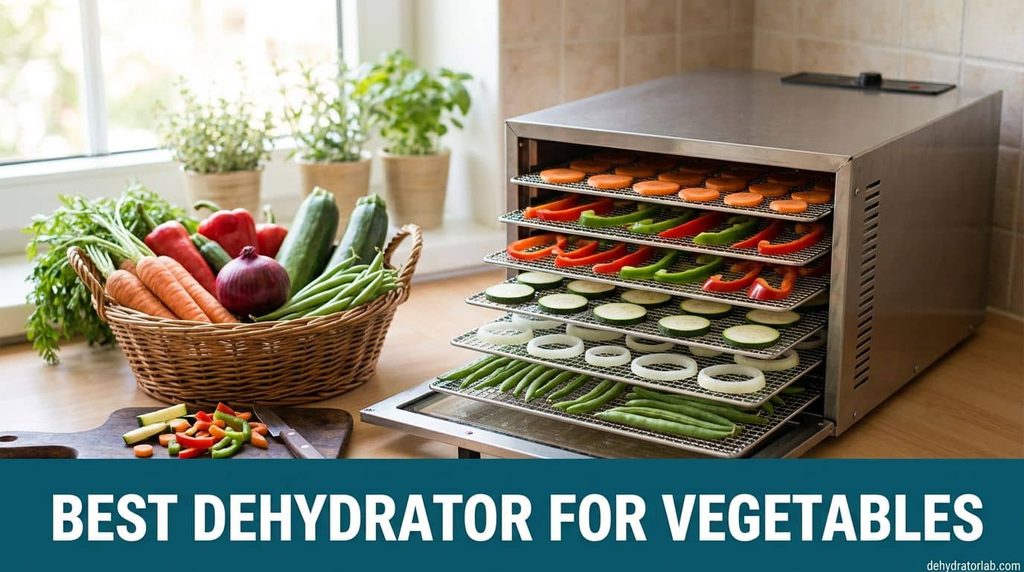
I’ve dried carrots, peppers, zucchini, onions, mushrooms, tomatoes and more green beans than I care to admit, in machines from $50 to $400. Below are the seven I’d actually buy for vegetables, what each one is for, and — the part almost nobody covers — exactly which vegetables you have to blanch first. Let’s empty that garden.
As an Amazon Associate, I earn from qualifying purchases. If you make a purchase after clicking on a link I may earn a small commission at no extra cost to you if items are purchased.
Quick Picks: The Best Dehydrator for Vegetables, at a Glance
- 🥇 Best Overall: Magic Mill MFD-1010 – 18 sq ft, stainless, five mesh screens in the box
- 💎 Best for Big Garden Harvests: Excalibur 3926TB 9-Tray – 15 sq ft and horizontal airflow, no tray rotation
- 🥈 Best Stainless for Everyday Batches: Magic Mill MFD-7070 – 7.6 sq ft, clear door, 24-hour timer
- 🌡️ Best Temperature Control: COSORI 6-Tray – one-degree steps, so you can sit at exactly 125°F
- 🎯 Best Value: Nesco FD-75A Snackmaster Pro – two mesh screens and two solid sheets included, expands to 12 trays
- 🧅 Best for Onions, Garlic & Strong Smells: Brod & Taylor Sahara – sealed stainless chamber that folds away afterwards
- 💰 Best Budget Digital: Presto 06301 Dehydro – 90°F floor and a real timer for very little money
Best Dehydrator for Vegetables: Comparison Table
| Model | Trays / capacity | Drying area | Watts | Temp range | Timer | Airflow | Fine-mesh screens | Price |
|---|---|---|---|---|---|---|---|---|
| Magic Mill MFD-1010 11-Tray | 11 stainless | 18 ft² | 1000W | 95–167°F (9° steps) | Digital | Rear, horizontal | 5 mesh + 5 solid included | $$$ |
| Excalibur 3926TB 9-Tray | 9 (15×15 in) | 15 ft² | 600W | 105–165°F | 26 h | Rear, horizontal | Sold separately | $$$ |
| Magic Mill MFD-7070 7-Tray | 7 stainless (13×12 in) | ~7.6 ft² | 600W | 95–167°F (9° steps) | 24 h, 30-min steps | Rear, horizontal | Fruit-roll trays incl.; mesh not listed | $$ |
| COSORI 6-Tray Stainless Steel | 6 stainless (12×13 in) | ~6.5 ft² | 600W | 95–165°F (1° steps) | 48 h digital | Rear, horizontal | 1 mesh included | $$ |
| Nesco FD-75A Snackmaster Pro | 5 round (13.5 in), expands to 12 | ~4.5 ft² as shipped | 600W | 95–160°F | None | Top-mounted, vertical | 2 mesh + 2 solid included | $ |
| Brod & Taylor Sahara Folding | 7 shelves | 11+ ft² | 750W (2×375W) | 85–165°F + fan-only | Dual, up to 99 h each | Rear, horizontal | Sold separately | $$$ |
| Presto 06301 Dehydro Digital | 6 round, expands to 12 | ~5 ft² as shipped | 750W | 90–165°F | Digital | Bottom-mounted, vertical | Sold separately | $ |
Two columns decide it for vegetables: fine-mesh screens (peas, corn, diced onion and chopped celery fall straight through a bare tray) and airflow (a rear fan dries every shelf at the same rate, so you never rotate). Capacity matters too, but only in August.
How I Picked These
I didn’t rank these by Amazon popularity. I ranked them by the two jobs that separate a vegetable dehydrator from a fruit one: holding a flat temperature over small, low-sugar pieces that dry unevenly, and keeping the smell of a full tray of onions inside the machine. Most have full hands-on reviews on this site, linked in each section; the rest were checked against manufacturer specs and long-run owner feedback.
- Hold a flat 125–140°F. That’s the vegetable window, and it’s higher than fruit’s — there’s no sugar to caramelize, so the limit is nutrient loss, not scorching.
- Come with, or accept, fine-mesh screens. Half of what you dry is small. A machine that can’t hold small pieces is a machine you’ll fight.
- Contain the smell. A sealed chamber with stainless trays is worth real money the first time you dry three pounds of onions.
1. 🥇 Best Overall for Vegetables: Magic Mill MFD-1010 11-Tray

- NOW WITH 11 TRAYS – Formally with 10 Trays – This Magic Mill Dehydrator Has Been Upgraded to 11 Trays to Add 30 inches o…
- Healthy enjoy the homemade easiest healthiest snacks, preserve foods, without additives, made with BPA free Machine.
- Digital Temperature Control with 95-167 Degree Fahrenheit (with 9 num. increments) Capability with 24 Hour Timer, Horizo…
Specs at a glance: 11 stainless · 18 ft² drying area · 1000W · 95–167°F (9° steps) · Timer: Digital · Rear airflow · Fine-mesh screens: 5 mesh + 5 solid included
If I keep one machine for vegetables, it’s this one. Eleven stainless trays give you 18 square feet — more than the nine-tray Excalibur — and the box includes five fine-mesh trays and five solid sheets, which is roughly $60 of accessories you’d otherwise buy separately. For vegetables that’s not a nice-to-have. Full teardown in my Magic Mill MFD-1010 review.
Stainless is the other reason it wins here. Plastic trays hold the smell of onions and garlic for weeks, no matter how you wash them. Stainless doesn’t. Run a full load of onions on Saturday and a load of apple rings on Sunday, and the apples still taste like apples.
Pros
- 18 sq ft on eleven stainless trays — the most capacity here
- Five fine-mesh trays and five solid sheets included
- 1000W and rear horizontal airflow, no tray rotation
- Stainless throughout, so it doesn’t hold onion or garlic smell
Cons
- 9°F temperature steps, not one-degree control
- The door has no handle — a magnet catch you pry open
- Heavy and genuinely large — measure your counter first
Who It’s For
Anyone with a vegetable garden, a chest freezer to empty, or a habit of buying celery in bulk. Skip it if your counter is small. Otherwise the Magic Mill MFD-1010 is the machine everything else here gets measured against. Buy once.
2. 💎 Best for Big Garden Harvests: Excalibur 3926TB 9-Tray

- Large Capacity: Equipped with 9 Excalibur dehydrator trays, this large food dehydrator boasts 15 square feet of drying s…
- Versatile Uses: Features a 26-hour dehydrator timer and an adjustable thermostat with a range of 105 to 165 degrees F – …
- Low & Slow for Immune Boost: Cooking foods at no higher than 115-118 degrees in a dehydrator preserves nutrients; it’s t…
Specs at a glance: 9 (15×15 in) · 15 ft² drying area · 600W · 105–165°F · Timer: 26 h · Rear airflow · Fine-mesh screens: Sold separately
The 3926TB is what serious gardeners graduate to. Nine 15×15 inch trays, 15 square feet, and a rear fan that pushes air across every shelf at the same time, so the top tray and the bottom tray finish together. Pull the trays out and you have a 12-inch chamber, which is how I dry whole mushroom caps and thick slices of squash. Full review here: Excalibur 3926TB review.
Its weakness for vegetables is the accessory bill. The trays are open polypropylene mesh with a fairly wide weave, so peas, corn and diced onion need the fine-mesh Paraflexx screens, and those aren’t in the box. Budget for three or four. The 105°F floor is irrelevant here — vegetables never go that low.
Pros
- 15 sq ft on nine full-size trays — a whole harvest in one run
- Rear horizontal airflow, even drying with no rotation
- Trays come out for tall items like whole mushrooms
- Made in Sacramento since 1973, cheap spare parts, long-warranty option
Cons
- Fine-mesh screens sold separately — you’ll need several
- Polypropylene trays hold strong smells longer than stainless
- Big, boxy footprint that lives on the counter permanently
Who It’s For
Gardeners with real volume who don’t mind buying screens. Skip it if you want everything in the box. If capacity is the first filter, the Excalibur 3926TB is still the benchmark. Every current model is ranked in Best Excalibur Dehydrator.
3. 🥈 Best Stainless for Everyday Batches: Magic Mill MFD-7070 7-Tray

- REAR MOUNTED FAN FOR SUPERIOR HEAT DISTRIBUTION – Dries food evenly, This electric dehydration machine is equipped with …
- DIGITAL THERMOSTAT AND TIMER- AUTOMATIC SHUT OFF WHEN TIMER DONE — An adjustable temperature and timer ensure you to ha…
- SPACIOUS ADJUSTABLE 7 XL STAINLESS STEEL TRAYS – INCLUDED FRUIT ROLL TRAYS! Use the trays for regular food and the mesh …
Specs at a glance: 7 stainless (13×12 in) · ~7.6 ft² drying area · 600W · 95–167°F (9° steps) · Timer: 24 h, 30-min steps · Rear airflow · Fine-mesh screens: Fruit-roll trays incl.; mesh not listed
The MFD-7070 is the MFD-1010’s sensible younger brother, and for most kitchens it’s the right size. Seven stainless trays at 13×12 inches give you about 7.6 square feet — enough for a full colander of zucchini or a tray each of carrots, celery and peppers in one run. I covered it properly in my Magic Mill MFD-7070 review.
The clear door is the underrated feature. Vegetables go from leathery to brittle in about an hour at the end, and being able to look without opening the door means you catch that window instead of guessing. The timer runs up to 24 hours in half-hour steps, which covers everything except whole tomatoes.
Magic Mill lists fruit-roll trays as included but doesn’t list fine-mesh screens, so check the listing before you count on them for peas and corn.
Pros
- 7.6 sq ft on stainless trays, in a footprint that fits a normal kitchen
- Clear door — see the last hour without dumping the heat
- Rear horizontal airflow, 95°F floor, 24-hour timer
- Stainless doesn’t hold the smell of strong vegetables
Cons
- 9°F temperature steps and 30-minute timer steps
- Mesh screens not clearly listed as included
- Half the capacity of the MFD-1010 for more than half the price
Who It’s For
Households drying a few trays a week who want stainless without a commercial footprint. Skip it if you’re processing a harvest — go to the 1010. Otherwise the Magic Mill MFD-7070 is the sensible one.
4. 🌡️ Best Temperature Control: COSORI 6-Tray Stainless Steel

- 𝗠𝗔𝗫𝗜𝗠𝗜𝗭𝗘 𝗘𝐕𝗘𝗥𝗬 𝗕𝗔𝗧𝗖𝗛: 6 stainless steel trays offer 6.5 ft² of drying space, giving you plenty of room to dehydrate larg…
- 𝗠𝗢𝗥𝗘 𝗣𝗢𝗪𝗘𝗥𝗙𝗨𝗟 & 𝗘𝗙𝗙𝗜𝗖𝗜𝗘𝗡𝗧: Equipped with a 600 W motor, rear-mounted drying fan, and upgraded airflow technology for fas…
- 𝗦𝗨𝗣𝗘𝗥 𝗤𝗨𝗜𝗘𝗧 𝗢𝗣𝗘𝗥𝗔𝗧𝗜𝗢𝗡: Features an advanced brushless motor with noise levels below 48 dB, letting you dehydrate your fo…
Specs at a glance: 6 stainless (12×13 in) · ~6.5 ft² drying area · 600W · 95–165°F (1° steps) · Timer: 48 h digital · Rear airflow · Fine-mesh screens: 1 mesh included
The Cosori is the machine I recommend to people who care about getting it exactly right. Its thermostat moves in one-degree steps from 95°F to 165°F, so you can sit at precisely 125°F for leafy greens and precisely 140°F for potatoes, instead of choosing between two presets. I covered it in depth in my Cosori 6-tray review.
Six stainless trays give 6.5 square feet, there’s a glass door, and it runs under 48 dB — which matters more than you’d think when a batch of peppers needs ten hours and the machine lives in an open-plan kitchen. Trays are dishwasher-safe, so the sticky residue from tomatoes goes in the machine, not your sink.
Pros
- One-degree control — hit 125°F or 140°F exactly
- Stainless, dishwasher-safe trays and a glass door
- Under 48 dB, quiet enough to run overnight nearby
- 48-hour timer with auto shut-off
Cons
- 6.5 sq ft fills up fast in tomato season
- Only one mesh sheet included
- Deep footprint takes most of a counter’s depth
Who It’s For
Cooks who want precision and quiet more than raw capacity. Skip it if you’re drying a garden. For everyone else the Cosori 6-Tray is the easiest machine here to live with. Hard to regret.
5. 🎯 Best Value (Screens Included): Nesco FD-75A Snackmaster Pro

- 600‑WATT DRYING SYSTEM WITH CONVERGA‑FLOW AIRFLOW evenly circulates heat without tray rotation, helping home users relia…
- EXPANDABLE FROM 5 UP TO 12 TRAYS lets you dry small portions for quick snacks or scale up for larger batches, making it …
- ADJUSTABLE TEMPERATURE CONTROL (95°F–160°F) allows precise heat selection for different ingredients, ensuring meat dries…
Specs at a glance: 5 round (13.5 in), expands to 12 · ~4.5 ft² as shipped drying area · 600W · 95–160°F · Timer: None · Top-mounted airflow · Fine-mesh screens: 2 mesh + 2 solid included
The Snackmaster Pro is the dehydrator half of America learned on, and for vegetables it punches well above its price for one reason: it ships with two Clean-A-Screens and two fruit-roll sheets. Every other budget machine makes you buy those, and for vegetables you need them on day one. Details in my Nesco Snackmaster Pro review, and the family is ranked in Best Nesco Food Dehydrator.
Five 13.5-inch trays give about 4.5 square feet, expandable to twelve as the garden gets ambitious. The opaque Vita-Save housing blocks light, which genuinely helps with red peppers and anything else that fades. The top-mounted fan keeps liquid out of the motor, a real advantage when a tray of tomatoes weeps.
Be advised: there is no timer — the one complaint that comes up again and again, and a $10 plug-in outlet timer solves it.
Pros
- Two mesh screens and two solid sheets in the box
- Expands from 5 to 12 trays as your harvest grows
- Opaque housing protects colour in peppers and greens
- 95°F floor, cheap to buy, cheap to replace parts
Cons
- No timer at all — budget for a plug-in one
- Round trays with a centre hole waste usable area
- Plastic trays hold the smell of onions and garlic
Who It’s For
First gardens, small budgets, and anyone who wants the accessories without the invoice. Skip it if you need a timer or a big single run. Otherwise the Nesco FD-75A Snackmaster Pro is the most machine per dollar on this list.
6. 🧅 Best for Onions, Garlic & Strong Smells: Brod & Taylor Sahara Folding

- Folds in seconds to 1/3 its size. Enjoy healthy and delicious benefits of food dehydration without a bulky and hard-to-s…
- Over 1 square meter (11 square feet) of drying area, stainless steel shelving, digitally-controlled 700W dual heaters, a…
- Automated dual time/temperature controls: Run at higher temperature for fast initial drying then automatically switch to…
Specs at a glance: 7 shelves · 11+ ft² drying area · 750W (2×375W) · 85–165°F + fan-only · Timer: Dual, up to 99 h each · Rear airflow · Fine-mesh screens: Sold separately
Nobody warns you about this until it’s too late: three pounds of onions in an open stacking dehydrator will scent your entire flat, and it lingers. The Sahara is the answer. Seven stainless shelves in a sealed chamber with a rear fan, over 11 square feet, and when the harvest is done the whole unit folds down to about 3.75 inches and goes in a cupboard.
It’s a serious dryer, not a novelty. Two 375-watt elements, a range from 85°F to 165°F, a fan-only mode with no heat, and a dual timer that programs two stages up to 99 hours each. For vegetables that means you can run a hot first stage and a gentler finish without standing over it — useful for mushrooms, which go from limp to brittle very suddenly.
Pros
- Sealed stainless chamber — the least smelly machine here
- 11+ sq ft that folds to 3.75 inches for off-season storage
- Two-stage programming up to 99 hours per stage
- 85–165°F plus fan-only mode, and it runs quietly
Cons
- Shelves sit close together — no tall items
- Mesh and non-stick sheets sold separately
- Premium price for the capacity
Who It’s For
Apartments, open-plan kitchens, and anyone who dries a lot of alliums. Skip it if smell isn’t an issue and you have the counter space. If it is, the Brod & Taylor Sahara is worth every cent.
7. 💰 Best Budget Digital: Presto 06301 Dehydro Digital

- VERSATILE DEHYDRATOR: Dehydrates fruits, vegetables, herbs, spices, and more. Ideal for jerky and fruit roll preparation
- EXPANDABLE CAPACITY: Includes 6 trays, expands to 12 (add-on trays sold separately). Innovative nesting design reduces s…
- PRECISE CONTROL: Digital thermostat and timer with temperatures from 90° to 165°F for customized drying. Shuts off autom…
Specs at a glance: 6 round, expands to 12 · ~5 ft² as shipped drying area · 750W · 90–165°F · Timer: Digital · Bottom-mounted airflow · Fine-mesh screens: Sold separately
The 06301 is the cheapest honest way to get a digital thermostat and a real timer, and it goes down to 90°F. That combination at this price is why it beats fancier machines for anyone still deciding whether dehydrating is a hobby or a phase. I went through it in my Presto 06301 review, and the range is ranked in Best Presto Food Dehydrator.
Six round trays give about five square feet and expand to twelve, and 750 watts dries a wet load faster than most 600-watt machines. The trays nest, so it disappears into a cupboard between seasons.
The fan sits at the bottom, so the lowest tray finishes first. Rotate once at the halfway mark and a batch of carrots comes out even. Mesh screens are extra, so add a set to the order.
Pros
- Digital thermostat and a real timer at a budget price
- 90°F floor, 750W, expands from 6 to 12 trays
- Trays nest for storage between seasons
- Cheap enough to find out if you’ll stick with it
Cons
- Bottom-mounted fan means rotating trays once per batch
- Mesh screens sold separately
- Plastic trays and round shape waste some space
Who It’s For
Beginners, small households and anyone testing the hobby. Skip it if you already know you’ll be drying in bulk. To find out, the Presto 06301 costs less than a season of store-bought soup mix. Start cheap.
Blanching: The Step That Decides Whether Your Vegetables Keep
Here’s what almost every dehydrator roundup leaves out. Most vegetables need to be blanched before they go on a tray, and skipping it is the single most common reason home-dried vegetables turn grey, taste flat after four months, and refuse to rehydrate properly.
Montana State University Extension explains why: blanching destroys the enzymes that keep working during drying and storage, which is what causes the loss of colour and flavour. It also shortens both the drying time and the rehydration time. It is not an optional refinement — for most vegetables it is the difference between a jar you’ll actually cook with and a jar you’ll throw out in March.
Steam or water?
Both work. Colorado State University Extension recommends water blanching over steam because water gives more even heat penetration. Steam uses less water and leaches out fewer nutrients, and Penn State Extension lists it as a perfectly good option. In practice: use steam for delicate pieces that go mushy, water for dense root vegetables. Drop everything into ice water the second it comes out, then pat it dry — wet vegetables on a tray add an hour to the run.
Blanching times by vegetable
| Vegetable | Steam blanch | Water blanch |
|---|---|---|
| Asparagus | 4–5 min | 3½–4½ min |
| Green beans | 2 min | — |
| Broccoli | 3–3½ min | 2 min |
| Carrots | 3–3½ min | — |
| Potatoes | 6–8 min | 5–6 min |
| Tomatoes | 3 min | 1 min |
What you can skip
Onions, garlic, peppers, mushrooms and herbs need no blanching at all — Penn State Extension and Montana State University Extension agree on those, and it’s why an onion or pepper batch is the easiest place to start.
Montana State University Extension also lists beets (they’re cooked first anyway), horseradish, okra and parsley as no-blanch. The sources disagree about corn and tomatoes, so if you’re unsure, blanch them: a blanched vegetable is never worse than an unblanched one, just wetter going in.
Frozen vegetables are a shortcut worth knowing, because they were blanched before freezing. Tip them straight onto the trays — no thawing, no blanching. The full method is in dehydrating frozen veggies.
What to Look For in a Dehydrator for Vegetables
Vegetables reward a short list of features and ignore the rest. Here’s what actually moves the needle.
Fine-mesh screens, included or cheap
This is the vegetable-specific one. Peas, corn, diced onion, chopped celery and anything destined for a soup mix all fall through a standard tray. The Magic Mill MFD-1010 and the Nesco ship with screens; the Cosori gives you one; both Excaliburs, the Sahara and the Presto need them bought. Add $20–60 to those.
A flat 125–140°F across every tray
Vegetables dry hotter than fruit. Montana State University Extension names 140°F as the optimum for drying food, and because there’s no sugar to caramelize you can use it. The question is never whether a machine displays 140 — it’s whether the top shelf is also at 140 six hours in, under a full wet load. Rear-fan horizontal machines hold that; cheap vertical ones drift.
A chamber that contains the smell
Dry three pounds of onions in an open stacking dehydrator and you’ll smell it for two days. A sealed front-loading chamber with stainless trays contains it. Plastic trays absorb it — they recover, but slowly. If your machine lives in a one-room kitchen, weight this heavily.
Drying area, in square feet
Vegetables arrive in a rush. One large zucchini plant produces more than a five-tray machine handles in a week. Eighteen square feet on the Magic Mill or fifteen on the Excalibur means one run; 4.5 square feet means five. Buy for your worst week, not your average one.
Trays that survive a dishwasher
Tomato and beetroot residue sets hard, and beetroot stains plastic permanently. If that alone decides it for you, I have ranked a machine that won’t stain against the rest of the low-plastic field. Dishwasher-safe stainless — Magic Mill, Cosori, Sahara — is worth real money here. Plastic trays are fine; plan on soaking.
A timer that outlasts the batch
Most vegetables take 6 to 14 hours. Colorado State University Extension gives asparagus 6 to 10, green beans 8 to 14, and tomatoes anywhere from 6 to 24 depending on thickness; carrots land in the middle. A 24-hour timer covers nearly everything. No timer at all means you get up at 3am or you over-dry.
How to Dehydrate Vegetables: Quick Tips
- Cut everything to the same thickness. About ¼ inch for roots, a bit thinner for zucchini. Mixed thicknesses on one tray is why half a batch is leathery and half is dust.
- Blanch first, then chill and dry the surface. See the table above. Ice water stops the cooking; a clean towel saves you an hour of drying time.
- Run 125–140°F. Leafy greens and delicate pieces at the low end, roots and potatoes at the high end.
- Dry the alliums on their own day. Onions and garlic will flavour anything sharing the machine. I learned this on a batch of minty garlic powder.
- Dry to brittle, not leathery. Fruit stays pliable; vegetables should snap. Montana State University Extension puts it plainly: vegetables are done when they are brittle or crisp.
- Cool completely before the jar goes on. Warm vegetables release moisture into a sealed jar and that’s how mould starts. Then store cool and dark — Montana State University Extension gives roughly a year at 60°F, six months at 80°F.
- Powder the ugly ones. Broken broccoli and misshapen carrot slices grind into a stock booster that’s better than anything in a box.
Recipe ideas once the machine arrives: 15 dehydrated vegetable chip recipes, 9 root vegetable chip recipes and 10 best vegetables for homemade soups.
New to all of this? How to use a food dehydrator covers the basics that apply to every batch, and how long dehydrated food lasts explains how long the results keep.
Best Dehydrator for Vegetables FAQs
What temperature should I dehydrate vegetables at?
Vegetables dry at 125 to 140°F (52 to 60°C), which is hotter than fruit. Montana State University Extension names 140°F as the optimum for drying food, and because vegetables have no sugar to caramelize you can use the top of that range. Leafy greens and delicate pieces do better at the low end, dense roots and potatoes at the high end.
Do I have to blanch vegetables before dehydrating them?
For most of them, yes. Blanching destroys the enzymes that keep degrading colour and flavour during drying and storage, and it shortens both drying and rehydration time. Onions, garlic, peppers, mushrooms and herbs are the exceptions and need no blanching. Sources disagree about corn and tomatoes, so blanch those if you are unsure.
How long does it take to dehydrate vegetables?
Most vegetables take 6 to 14 hours. Colorado State University Extension gives asparagus 6 to 10 hours and green beans 8 to 14, while tomatoes can run anywhere from 6 to 24 hours depending on how thickly they are sliced. Load, humidity and cut thickness all shift the number, so judge by feel: vegetables should be brittle, not leathery.
Do I need fine-mesh screens for vegetables?
If you dry peas, corn, diced onion, chopped celery or anything going into a soup mix, yes — those pieces fall straight through a standard tray. The Magic Mill MFD-1010 and the Nesco Snackmaster Pro include screens, the Cosori includes one, and the Excaliburs, Sahara and Presto need them bought separately for roughly $20 to $60.
Will my dehydrator smell of onions afterwards?
Plastic trays absorb the smell of onions and garlic and hold it for weeks; stainless trays in a sealed chamber barely do. If your machine lives in a small or open-plan kitchen, that alone is a reason to pay more for stainless. Running the alliums on their own day also stops them flavouring everything else in the load.
Can I dehydrate frozen vegetables?
Yes, and it is the easiest possible start, because frozen vegetables were already blanched before freezing. Tip them onto the trays straight from the bag with no thawing and no blanching, spread them so the pieces do not touch, and dry at the usual temperature. They take a little longer than fresh because of the surface ice.
Final Verdict: Which Dehydrator for Vegetables Should You Buy?
- If you have a garden and want it all in the box, get the Magic Mill MFD-1010. Eighteen square feet, stainless, and five mesh screens included.
- If you want the classic and don’t mind buying screens, get the Excalibur 3926TB. Fifteen square feet, horizontal airflow, parts available forever.
- If you dry a few trays a week, get the Magic Mill MFD-7070 for stainless in a normal footprint, or the Cosori 6-Tray if one-degree control and a quiet, glass-door machine matter more than capacity.
- If onions and garlic are most of what you dry, get the Brod & Taylor Sahara for its sealed stainless chamber. If money is the first filter, the Nesco FD-75A includes the screens and the Presto 06301 adds a timer.
Personal Tips You Can Steal
I keep a kitchen scale next to the machine and weigh a tray before and after, because “about 90% lighter” beats poking a carrot. I blanch in one big pot with a bowl of ice water waiting in the sink, rather than doing four small batches.
I dry onions and garlic on a Sunday and nothing else that day, no exceptions. I grind every broken piece into powder instead of binning it, and that jar of mixed vegetable powder is what I reach for most.
More Dehydrator Buying Guides
- Best Dehydrator for Fruit — the fruit-specific picks, where capacity and fruit-roll sheets decide it.
- Best Dehydrator for Herbs — why a 95°F floor matters more than capacity when you’re drying basil.
- Best Dehydrator for Jerky — the meat-specific picks, where the 160°F rule changes everything.
- Best Excalibur Dehydrator — every current Excalibur ranked, if you’ve decided on the brand.
P.S. Blanch and dry one tray of carrots this weekend, then drop a handful into a soup in January. That’s the whole argument for owning one of these 🙂