
Fruit is the easiest thing to dehydrate and the easiest thing to get wrong. If this would be your very first machine, my best dehydrator for beginners guide covers the cheaper end of the market in more detail. Too hot and the outside seals before the middle dries, so you get apple rings that feel done and mould in the jar three weeks later. Too little airflow and the bottom tray finishes while the top tray is still wet.
So the best dehydrator for fruit isn’t the one with the fanciest display. It’s the one that holds 135°F across every tray at once, has enough room for a whole bushel of apples, and comes with solid sheets so nothing sticky drips onto the heater.
I’ve dried apples, mangoes, strawberries, bananas, pineapple and more citrus than any one household needs, in machines from $50 to $400. Below are the seven I’d actually buy for fruit, what each one is for, and the specs that decide it. Let’s get that harvest into jars.
As an Amazon Associate, I earn from qualifying purchases. If you make a purchase after clicking on a link I may earn a small commission at no extra cost to you if items are purchased.
Quick Picks: The Best Dehydrator for Fruit, at a Glance
- 🥇 Best Overall: Excalibur 3926TB 9-Tray – 15 sq ft, horizontal airflow, no tray rotation
- 🍎 Best for Apple & Peach Season: Nesco FD-1040 Gardenmaster – 4 trays that expand to 20, fruit-roll sheet included
- 🥈 Best Stainless Steel: COSORI 6-Tray – glass door, 48-hour timer, dishwasher-safe trays
- 💎 Best Large-Capacity Stainless: Magic Mill MFD-1010 – 18 sq ft and five fruit-roll sheets in the box
- 🎯 Best Premium Digital: Excalibur 3948CDB – 95°F floor and a 48-hour two-stage timer
- 📦 Best Compact: Brod & Taylor Sahara – 11+ sq ft that folds to 3.75 inches between seasons
- 💰 Best Budget: Hamilton Beach 32100A – digital timer, solid sheet included, cheapest here
Best Dehydrator for Fruit: Comparison Table
| Model | Trays / capacity | Drying area | Watts | Temp range | Timer | Airflow | Fruit-roll sheets | Price |
|---|---|---|---|---|---|---|---|---|
| Excalibur 3926TB 9-Tray | 9 (15×15 in) | 15 ft² | 600W | 105–165°F | 26 h | Rear, horizontal | Sold separately | $$$ |
| Nesco FD-1040 Gardenmaster | 4 round (15.5 in), expands to 20 | ~4.5 ft² as shipped | 1000W | 90–160°F | 48 h digital | Top-mounted, Converga-Flow | Fruit Roll sheet + mesh included | $$ |
| COSORI 6-Tray Stainless Steel | 6 stainless (12×13 in) | ~6.5 ft² | 600W | 95–165°F | 48 h digital | Rear, horizontal | 1 mesh; solid sheets separate | $$ |
| Magic Mill MFD-1010 11-Tray | 11 stainless | 18 ft² | 1000W | 95–167°F | Digital | Rear, horizontal | 5 fruit-roll + 5 mesh included | $$$ |
| Excalibur 3948CDB 9-Tray Digital | 9 (15×15 in) | 15 ft² | 600W | 95–165°F | 48 h, two-stage | Rear, horizontal | Sold separately | $$$$ |
| Brod & Taylor Sahara Folding | 7 shelves | 11+ ft² | 750W (2×375W) | 85–165°F + fan-only | Dual, up to 99 h each | Rear, horizontal | Sold separately | $$$ |
| Hamilton Beach 32100A | 5 stackable, square | ~4.5 ft² | 500W | 100–160°F | 48 h digital | Bottom-mounted, vertical | Solid sheet + mesh included | $ |
Two columns decide it for fruit: drying area (fruit arrives all at once, in bushels) and airflow (rear-mounted horizontal fans dry every tray at the same rate, so you never rotate). Everything else is comfort.
How I Picked These
I didn’t rank these by Amazon popularity. I ranked them by the one job that breaks most machines with fruit: holding a steady 135°F over a full load of wet, sugary slices for eight to twelve hours without cooking the outside first. Most of these models have full hands-on reviews on this site already, linked in each section. The rest were checked against manufacturer specs and long-run owner feedback on the things spec sheets hide, like thermostat drift and how badly sticky juice welds itself to a tray.
- Hold 125–135°F across every tray. That’s the fruit window. A machine that runs 15 degrees hot at the top shelf will case-harden your apples.
- Give you real capacity. A 20-pound box of peaches fills four square feet three times over. Small machines turn a one-day job into a four-day job.
- Handle sticky, dripping fruit. Solid fruit-roll sheets, mesh screens and trays that actually survive a dishwasher.
1. 🥇 Best Overall for Fruit: Excalibur 3926TB 9-Tray

- Large Capacity: Equipped with 9 Excalibur dehydrator trays, this large food dehydrator boasts 15 square feet of drying s…
- Versatile Uses: Features a 26-hour dehydrator timer and an adjustable thermostat with a range of 105 to 165 degrees F – …
- Low & Slow for Immune Boost: Cooking foods at no higher than 115-118 degrees in a dehydrator preserves nutrients; it’s t…
Specs at a glance: 9 (15×15 in) · 15 ft² drying area · 600W · 105–165°F · Timer: 26 h · Rear airflow · Fruit-roll sheets: Sold separately
If I keep one machine for fruit, it’s this one. Nine 15×15 inch trays give you 15 square feet, which is the difference between drying a bushel of apples in one go and doing it over three evenings. The rear-mounted fan pushes air horizontally across every tray at the same time, so the top shelf and the bottom shelf finish together and you never open the door to rotate. Full teardown in my Excalibur 3926TB review.
For fruit specifically, the 105°F floor is irrelevant — you’ll live at 135°F anyway. What matters is that the thermostat actually holds there under a heavy, wet load, and this one does. Pull the trays out entirely and you have a 12-inch-tall chamber, which is how I dry whole citrus wheels and thick peach halves without slicing them thin.
One honest gripe: the non-stick Paraflexx sheets you’ll want for fruit leather aren’t in the box. Budget for two or three.
Pros
- 15 sq ft on nine full-size trays — a whole harvest in one run
- Rear horizontal airflow, no tray rotation, even drying top to bottom
- Remove trays for tall items like whole citrus wheels
- Made in Sacramento since 1973, long-warranty option, cheap spare parts
Cons
- Non-stick fruit-leather sheets sold separately
- Big, boxy footprint — it lives on the counter or not at all
- Polypropylene trays, not stainless
Who It’s For
Anyone with a fruit tree, a farmers-market habit or a chest freezer they’d rather empty. Skip it if you dry one tray of banana chips a month. Otherwise the Excalibur 3926TB is the machine everything else here gets compared to. Buy once.
2. 🍎 Best for Apple & Peach Season: Nesco FD-1040 Gardenmaster

- 1000-WATT DRYING POWER WITH CONVERGA-FLOW AIRFLOW SYSTEM: Delivers fast, even dehydration without tray rotation, helping…
- EXPANDABLE FROM 4 UP TO 20 BPA-FREE TRAYS: Allows users to start small or scale up drying capacity as needed, making it …
- DIGITAL TIMER AND ADJUSTABLE TEMPERATURE RANGE: Timer programmable up to 48 hours and adjustable temperature range from …
Specs at a glance: 4 round (15.5 in), expands to 20 · ~4.5 ft² as shipped drying area · 1000W · 90–160°F · Timer: 48 h digital · Top-mounted airflow · Fruit-roll sheets: Fruit Roll sheet + mesh included
The Gardenmaster is the answer to a very specific problem: your neighbour just handed you four crates of apples. It ships with four trays and expands to twenty, so you scale the machine to the harvest instead of the other way round. A 1000-watt motor and Nesco’s top-mounted Converga-Flow push air down the outside and across each tray, which is the best that a stacking design gets. Full write-up in my Nesco FD-1040 Gardenmaster review, and the family is ranked in Best Nesco Food Dehydrator.
Two things make it a fruit machine rather than a general one. The box includes a no-spill Fruit Roll sheet with raised lips, so purée doesn’t run off the edge, plus a Clean-A-Screen for berries and small pieces. And the 48-hour digital timer means you can start a load of apple rings at 9pm and let it shut itself off at 7am.
Be advised: at twenty trays it’s a tower, and it’s louder than the horizontal-fan machines. Also, round trays with a centre hole waste space. You’ll fit fewer apple rings per square foot than the Excalibur’s square trays.
Pros
- Grows from 4 to 20 trays — buy the harvest you actually have
- 1000W dries a heavy, wet load faster than 600W machines
- No-spill Fruit Roll sheet and mesh screen included
- 48-hour digital timer with auto shut-off, 90–160°F range
Cons
- Round trays with a centre hole waste usable area
- Tall stack wobbles and is noticeably louder
- Extra trays add up quickly in cost
Who It’s For
Gardeners, orchard owners and anyone whose fruit arrives in one overwhelming week. Skip it if you want a quiet machine or a glass door. If you just need volume, the Nesco FD-1040 is the cheapest path to twenty trays.
3. 🥈 Best Stainless Steel: COSORI 6-Tray Stainless Steel

- 𝗠𝗔𝗫𝗜𝗠𝗜𝗭𝗘 𝗘𝐕𝗘𝗥𝗬 𝗕𝗔𝗧𝗖𝗛: 6 stainless steel trays offer 6.5 ft² of drying space, giving you plenty of room to dehydrate larg…
- 𝗠𝗢𝗥𝗘 𝗣𝗢𝗪𝗘𝗥𝗙𝗨𝗟 & 𝗘𝗙𝗙𝗜𝗖𝗜𝗘𝗡𝗧: Equipped with a 600 W motor, rear-mounted drying fan, and upgraded airflow technology for fas…
- 𝗦𝗨𝗣𝗘𝗥 𝗤𝗨𝗜𝗘𝗧 𝗢𝗣𝗘𝗥𝗔𝗧𝗜𝗢𝗡: Features an advanced brushless motor with noise levels below 48 dB, letting you dehydrate your fo…
Specs at a glance: 6 stainless (12×13 in) · ~6.5 ft² drying area · 600W · 95–165°F · Timer: 48 h digital · Rear airflow · Fruit-roll sheets: 1 mesh; solid sheets separate
The Cosori is the machine I recommend to people who will actually use it. Six stainless trays, 6.5 square feet, a rear fan, and a glass door so you can watch a tray of strawberries without opening anything and dumping the heat. It runs under 48 dB, which in a kitchen means you forget it’s on. I covered it in depth in my Cosori 6-tray review.
Its edge for fruit is control. The thermostat moves in one-degree steps from 95°F to 165°F, so you can sit at exactly 135°F instead of picking between a 130 and a 145 preset. And because the trays are stainless and dishwasher-safe, mango juice that welded itself on overnight goes in the machine instead of your sink.
The stock mesh sheet is thin. If you dry a lot of berries or make fruit leather, budget for a proper set of liners.
Pros
- Stainless, dishwasher-safe trays survive sticky fruit
- One-degree control and a real 48-hour timer
- Glass door — check progress without losing heat
- Under 48 dB, quiet enough for an open-plan kitchen
Cons
- 6.5 sq ft fills up fast in peach season
- Only one mesh sheet in the box, no solid sheet
- Deep footprint eats most of a counter’s depth
Who It’s For
Households drying a few trays a week, year-round, who care about noise and cleanup. Skip it if you’re processing a harvest. For everyone else the Cosori 6-Tray is the easiest machine here to live with. Hard to regret.
4. 💎 Best Large-Capacity Stainless: Magic Mill MFD-1010 11-Tray

- NOW WITH 11 TRAYS – Formally with 10 Trays – This Magic Mill Dehydrator Has Been Upgraded to 11 Trays to Add 30 inches o…
- Healthy enjoy the homemade easiest healthiest snacks, preserve foods, without additives, made with BPA free Machine.
- Digital Temperature Control with 95-167 Degree Fahrenheit (with 9 num. increments) Capability with 24 Hour Timer, Horizo…
Specs at a glance: 11 stainless · 18 ft² drying area · 1000W · 95–167°F · Timer: Digital · Rear airflow · Fruit-roll sheets: 5 fruit-roll + 5 mesh included
Think of the MFD-1010 as the Cosori scaled up until it stops being a kitchen appliance. Eleven stainless trays, 18 square feet of rack space — more than the nine-tray Excalibur — with a 1000-watt element and a rear fan that dries every shelf evenly. Details in my Magic Mill MFD-1010 review.
The accessory kit is what makes it a fruit machine. Five fruit-roll sheets and five fine-mesh trays come in the box, which is roughly $60 of accessories you’d otherwise buy separately for the Excalibur. Run purée on the solid sheets and blueberries on the mesh in the same load and nothing falls through or drips onto the element.
Temperature goes to 95–167°F but adjusts in 9-degree steps, not single degrees. For fruit that’s fine — 131°F and 140°F both work. The door is held shut by magnets and has no handle, which is the kind of thing you stop noticing after a week and never stop mentioning in a review.
Pros
- 18 sq ft on eleven stainless trays — the most capacity here
- Five fruit-roll sheets and five mesh trays included
- 1000W and rear horizontal airflow, no rotation needed
- Stainless throughout, dishwasher-safe
Cons
- 9°F temperature steps, not one-degree control
- The door has no handle — a magnet catch you pry open
- Heavy and genuinely large — measure your counter
Who It’s For
Anyone who wants Excalibur capacity in stainless with the sheets already included. Skip it if you want precise single-degree control. Otherwise the Magic Mill MFD-1010 is the best-equipped box here.
5. 🎯 Best Premium Digital: Excalibur 3948CDB 9-Tray Digital
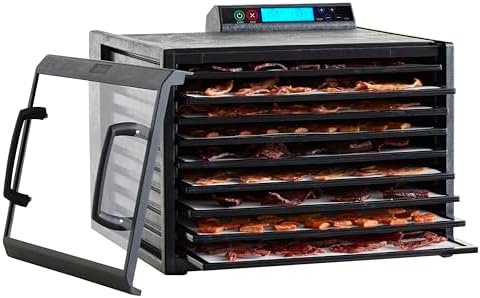
- Large Capacity: Equipped with 9 easy-to-clean Excalibur dehydrator trays, this large food dehydrator boasts 15 square fe…
- Accurate Temperature Control: Features a 48-hour dehydrator timer and an adjustable thermostat with a range of 95 to 165…
- Low & Slow for Immune Boost: The perfect dehydrator for food and jerky, dried fruit leather, fruit roll-up puree, pet tr…
Specs at a glance: 9 (15×15 in) · 15 ft² drying area · 600W · 95–165°F · Timer: 48 h, two-stage · Rear airflow · Fruit-roll sheets: Sold separately
The 3948CDB is the 3926TB with the two upgrades that matter most for long fruit runs: a 95°F floor instead of 105°F, and a 48-hour two-stage digital timer. Same nine trays, same 15 square feet, same rear fan. I went through it properly in my Excalibur 3948CDB review, and every current model is ranked in Best Excalibur Dehydrator.
Two-stage timing is the trick worth paying for. Set stage one at 145°F for the first hour to knock down surface moisture fast, then stage two at 135°F for the long finish, and walk away. Penn State recommends exactly that pattern for fruit, and this is the only machine here that will do it unattended.
It’s also the most expensive machine on this list by a wide margin, and for a lot of people the extra spend buys convenience rather than better dried fruit. Be honest with yourself about how many batches a year you actually run.
Pros
- Two-stage timer runs the 145°F-then-135°F pattern unattended
- 95°F floor — same machine also works for herbs and yogurt
- 15 sq ft, rear horizontal airflow, removable trays
- 48-hour timer, digital thermostat, US-made
Cons
- Priciest pick here by some distance
- Non-stick sheets still sold separately
- Same big footprint as the 3926TB
Who It’s For
People who dry fruit every week and want to set it and forget it. Skip it if the 3926TB’s 26-hour analog timer is enough, which for most people it is. If it isn’t, the Excalibur 3948CDB is the no-compromise upgrade.
6. 📦 Best Compact (Folds Away): Brod & Taylor Sahara Folding

- Folds in seconds to 1/3 its size. Enjoy healthy and delicious benefits of food dehydration without a bulky and hard-to-s…
- Over 1 square meter (11 square feet) of drying area, stainless steel shelving, digitally-controlled 700W dual heaters, a…
- Automated dual time/temperature controls: Run at higher temperature for fast initial drying then automatically switch to…
Specs at a glance: 7 shelves · 11+ ft² drying area · 750W (2×375W) · 85–165°F + fan-only · Timer: Dual, up to 99 h each · Rear airflow · Fruit-roll sheets: Sold separately
Fruit is seasonal. You run the machine hard for six weeks in autumn and then it sits there judging you until next August. One way to fill the rest of the year is vegetables, and several of these same machines show up in my best dehydrator for vegetables guide. The Sahara solves that: seven stainless shelves, over 11 square feet, and when the last batch is done it folds down to about 3.75 inches and slides into a cabinet.
It’s a serious dryer, not a novelty. Two 375-watt elements, a rear fan, a range from 85°F all the way to 165°F, and a fan-only mode with no heat. The dual timer lets you program two stages up to 99 hours each — the same 145°F-then-135°F trick as the Excalibur 3948CDB, for less money.
Worth noting: the shelves are close together, so tall items are out, and the non-stick sheets are extra. But for mango slices, banana coins and berries it’s a lot of drying area that disappears afterwards.
Pros
- 11+ sq ft that folds to 3.75 inches for off-season storage
- Two-stage programming up to 99 hours per stage
- 85–165°F plus fan-only mode — handles herbs and yogurt too
- Stainless shelves, rear horizontal airflow, quiet
Cons
- Shelves sit close together — no tall items
- Non-stick and mesh sheets sold separately
- Premium price for the capacity
Who It’s For
Small kitchens, seasonal driers, and anyone who resents an appliance that only earns its counter space two months a year. Skip it if you dry year-round and have the room. Otherwise the Brod & Taylor Sahara is the smartest use of a cabinet shelf here.
7. 💰 Best Budget for Fruit: Hamilton Beach 32100A

- 5 STACKABLE, BPA-FREE TRAYS: The food dehydrator machine trays provide up to 4.2 square feet of drying space for making …
- ADJUSTABLE TEMPERATURE CONTROL, DIGITAL TIME & AUTO SHUTOFF: Easily adjust the temperature from 100-160ºF to dry a varie…
- CONSISTENT, EVEN DRYING WITHOUT HAVING TO ROTATE TRAYS: The powerful 500 watt base-mounted heater and quiet fan on this …
Specs at a glance: 5 stackable, square · ~4.5 ft² drying area · 500W · 100–160°F · Timer: 48 h digital · Bottom-mounted airflow · Fruit-roll sheets: Solid sheet + mesh included
If you want to find out whether you’ll actually keep dehydrating before spending real money, start here. The 32100A gives you a digital thermostat from 100°F to 160°F, a 48-hour timer with auto shut-off, and — the part that matters — both a solid sheet and a fine mesh sheet in the box. Most budget machines make you buy those. My full notes are in the Hamilton Beach 32100A review.
Five square stackable trays give you roughly 4.5 square feet, which is about two large apples’ worth of rings per tray. The fan sits at the bottom and pushes air up through the stack, so in practice the bottom tray finishes first. Rotate once at the halfway mark and the batch comes out even.
It won’t dry a harvest and it isn’t stainless. But at this price, with a real timer and a real thermostat, it’s the honest entry point — and the square trays waste less space than the round ones on machines costing more.
Pros
- Digital thermostat and 48-hour timer at the lowest price here
- Solid sheet and fine mesh sheet included — fruit leather on day one
- Square trays waste less area than round ones
- Small, light, 8 lb, easy to store
Cons
- ~4.5 sq ft — a harvest takes several days
- Bottom-mounted fan means rotating trays once per batch
- BPA-free plastic trays, not stainless
Who It’s For
First-timers, small households and anyone testing the hobby. Skip it if you already know you’ll be drying in bulk. To find out if you will, the Hamilton Beach 32100A costs less than a month of store-bought dried mango. Start cheap.
What to Look For in a Dehydrator for Fruit
Fruit rewards a short list of features and ignores the rest. Here’s what actually moves the needle.
A steady 125–135°F, not just a dial that says 135
Fruit dries at 125–135°F (52–57°C). Penn State Extension recommends starting at 145°F for the first hour to drive off surface moisture, then dropping to 135–140°F to finish. Any machine here will display 135. The question is whether the top tray is also at 135 four hours in, under a full wet load. Horizontal rear-fan machines hold that; cheap vertical ones drift.
Drying area, measured in square feet
Fruit arrives all at once. A 20-pound box of apples is roughly 12 square feet of rings, which means one run on the Excalibur or Magic Mill, three runs on the Cosori, and the better part of a week on a five-tray budget machine. Buy for your worst week, not your average one. Purée is a different calculation again, since one sheet covers an entire tray — my best dehydrator for fruit leather guide ranks these same machines on their solid sheets instead.
Horizontal airflow if you can afford it
A rear-mounted fan blows air across every shelf at once. A bottom- or top-mounted fan pushes it through a stack, so the tray nearest the fan dries first and you rotate. With herbs that’s a minor annoyance. With ten hours of peaches it’s the difference between checking in twice and checking in eight times.
Solid fruit-roll sheets and fine mesh screens
This is the fruit-specific one everyone forgets. Sticky slices weld themselves to bare mesh, berries fall through, and purée for fruit leather drips straight onto the element if the sheet has no lip. The Nesco, Magic Mill and Hamilton Beach include sheets; both Excaliburs and the Sahara don’t. Add $20–60 to those.
A timer that outlasts the batch
Firm fruit like apples and pears takes 7 to 14 hours. High-water fruit — grapes, plums, whole blueberries — can run 24 to 48. A 26-hour timer covers most of it; a 48-hour timer covers all of it. A machine with no timer means you get up at 3am or you over-dry.
Trays you can actually clean
Mango and pineapple juice sets like glue. That is the strongest practical argument for dishwasher-safe stainless, which I rank separately. Dishwasher-safe stainless (Cosori, Magic Mill, Sahara) is worth real money here. Plastic trays are fine, but plan on soaking.
For the official guidance on temperatures, pretreatment and safe storage, the National Center for Home Food Preservation and Penn State Extension both have fruit-drying pages worth a bookmark.
How to Dehydrate Fruit: Quick Tips
- Cut to a uniform ¼ inch. Thickness decides drying time more than anything else, and mixed thicknesses on one tray is why half a batch is leathery and half is brittle. Start with the 15 best fruits to dehydrate.
- Pretreat light-coloured fruit. Apples, pears, peaches and bananas brown fast. Penn State’s dip is 3¾ teaspoons of powdered ascorbic acid (or 20 crushed 500 mg vitamin C tablets) in 2 cups of water for 10 minutes — or equal parts bottled lemon juice and water. Worth the extra five minutes on apple rings.
- Run 145°F for the first hour, then drop to 135°F. The high start pulls surface water off fast; the drop stops the outside from sealing before the middle is done.
- Skins down, cut side up. Halved apricots, plums and banana coins dry faster cut side up, because the moisture escapes through the flesh, not the wax.
- Don’t crowd the trays. Leave a slice’s width between pieces. Air that can’t move is air that isn’t drying anything.
- Condition before you store. Cool the fruit, pack it loosely into jars about two-thirds full, and leave it a week. Utah State University Extension says to stir and feel it every day; if you see condensation, it goes back in the dryer. This one step prevents most jar mould.
- Store cool, dark and airtight. Properly dried and conditioned fruit keeps six to twelve months. The full storage rules are in how long dehydrated food lasts.
New to all of this? How to use a food dehydrator and 6 essential beginner tips cover the basics that apply to every batch.
Best Dehydrator for Fruit FAQs
What temperature is best for dehydrating fruit?
Fruit dries best at 125–135°F (52–57°C). Penn State Extension suggests starting at 145°F for the first hour to drive off surface moisture, then dropping to 135–140°F to finish. Higher than that and the outside seals before the centre dries, a problem called case hardening. Lower and the batch sits wet long enough for yeast to get interested.
How long does it take to dehydrate fruit?
Firm fruit such as apples, pears, peaches and nectarines usually takes 7 to 14 hours at 135°F. High-water fruit like grapes, plums, cherries and whole berries can run 24 to 48 hours. Slice thickness, tray load, room humidity and how ripe the fruit was all shift the number, so judge by feel rather than the clock.
Do I need a dehydrator with a fruit roll sheet?
For sliced fruit, no — mesh screens are enough. For purées, jams and anything sticky you do, because liquid runs straight through mesh onto the heating element. The Nesco FD-1040, Magic Mill MFD-1010 and Hamilton Beach 32100A include sheets. Both Excaliburs and the Sahara need them bought separately, which adds roughly $20 to $60.
Is a round stacking dehydrator good enough for fruit?
It works, with two compromises. Round trays have a centre hole, so you lose usable area, and a top- or bottom-mounted fan dries the nearest tray first, meaning you rotate partway through. For a few trays a week that is fine. For a harvest, a rear-fan horizontal machine saves hours of fiddling.
Why did my dried fruit go mouldy in the jar?
Almost always under-drying plus skipping conditioning. Pieces that feel dry on the outside can still hold moisture in the centre, and that moisture redistributes in storage. Cool the fruit, pack it loosely in jars about two-thirds full for a week, stir daily, and return it to the dryer if condensation appears.
Should I pretreat fruit before dehydrating it?
Only light-coloured fruit that browns: apples, pears, peaches, apricots and bananas. A ten-minute soak in ascorbic acid solution or in equal parts bottled lemon juice and water keeps the colour and helps preserve vitamins A and C. Dark fruit like berries, cherries and plums needs nothing beyond a rinse.
Final Verdict: Which Dehydrator for Fruit Should You Buy?
- If you have a fruit tree, a garden or a farmers-market habit, get the Excalibur 3926TB. Fifteen square feet, horizontal airflow, no rotation. It’s the machine the rest are measured against.
- If you want stainless and the sheets already in the box, get the Magic Mill MFD-1010 for 18 square feet, or the Cosori 6-Tray if 6.5 square feet is enough and you’d rather have a glass door and one-degree control.
- If the harvest comes in waves, get the Nesco FD-1040 Gardenmaster and add trays as the crates arrive. If it comes once a year and your kitchen is small, the Brod & Taylor Sahara folds away between seasons.
- If you’re not sure you’ll stick with it, get the Hamilton Beach 32100A. Timer, thermostat and a solid sheet for very little money.
Personal Tips You Can Steal
I weigh a tray of apples before and after, because “about 80% lighter” is a far better done-signal than poking one ring. I dry the thickest slices on the bottom tray of any horizontal machine, since that shelf runs a hair warmer. I keep one solid sheet permanently in the machine so that a spontaneous batch of purée never has to wait for an Amazon delivery. I condition everything for a week without exceptions, because I lost two jars of mango learning that lesson. And I label jars with the fruit and the month, since “brown slices, some autumn” is not an inventory.
More Dehydrator Buying Guides
- Best Dehydrator for Jerky — the meat-specific picks, where the 160°F rule changes everything.
- Best Dehydrator for Herbs — why a 95°F floor matters more than capacity when you’re drying basil.
- Best Excalibur Dehydrator — every current Excalibur ranked, if you’ve decided on the brand.
- Best Nesco Food Dehydrator — the full Nesco lineup, from Snackmaster to Gardenmaster.
Recipe ideas once the machine arrives: 8 tropical fruit recipes, 10 fruit snacks kids will eat and 10 ways to use fruit powders.
P.S. Dry one tray of apple rings at 135°F this weekend and hide them from the kids for a week. That’s how the habit starts 🙂