
Two round, stackable, budget dehydrators from two old American brands, and they look almost identical on a store shelf. So which one? The nesco vs presto dehydrator question comes down to one design choice that’s easy to miss: where the fan sits. Nesco puts it on top. Presto puts it underneath. That one decision shapes almost everything else.
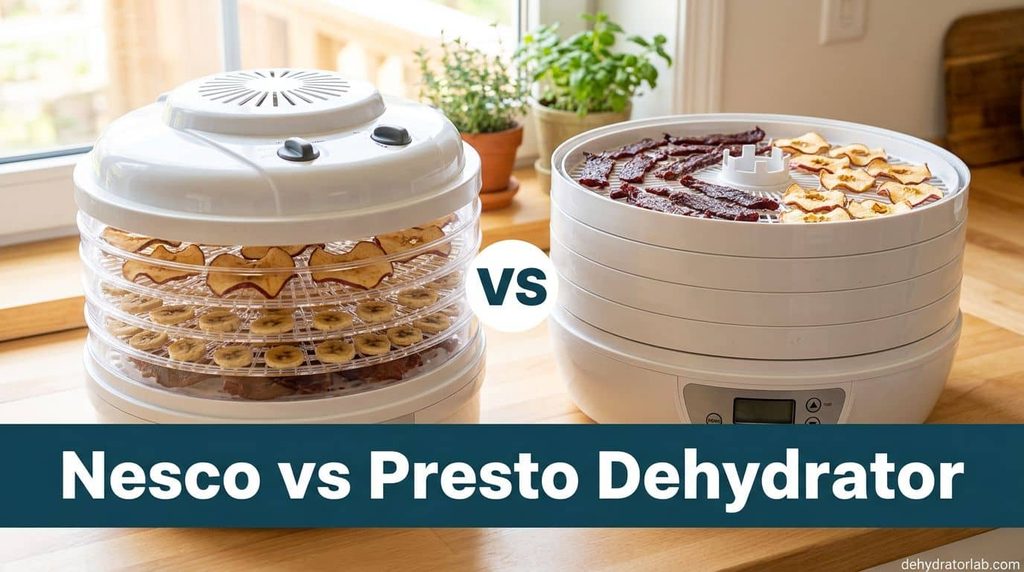
I’m comparing the two models people actually choose between: the Nesco FD-75A Snackmaster Pro (the Amazon listing; Nesco sells the FD-75PR with the same published specs) and the Presto 06301 Dehydro Digital. Every spec below comes from the makers’ own pages, except the Presto tray diameter, which comes from an independent review. Let’s settle it.
As an Amazon Associate, I earn from qualifying purchases. If you make a purchase after clicking on a link I may earn a small commission at no extra cost to you if items are purchased.
Quick Verdict: Nesco vs Presto Dehydrator in 60 Seconds
- 🥇 Overall winner: the Nesco FD-75A, for top-down airflow that keeps drips away from the motor and a cheaper price
- ⏱️ Get the Presto if you want a timer: the Presto 06301 has a 48-hour digital timer and an on/off switch; the Nesco has neither
- 🌡️ Temperature: Presto 90–165°F, Nesco 95–160°F. Close enough for fruit and herbs; the Presto has a little more headroom for jerky
- 📦 Capacity: Presto ships 6 trays, Nesco 5, and both expand to 12
- 🧺 In the box: both include 2 mesh screens and 2 fruit-roll sheets

- 600‑WATT DRYING SYSTEM WITH CONVERGA‑FLOW AIRFLOW evenly circulates heat without tray rotation, helping home users relia…
- EXPANDABLE FROM 5 UP TO 12 TRAYS lets you dry small portions for quick snacks or scale up for larger batches, making it …
- ADJUSTABLE TEMPERATURE CONTROL (95°F–160°F) allows precise heat selection for different ingredients, ensuring meat dries…

- VERSATILE DEHYDRATOR: Dehydrates fruits, vegetables, herbs, spices, and more. Ideal for jerky and fruit roll preparation
- EXPANDABLE CAPACITY: Includes 6 trays, expands to 12 (add-on trays sold separately). Innovative nesting design reduces s…
- PRECISE CONTROL: Digital thermostat and timer with temperatures from 90° to 165°F for customized drying. Shuts off autom…
Nesco vs Presto: Side-by-Side Specs
| Spec | Nesco FD-75A | Presto 06301 |
|---|---|---|
| Price band | $ | $$ (list price right at $100) |
| Trays included | 5 | 6 |
| Expands to | 12 trays | 12 trays |
| Drying area | ~4 ft² as shipped (0.8 ft² per tray, per Nesco); 13.5 in round trays | Not published by Presto (trays measure about 12 in, per an independent review) |
| Power | 600W | 750W |
| Temperature range | 95–160°F (35–71°C) | 90–165°F (32–74°C) |
| Timer | None | Digital, 30 min to 48 h |
| On/off switch | No (unplug to stop) | Yes |
| Fan and heater | Top-mounted | Bottom-mounted |
| In the box | 2 Clean-A-Screens, 2 fruit-roll sheets (Nesco also lists a jerky spice and cure sample) | 2 mesh screens, 2 fruit-roll sheets |
| Warranty | 1 year limited | 1 year limited |
Sources: Nesco’s spec page and Presto’s product page. Two rows decide this matchup for most people: fan position and timer. The rest is closer than the marketing suggests.
Design & Build
Both are white, round, stackable plastic machines with BPA-free trays, and both nest down for storage. The difference is the stack order. On the Nesco, the fan and heater live in a cap on top, and air is pushed down an outer chamber and then across each tray. On the Presto, they sit in the base, and air rises up through the stack.
Why care? Because jerky marinade and sticky fruit juice drip. On the Nesco, drips fall away from the motor. On the Presto, they fall toward it, so you’ll be wiping the base more often and keeping an eye on spills.
Owners of both report the occasional heater or fan dying after a few years, which is about what you’d expect at this price. The Presto does have one build advantage: a real on/off switch, whereas the Nesco is on whenever it’s plugged in.
Winner: Nesco, because a top-mounted motor is the better design for anything that drips.
Capacity & Drying Area
Out of the box, the Presto ships six trays to the Nesco’s five. Both expand to twelve with extra trays sold separately, so the ceiling is the same. Per tray, the Nesco is the bigger machine: Nesco rates each 13.5-inch tray at 0.8 sq ft. Presto doesn’t publish its tray size, and one independent review measures it at about 12 inches across.
In practice, that means the Presto’s extra tray roughly makes up for its smaller trays, and you get similar drying area from either one as shipped. Nesco’s manual also advises running with at least four trays in place, even if some are empty, so the airflow works as designed. For big harvests, both scale, but neither is a big-batch machine; the large-capacity guide covers those.
Winner: Draw. The Presto has one more tray; the Nesco has bigger ones.
Airflow & Evenness
Both are vertical-airflow stackers, so neither matches a rear-fan box dehydrator (the horizontal vs vertical airflow explainer covers why). Within that design, the Nesco’s top-down setup is the better one. Nesco’s Converga-Flow system pushes air down an outer chamber and then across each tray toward the center, which is why Nesco says you don’t need to rotate trays.
The Presto’s bottom fan pushes heat straight up through the stack. Presto also says no rotation is needed, but on a full stack the air reaches the top trays last, and owners do see the top layers lag. A quick top-to-bottom swap halfway through fixes it. On the Nesco, I’d only bother on a fully loaded 12-tray stack.
Winner: Nesco. Better airflow design, and fewer tray swaps.
Temperature Range & Controls
Closer than you’d think: Nesco 95–160°F, Presto 90–165°F. Both cover herbs at the low end and fruit and vegetables in the middle. For jerky, the Presto’s 165°F top gives a little more headroom, but on either machine the safety step is the same: heat beef to 160°F, or poultry to 165°F, before it goes on the trays (USDA jerky guidance).
The real gap is the timer. The Presto has a digital one, from 30 minutes to 48 hours, plus an on/off switch. The Nesco has a dial and nothing else, so it runs until you unplug it. If you start fruit at night and want the machine to stop on its own, that settles it.
Winner: Presto. A digital timer and an on/off switch beat a bare dial.
Noise, Cleaning & Everyday Use
Neither maker publishes a noise figure. My Nesco review lists it as quiet, and many Presto owners call theirs noticeably noisy, but without measured numbers I’d treat that as a lean, not a verdict. Cleaning favors the Nesco: with the motor on top, the base doesn’t collect drips, and the trays wash easily. On the Presto, wipe the base after every sticky batch. The dehydrator cleaning guide works for both.
Day to day, though, the Presto is the easier one to live with. Set the timer, walk away, and it shuts off. With the Nesco, you set a phone alarm and come back to unplug it.
Winner: Presto for everyday convenience; the Nesco is the easier one to keep clean.
Price, Value & Warranty
The Nesco usually sells for less. The Presto’s list price sits right at $100, and it tends to sell near that. Both include two mesh screens and two fruit-roll sheets, so neither needs a second order before your first batch of fruit leather. Nesco also lists a jerky spice and cure sample with the FD-75PR. Both carry a one-year limited warranty.
So you pay a little more for the Presto’s timer and extra tray, and a little less for the Nesco’s better airflow. For most budget buyers, I’d rather have the airflow.
Winner: Nesco. Cheaper, same warranty, and a better core design.
Nesco vs Presto for Jerky, Fruit and Herbs
Specs are one thing. Here’s how the two shake out for the three jobs most people buy a budget dehydrator for.
Jerky
The Nesco is the better jerky machine, mostly because of the fan. Marinated strips drip, and on the Nesco those drips land on the tray below or the base, not the motor. The Presto’s 165°F ceiling is a small plus, but the pre-heat step matters more than the dial. The full method is in how to make beef jerky with a dehydrator. Edge: Nesco.
Fruit
Fruit runs are long, and they’re the batches you most often want to start at night. That’s where the Presto’s timer earns its keep: set it, sleep, and it switches off. On a full stack, swap the top and bottom trays once. For slicing and timing, see how to dehydrate apples. Edge: Presto.
Herbs
Both go low enough: 90°F on the Presto and 95°F on the Nesco, inside the 95–115°F range herbs want. Both include mesh screens so small leaves don’t fall through. The Nesco’s gentler top-down airflow is less likely to scatter dried leaves around the stack. More in how to dehydrate basil. Edge: Nesco, barely.
Nesco FD-75A: Pros & Cons
Pros
- Top-mounted fan: drips can’t reach the motor
- Top-down airflow, fewer tray swaps
- Bigger 13.5-inch trays
- Usually the cheaper of the two
- Mesh screens and fruit-roll sheets included
Cons
- No timer and no on/off switch
- 160°F ceiling, 5°F lower than the Presto
- One fewer tray out of the box
Presto 06301: Pros & Cons
Pros
- Digital timer, 30 min to 48 h
- On/off switch
- Six trays out of the box
- 90–165°F range
- Mesh screens and fruit-roll sheets included
Cons
- Bottom fan: drips fall toward the motor
- Top trays can lag on a full stack
- Price sits right at $100
Who Should Buy the Nesco FD-75A?
Buy the Nesco if you make jerky and sticky fruit, want the most even drying for the money, and don’t mind checking on it yourself. It’s also the better pick if you’re on a tight budget. My full Nesco Snackmaster Pro review has the details, and the Nesco lineup guide covers the bigger models. Check today’s price on the Nesco FD-75A.
Who Should Buy the Presto 06301?
Buy the Presto if you want to set a timer and walk away, especially for overnight fruit runs, or if you want six trays without buying extras. It’s the more convenient machine, as long as you check the top trays and wipe the base. More in my Presto 06301 review and the Presto lineup guide. See the current price on the Presto 06301.
Nesco vs Presto Dehydrator FAQs
Is Nesco or Presto better?
For most budget buyers, the Nesco FD-75A. Its top-mounted fan pushes air down an outer chamber and then across each tray, keeping drips away from the motor, and it usually costs less. The Presto 06301 wins if you want a digital timer and an on/off switch, which the Nesco doesn’t have.
Does the Nesco FD-75A have a timer?
No. The Nesco FD-75A has an adjustable thermostat from 95 to 160°F but no timer and no on/off switch, so it runs until you unplug it. A plug-in outlet timer is the usual workaround. The Presto 06301 has a built-in digital timer from 30 minutes to 48 hours.
Can you make jerky in the Nesco or the Presto?
Yes. The Nesco reaches 160°F and the Presto 165°F. On either one, heat beef to 160°F, or poultry to 165°F, before drying, as the USDA advises. The Nesco’s top-mounted fan is the better design for marinated meat, since drips fall away from the motor.
Can I add more trays to the Nesco and Presto?
Yes. Both expand to 12 trays with extra trays sold separately. The Nesco ships with 5 trays and the Presto with 6. Trays aren’t interchangeable between the two brands, so buy extras made for your model.
What’s the difference between the Presto 06300 and 06301?
The 06301 is the digital model: adjustable 90–165°F, a 48-hour timer, 750 watts, 6 trays, and mesh screens and fruit-roll sheets in the box. The 06300 is the basic model: no adjustable thermostat, no timer, 600 watts, 4 trays expandable to 8, and a top-mounted fan.
Do I need to rotate trays on the Nesco and Presto?
Both makers say no. Nesco’s Converga-Flow moves air across each tray, and Presto says its bottom fan dries evenly without rotation. In practice, the top trays on a full Presto stack can lag, so a top-to-bottom swap halfway through is cheap insurance. On the Nesco, it’s rarely needed unless all 12 trays are loaded.
Which is quieter, Nesco or Presto?
Neither maker publishes a noise rating. Owners more often describe the Nesco as quiet and the Presto as noticeably noisy, but there are no measured numbers to compare. Both are small fan-and-heater machines that make a steady hum. If noise matters, run either one in a room you’re not sleeping in.
Final Verdict: Nesco or Presto?
The Nesco FD-75A wins this one. Top-down airflow, a motor that stays clean, a lower price and the same accessories and warranty. For jerky, fruit and herbs on a budget, it’s the better machine.
The exception is the timer. If you want to set a batch at night and have the machine shut itself off, get the Presto 06301, and check its top trays halfway through. And if neither feels quite right, the beginners guide has a few more options at this price. Pick the fan position first.
Personal Tips You Can Steal
I always run a tray of thin apple slices through a new round dehydrator first. Whichever tray browns first tells you where the heat really is. On a bottom-fan machine like the Presto, I put the juiciest food on the top trays, so drips land on other food instead of the base. And on the Nesco, I keep a cheap outlet timer next to it, which gives it the one feature it’s missing.
More Dehydrator Buying Guides
- Best Dehydrator for Beginners – both of these, plus the other good first machines.
- Excalibur vs Cosori – the same head-to-head, one price tier up.
- Best Dehydrator for Jerky – if jerky is the main job.
- Best Dehydrator Under $100 – both of these, plus five more budget machines.
- Best Dehydrator Sheets – extra mesh and solid sheets for either machine.
P.S. If you can’t decide, look at where you’ll set it up. Next to a bedroom, buy the one with a timer. Next to the jerky marinade, buy the one with the fan on top. 🙂