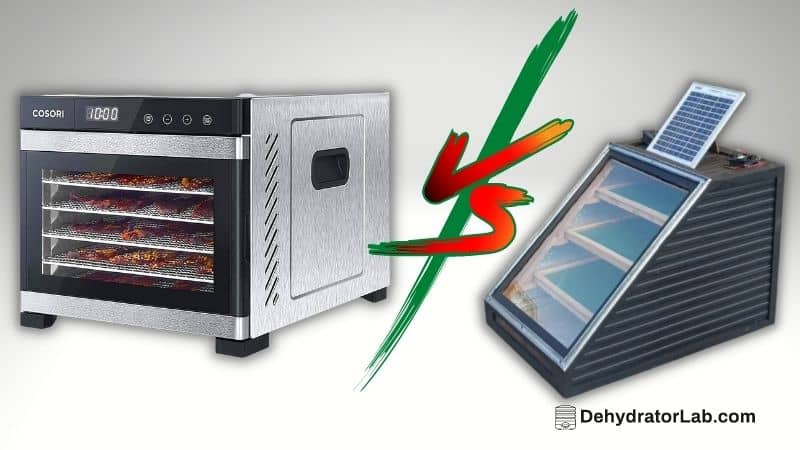
Food Dehydrator Air Flow Explained
Food dehydrators for home use are generally available in two main types: stackable tray dehydrators with vertical airflow that are generally cylindrical in shape, such as the Presto 06301, and cabinet-type horizontal airflow dehydrators containing removable rectangular or square shelves, such as the Excalibur range of dehydrators.
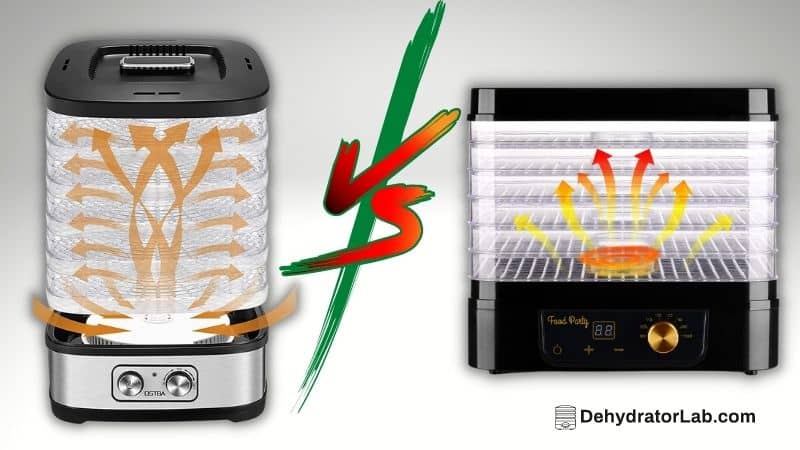
Some stackable vertical airflow dehydrators are available with rectangular or square-shaped trays, such as the Hamilton Beach 32100A, but these are less common than those with round trays. Almost all horizontal air flow food dehydrators, such as TSM and Tribest Sedona dehydrators, are cabinet or box-shaped. That shape difference is also a capacity difference: a round stackable tray has a hole in the middle for the air to pass through, so nine square trays can hold what fourteen round ones hold — which is the whole basis of my ranking of the big-batch machines.
In this article:
🔑 TL;DR: Key Takeaways
- 🔄 Vertical airflow (stackable) dehydrators dry the bottom trays faster than the top, so you’ll need to rotate trays partway through.
- 📦 Horizontal airflow (cabinet) dehydrators, like Excalibur and TSM models, push heat evenly across every tray front to back — no rotating required.
- 💵 Stackable vertical models like the Presto 06301 usually cost less and can expand tray count, but horizontal cabinets hold their drying area steady since trays can’t be added.
- 🥩 Both airflow types work for jerky, but a horizontal cabinet dehydrator is the better pick for big batches or anything delicate, like fruit leather, that needs even heat.
What’s The Difference?

Most stackable vertical air flow food dehydrators are generally more compact and easier to move around and store away. They are more popular with people with less kitchen counter space, or those who do not do large quantities of food dehydration. Examples of stackable vertical airflow food dehydrator brands are Nesco / American Harvest, NutriChef, Waring, and Ronco.
Horizontal airflow cabinet-type food dehydrators, especially stainless steel ones, are often larger and heavier than their stackable counterparts, and are usually used by people who do large amounts of food dehydration.
They can take up a lot of counter space and are not very portable or easy to store in kitchen cupboards. For example, the all-stainless steel commercial STX Dehydra 1200W-XLS horizontal airflow cabinet dehydrator has an impressive 16 sq. ft. drying area and, being all stainless steel, weighs in at 32 lbs. Smaller cabinet-type horizontal airflow food dehydrator brands include Aroma and Magic Mill.
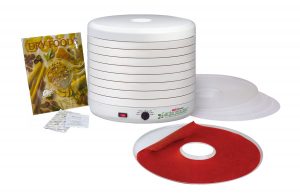
Most stackable vertical air flow food dehydrators, however, can be expanded by adding extra stackable trays to increase their total drying area. The Nesco Gardenmaster FD-1040 can, according to the manufacturer, be expanded from 4 trays to 20 trays, increasing its drying area to a total of 20sq. ft. User reviews, however, indicate that the optimum number of trays is between six and twelve, after which its performance drops noticeably.
How Do They Work?
Although stackable vertical air flow food dehydrators vary from one another in some respects, both are great dehydrators for making jerky, but the main feature is that the air is heated and fan-fed either in an upward or a downward direction through the stacked trays, depending on whether the fan-heater unit is in the base or the lid of the dehydrator. Some makes, such as Nesco American Harvest, claim to have a horizontal airflow system (Converge-Flow®) in a stackable dehydrator, whereby the heated air is forced down channels along the outside of the trays and then horizontally across the surface of the trays and into the hollow central column.
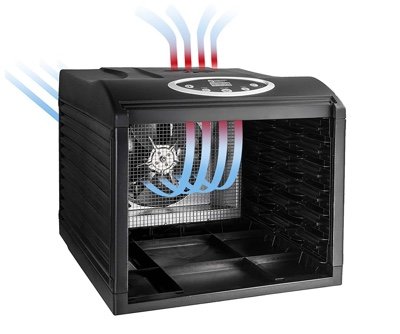
Cabinet-shaped horizontal air flow food dehydrators generally have the fan heater unit located in the rear panel of the unit, with the fan drawing air in from behind the cabinet and blowing the heated air horizontally across the tray surfaces from the back of the cabinet to the front.
These usually have one fan with long blades, but some have two fans, one above the other, aimed at achieving a better spread of airflow.
Pros & Cons
Vertical Air Flow Food Dehydrators
| Pros | Cons |
|
|
Horizontal Air Flow Food Dehydrators
| Pros | Cons |
|
|
Personal Tips You Can Steal
On my stackable models, I set a kitchen timer for the halfway point of any long dry and swap the top and bottom trays then, not on a whim — food on the bottom shelf near a base-mounted fan can finish an hour or more ahead of the top. On cabinet-style units, I still check the back row against the front row on the first run with a new dehydrator, since fan placement varies enough between brands that “even” airflow isn’t always as even as the spec sheet claims.
Conclusion
As you can see, vertical airflow and horizontal airflow food dehydrators both have good and bad points. Each type will suit different people with differing requirements, and it is hard to say which is the best dehydrator for the money.
It might be a case of moving from one type to another as your circumstances change, and you may want to buy a small stackable dehydrator that you can add to as you get into the swing of drying food. If you can afford it, however, a good horizontal airflow food dehydrator is a great investment.
P.S. If you’re on the fence, think about what you’re drying most — jerky and herbs forgive uneven airflow just fine, but fruit leather and delicate greens show every hot spot. Let the food you make most often decide 🙂