
Almost every dehydrator ships with one solid sheet and one mesh screen, whatever its tray count. Eleven trays, one sheet. Ten trays, one screen. It is the single most consistent stinginess in the category, and it is why the first thing most people buy after the machine is a set of liners.
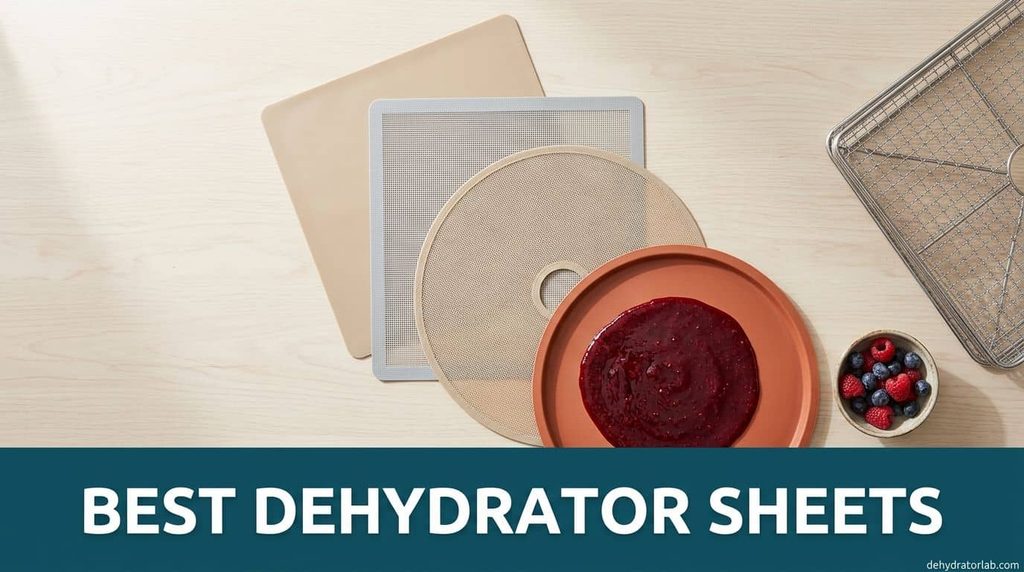
The trouble is that “silicone dehydrator sheets” is a shelf label rather than a material, and half the listings under it are neither silicone nor doing the job you think. Excalibur sells two flagship sheets under almost the same name – one is silicone, the other is a Teflon-coated sheet the company used to sell as Teflex.
So the best dehydrator sheets for you depend on three things nobody puts in a title: solid or mesh, what it is actually made of, and whether it fits your trays.
Below are six sets that each do a different job, and a size chart at the end for the machines whose tray dimensions I could confirm – because a 14-inch sheet is useless on a 12-inch tray, and most product pages will not tell you that.
As an Amazon Associate, I earn from qualifying purchases. If you make a purchase after clicking on a link I may earn a small commission at no extra cost to you if items are purchased.
Quick Picks: The Best Dehydrator Sheets at a Glance
- 🥇 Best Overall: Kispog 10-Pack Silicone Mesh – ten 14×14 mesh liners, the size that fits most square-tray machines
- 🎯 Best Solid Sheet: Excalibur ParaFlexx Ultra – genuine silicone, for fruit leather and anything that pours
- 💰 Best Value: 12-Pack Silicone Mesh Sheets – twelve mesh liners for about the price of four branded ones
- ⭕ Best for Round Trays: Dostk 8-Pack Round Mesh – 13-inch discs with the centre hole, for stackable machines
- 🥣 Best for Liquids: Lipped Fruit Leather Sheets – a raised lip, so purée cannot run off the edge
- 📦 Best Brand Fit: Cosori CFD-MS102 Mesh Screens – the factory part for the 10-tray Premium Pro
Dehydrator Sheets Comparison Table
| Product | Type | Material | Size | In the pack | Best for |
|---|---|---|---|---|---|
| Kispog 10-Pack Silicone Mesh | Mesh liner | Silicone | 14 × 14 in square | 10 | Everyday drying, small pieces |
| Excalibur ParaFlexx Ultra | Solid sheet | Silicone | 14 × 14 in square | 4 | Fruit leather, purée, batter |
| 12-Pack Silicone Mesh Sheets | Mesh liner | Silicone | 14 × 14 in square | 12 | Filling a big machine cheaply |
| Dostk 8-Pack Round Mesh | Mesh liner | Silicone | 13 in round, centre hole | 8 | Stackable round-tray machines |
| Lipped Fruit Leather Sheets | Solid, raised edge | Silicone | Round, fits Nesco-style trays | 4 | Liquids that would run off |
| Cosori CFD-MS102 Mesh Screens | Mesh screen | Plastic | Cosori 10-tray fit | 2 | Exact-fit spares for a Cosori |
Read the second column first. Mesh and solid are not competing products — they do opposite jobs, and buying the wrong one is the most common mistake in this whole category. The next section is thirty seconds that will save you a return.
Mesh or Solid? The Thirty-Second Version
- Mesh liners sit on the tray and let air through. They are for anything small enough to fall through the tray grid or sticky enough to weld to it — mushroom slices, sliced apple, berries, peas, chopped herbs. Airflow is barely affected, which is the whole point.
- Solid sheets block air completely and hold liquid. They are for fruit leather, purée, yoghurt, sauces, anything you pour. On a solid sheet, the food dries from the top only, so it takes longer, and you flip it halfway.
- Lipped sheets are solid sheets with a raised edge. Only worth it if you dry genuinely runny things — on a flat sheet a thin purée finds the edge and ends up on the tray below.
If you are buying one set, buy mesh. It covers most of what a dehydrator does. Add two or three solid sheets later for the days you make leather — you rarely need a solid sheet on every tray at once, and stopping food from sticking to the trays explains why.
1. 🥇 Best Overall: Kispog 10-Pack Silicone Mesh Sheets
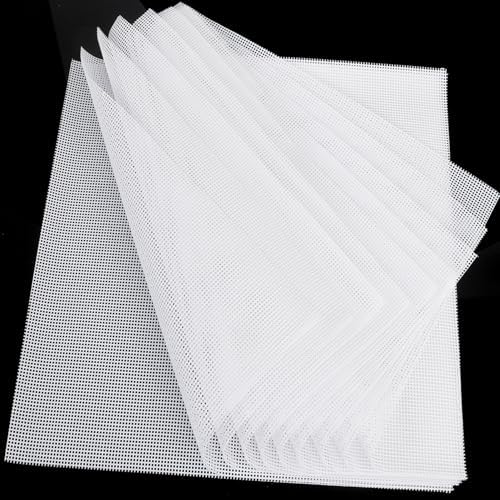
- STOP SMALL FRUIT FROM FALLING – Our ultra-fine 1mm mesh structure ensures tiny berries, sliced herbs, and seeds stay on …
- SAVE 60 MINUTES ON CLEANUP – High-release silicone coating makes these 100% non-stick. Meat oils and fruit sugars slide …
- PROFESSIONAL GRADE & BPA-FREE – Made from premium food-grade silicone, certified safe for temperatures up to 450°F. Enjo…
At a glance: Mesh liner · Material: Silicone · Size: 14 × 14 in square · In the pack: 10 · Best for: Everyday drying, small pieces
Ten mesh liners at fourteen inches square is the set that solves the problem most people actually have: not enough liners to fill the machine. A ten-tray Cosori or an eleven-tray Magic Mill needs eight or nine of these to be fully lined, and buying two branded four-packs costs more than this whole set.
Fourteen by fourteen is the standard square size, set years ago by Excalibur’s tray footprint, and it is why this dimension turns up on every generic listing. On a 15-inch Excalibur tray, it drops straight in. On anything smaller, you cut it with kitchen scissors, which takes a minute per sheet and works because the weave does not fray.
The mesh is fine enough to stop chopped basil and loose berries falling through, open enough that drying time barely changes, and it peels off cleanly once the food is dry. They wash in warm, soapy water; the dishwasher will do it, but the sheets tend to fold over and come out creased.
Pros
- Ten sheets — enough to line a large machine in one purchase
- 14 × 14 in, the standard square size
- Trims to size with scissors without fraying
- Fine enough for herbs and small slices, open enough not to slow drying
Cons
- Needs trimming for anything under 14 inches
- Creases if you machine-wash them
- No raised edge, so not for liquids
Who It’s For
Anyone with a square-tray machine and not enough liners, which is almost everyone. Skip it if your trays are round. Otherwise, this ten-pack is the set to start with. The default buy.
2. 🎯 Best Solid Sheet: Excalibur ParaFlexx Ultra Silicone

- SET OF FOUR- Designed for use with Excalibur Dehydrator, each silicone sheet measures 14 x 14 inches
- COMPATABILITY: Fits Excalibur EXC10EL, 2500, 2900 & 3900 series dehydrators
- VERSATILITY: Expand the use of your Excalibur Dehydrator with reusable drying sheets; perfect for making fruit roll-ups,…
At a glance: Solid sheet · Material: Silicone · Size: 14 × 14 in square · In the pack: 4 · Best for: Fruit leather, purée, batter
When you want a solid sheet, buy the one whose material you can actually confirm. Excalibur’s ParaFlexx Ultra is described by the manufacturer as coated with high-grade silicone, and it is the sheet I use for fruit leather and for anything poured.
The distinction matters because Excalibur’s other flagship sheet, the ParaFlexx Premium, is a different material: distributors list it as the Teflon-coated sheet the company used to sell as Teflex, and it is sold beside the Ultra under a nearly identical name. Both work. They are simply not the same thing, and only one of them is silicone — which is the section further down this page.
In use, a solid sheet behaves nothing like mesh. Air cannot get underneath, so a tray of purée dries from the top down and takes roughly half again as long as the same weight spread thin on mesh. Flip the leather once the top is dry to the touch and give it another hour face-down; that is the whole trick.
Four is the right number. You almost never want solid sheets on every tray — one or two trays of leather alongside a machine full of apple slices is the normal batch.
Pros
- Manufacturer-stated silicone, from the company that defined the format
- 14 × 14 in, drops into Excalibur trays and trims for others
- Handles purée, yoghurt and batter without seeping
- Thick enough to keep its shape after dozens of runs
Cons
- Costs several times what a generic sheet costs
- Four sheets, not a full machine’s worth
- Easy to confuse with the Teflon-coated ParaFlexx Premium
Who It’s For
Anyone who makes leather, purée or yoghurt more than once a season. Skip it if you only ever dry slices — mesh does that better. Otherwise the ParaFlexx Ultra is the solid sheet worth paying for. The one whose material is on the record.
3. 💰 Best Value: 9-Pack Silicone Mesh Sheets

- Safety- BPA Free: Silicone dehydrator sheets made from premium non stick heat-resistant(-40℃ to 220℃ / -40℉ to 428℉) foo…
- Versatile application for dehydrator sheets fit for excalibur 2500, 3500, 2900 or 3900 non stick food and steaming mesh …
- Easy To Clean: They help keep our dehydrated food from sticking to the shelves. The dehydrator tray liner can be washed …
At a glance: Mesh liner · Material: Silicone · Size: 14 × 14 in square · In the pack: 9 · Best for: Filling a big machine cheaply
Nine sheets are more than any consumer dehydrator has trays, which is the point: you line the whole machine, keep spares for the ones that get cut down, and still spend less than a branded four-pack costs.
It is the same 14 × 14 format as the pick above, so everything there applies – trim for smaller trays, hand wash, no good for liquids. What you give up at this price is consistency: in a pack of twelve, expect one or two to be cut a little off-square. On a tray that does not matter, but it is the reason this is the value pick rather than the overall one.
If you own something large — an Excalibur 3926TB, a big-batch machine, a 10-tray cabinet — this is the sensible way to line it without buying three sets.
Pros
- Twelve sheets, enough for any home machine with spares
- Cheapest way to line a 9- or 10-tray cabinet
- Same standard 14 × 14 square size
- Trims down for smaller trays
Cons
- Cutting accuracy varies within a pack
- Thinner than the branded sheets and less rigid
- Mesh only — no solid sheet in the set
Who It’s For
Big machines and tight budgets. Skip it if you want every sheet identical. Otherwise, the twelve-pack lines the whole cabinet for the price of a takeaway. Volume, at the cost of a little precision.
4. ⭕ Best for Round Trays: Dostk 8-Pack Round Mesh

- Safety- BPA Free: Silicone dehydrator sheets made from premium non stick heat-resistant(-40℃ to 220℃ / -40℉ to 428℉) foo…
- The non-stick properties of silica gel ensure that food residues will not adhere to the tray. It is easy to pick up and …
- Silicone Dehydrator Sheets provide adequate airflow top and bottom,When done drying just fold in half & pour in canning …
At a glance: Mesh liner · Material: Silicone · Size: 13 in round, centre hole · In the pack: 8 · Best for: Stackable round-tray machines
Every square sheet on this page is useless to you if your dehydrator stacks round trays with a hole in the middle — the Nesco Gardenmaster, the Presto Dehydro, and most machines under $80. These are the same silicone mesh in the right shape, with the centre cut out so air still rises through the stack.
Thirteen inches is the common round size, and eight of them line a typical five- or six-tray stack with spares. Check your own tray diameter before ordering: round machines are less standardised than square ones, and a disc an inch too wide will not seat.
On a stacking machine, liners matter more than they do in a cabinet, because the bottom tray sits closest to the heat and dries first. A mesh liner does not fix that — you still rotate — but it stops small pieces dropping through onto the element, which is the failure mode nobody warns you about.
Pros
- The right shape for stackable round-tray dehydrators
- Centre hole keeps the vertical airflow path open
- Eight sheets — a full stack plus spares
- Stops small pieces falling toward the heating element
Cons
- Round trays vary in diameter; measure before ordering
- Cannot be trimmed as freely as a square sheet
- Mesh only — no solid version in this pack
Who It’s For
Owners of stacking machines, who the square-sheet listings quietly ignore. Skip it if your trays are square. Otherwise, these round liners are the shape that fits. The set for everyone the standard size forgot.
5. 🥣 Best for Liquids: Lipped Fruit Leather Sheets

- 4 Sheets have 1/4″ Edge / Lip to Hold in Liquids – Fits Nesco ALL Models of their Round and Square Dehydrators. For any …
- 100% Food Grade Silicone – NON-Toxic – No Toxic Plastic, No Toxic Teflon to Leach into your Food!
- 12.5″ Diameter with 3″ Center Hole – Edges on the sheet hold liquid batter on the sheet – NO Spill!
At a glance: Solid, raised edge · Material: Silicone · Size: Round, fits Nesco-style trays · In the pack: 4 · Best for: Liquids that would run off
A flat solid sheet holds a thick purée perfectly well. It does not hold a thin one — tilt the tray a few degrees while carrying it to the machine, and the edge is where you find out. These have a raised lip moulded around the rim, so whatever you pour stays in.
That makes them the right sheet for thin fruit purée, yoghurt, soups you are drying down to a powder, and any batter you want to dry into a cracker. It also makes them slower than a flat sheet, because the lip shelters the outer inch from moving air; expect the rim of a leather to finish after the middle, which is the opposite of what you are used to.
They are cut for Nesco-style round trays, which is the format most likely to need them — the stackable machines are also the ones whose factory fruit-roll sheet is a single flat disc. Four covers a stack. If you make leather in volume, the fruit leather roundup is the guide to which machine suits it.
Pros
- Raised lip holds thin purée, yoghurt and batter
- Silicone, flexible enough to peel a finished leather off in one piece
- Four sheets — a whole stack of leather at once
- Shaped for round Nesco-style trays
Cons
- The lip shelters the rim, so edges dry last
- Round format only — no use on a square cabinet
- Slower than flat sheets for anything thick
Who It’s For
Leather makers with round trays, and anyone who has cleaned purée off the tray below. Skip it if you dry thick mixes on flat sheets happily. Otherwise, these lipped sheets earn their place. The sheet with a wall around it.
6. 📦 Best Brand Fit: Cosori CFD-MS102 Mesh Screens

- Compatible with Cosori P101 and Other Square Food Dehydrators
- Item dimensions are 15 x 15 inches. Suitable for any food dehydrator with a tray size larger than these dimensions
- 2 BPA-free mesh screens are included
At a glance: Mesh screen · Material: Plastic · Size: Cosori 10-tray fit · In the pack: 2 · Best for: Exact-fit spares for a Cosori
Sometimes the right answer is the factory part. Cosori’s 10-tray Premium Pro ships with exactly one mesh screen for ten trays, and these are the screens cut to that tray — no trimming, no guessing; they seat the way the original does. If you own that machine, or the one I compared against the Excalibur, this is the least annoying way to add screens.
Worth knowing what you are buying, though: Cosori’s mesh screens are plastic, by the company’s own listing, on a machine sold for its stainless trays. That is not a flaw so much as an irony, and it is the same gap the stainless guide documents across the whole category — the trays are steel, the parts that sit directly under the food often are not.
Two screens is a thin pack for a ten-tray machine, and per sheet it costs several times what the generic square mesh costs. You are paying for the exact fit. Whether that is worth it depends on how you feel about scissors.
Pros
- Cut to Cosori’s tray — no trimming at all
- Seats exactly like the screen the machine shipped with
- BPA-free, and the part the manufacturer specifies
- Fits the Premium Pro 10-tray and other Cosori models
Cons
- Plastic, not silicone or steel
- Only two screens per pack
- Several times the per-sheet cost of generic mesh
- No use on any other brand
Who It’s For
Cosori owners who would rather not cut anything. Skip it if you are happy trimming a generic sheet, which costs a fraction as much. Otherwise, these factory screens are the exact-fit option. Convenience, priced as convenience.
What “Silicone” Actually Means on a Dehydrator Sheet
This is the part of the category nobody writes down. “Silicone dehydrator sheets” is how the shelf is labelled, not a promise about what is in the box, and the clearest proof comes from the company that invented the format.
- ParaFlexx Ultra — Excalibur describes it as coated with high-grade silicone. This is the silicone one.
- ParaFlexx Premium — sold by Excalibur distributors as the Teflon-coated sheet, and listed plainly as “previously Teflex”, the name it carried for years. Same brand, adjacent shelf, different material.
- Generic “silicone mesh” — usually a woven glass-fibre mesh with a silicone coating over it, which is why it holds its shape and does not fray when you cut it. That is a reasonable product, but it is a coating, not a solid silicone sheet.
None of that makes any of them bad. A PTFE-coated sheet is a perfectly good drying surface and has been for decades. The point is that if you went looking for silicone specifically — because you are avoiding non-stick coatings, which is the usual reason — then the word on the listing is not enough, and you have to read the material line. Excalibur’s own US pages muddle it, so a third-party listing certainly will.
The practical rule: if a sheet is described as coated and does not say what the coating sits on, it is a coated fabric. If that matters to you, buy a named product whose material the manufacturer states, which on this page means the ParaFlexx Ultra. The same argument, applied to trays rather than sheets, is the whole of the stainless steel guide.
Will a 14 × 14 Sheet Fit Your Dehydrator?
Fourteen inches square is the default because Excalibur’s trays are fifteen. Here is what that means on the machines whose tray dimensions I have been able to confirm, plus one where the maker does not publish them:
- Excalibur 3926TB — 15 × 15 in trays. A 14 × 14 sheet drops in with a margin all round. No trimming.
- Magic Mill MFD-1010 — 15.5 × 15.3 in trays. Fits as it comes, with room to spare. The Magic Mill guide has the rest of that line.
- Magic Mill MFD-7070 — 13 × 12 in trays. Trim about an inch off one side and two off the other.
- Cosori Premium Mini — 9.8 × 9.1 in trays. A 14-inch sheet needs a third cut off it; buy small or cut carefully.
- Cosori Premium 6-Tray and Premium Pro 10-Tray — Cosori’s own site and manual give no tray size, but its Amazon listing for the 6-tray CP267-FD states 12 × 13 in, so a 14 × 14 sheet needs about an inch trimmed off one side and two off the other. For the Premium Pro no tray size is published; dividing its rated area gives roughly 1.62 square feet per tray, near 15.3 inches square — my arithmetic from a rated figure, not a measurement, so measure before you cut. The Cosori guide explains where those rated numbers come from.
- Nesco, Presto and most stackables — round trays with a centre hole. A square sheet is no use at all; buy the round liners above.
Two minutes with a tape measure beats any listing’s compatibility claim. Measure the flat inside area of the tray, not the outer rim, and cut the sheet a little smaller than that so air can still move around the edges — a liner cut to the exact tray size seals the perimeter and slows everything down.
Dehydrator Sheets FAQs
Do I really need dehydrator sheets?
For slices on a clean tray, no. You need them the moment you dry something small enough to fall through the grid — herbs, berries, peas, chopped mushrooms — or anything wet enough to glue itself to the tray, which is most fruit. Since machines ship with one sheet regardless of tray count, almost everyone ends up buying a set.
What is the difference between mesh liners and solid sheets?
Mesh liners let air through and stop small pieces from falling; solid sheets block air and hold liquid. Mesh is for everyday drying; solid is for fruit leather, purée and yoghurt. They are not interchangeable — a purée poured onto mesh goes straight through, and slices on a solid sheet take half again as long to dry.
Can I use parchment paper instead?
For fruit leather, yes, at a pinch. Parchment blocks air the same way a solid sheet does, and it is fine for a one-off. It absorbs liquid over a long run, so a thin purée can stick to it by the end, and it is single-use. Never use wax paper, which can soften onto the food, or foil, which blocks airflow completely and sits against acidic fruit.
Are silicone dehydrator sheets actually silicone?
Often they are silicone coating over a woven glass-fibre mesh rather than solid silicone, which is exactly why they cut cleanly and hold their shape. Even within one brand, the naming is loose: Excalibur’s ParaFlexx Ultra is described as silicone-coated, while the similarly named ParaFlexx Premium is the Teflon-coated sheet the company used to sell as Teflex. Read the material line, not the title.
Can dehydrator sheets go in the dishwasher?
Most are dishwasher safe, but they come out creased because they fold over in the rack, and a creased mesh sheet never quite lies flat again. Warm, soapy water and a soft brush take under a minute per sheet. Let them dry fully before stacking, or they stick to each other.
What size dehydrator sheet should I buy?
14 × 14 inches for square-tray cabinets, 13 inches round for stackable machines. The square sheets are meant to be trimmed with scissors, so buy the standard size and cut it down rather than hunting for an exact match. Measure the flat inside area of your tray first and cut slightly smaller, so air can still move around the edge.
Final Verdict: Which Dehydrator Sheets Should You Buy?
- If you have square trays and one set to buy, get the Kispog 10-pack. Ten mesh liners cover the machine and the everyday drying you actually do.
- If you make fruit leather, add the ParaFlexx Ultra — four solid sheets, with the material stated by the manufacturer rather than implied.
- If you are lining a 9- or 10-tray cabinet on a budget, get the twelve-pack and accept that one or two will be cut slightly off-square.
- If your trays are round, get the 13-inch round mesh, and the lipped sheets if you pour anything thin.
- If you own a Cosori and refuse to cut anything, get the factory mesh screens and pay for the exact fit.
Personal Tips You Can Steal
I cut generic sheets with the tray upside down on top of them as a template, then take another half inch off — a liner that reaches the tray edge seals the perimeter and slows the whole load. I keep the solid sheets in a separate drawer from the mesh, because sorting them out mid-batch with wet hands is miserable.
And I write the tray size on the corner of each cut sheet with a laundry marker, since 14-inch and trimmed sheets look identical stacked, and I own three machines. 6 essential dehydrating tips cover the habits that matter more than any accessory.
More Dehydrator Buying Guides
- Best Large Capacity Dehydrator — the machines that ship with the fewest sheets, and how much area you are lining.
- Best Stainless Steel Dehydrator — why the trays are steel, and the screens often are not.
- Best Dehydrator for Fruit Leather — the machines built for purée, where solid sheets earn their keep.
- Best Dehydrator for Beginners — if you are buying the machine and the sheets at the same time.
P.S. Buy one set more than you think you need. The sheet you are missing is always the one under the tray you already loaded 🙂