
A bag of chicken jerky for dogs costs a small fortune, and the ingredient list usually runs longer than it should. Three pounds of chicken breast and a dehydrator get you the same thing for a fraction of the price, with one ingredient.

But dog treats are the one job where the machine’s temperature ceiling actually matters. Most guides get this wrong, so here’s the short version up front: the USDA says to heat meat to 160°F, or poultry to 165°F, before it goes in the dehydrator, because the dehydrator itself may never get the meat that hot. A 165°F machine is useful insurance. It is not a replacement for that step.
So the best dehydrator for dog treats is the one with a ceiling high enough to finish the job, trays you can actually scrub after raw chicken, and enough room to make a month of treats in one run. I’ve picked seven, ranked for exactly that. Let’s make the good stuff.
One honest caveat before we start: I make treats; I’m not a vet. If your dog has allergies, pancreatitis, kidney trouble, or is on a prescription diet, check with your vet before you change what goes in the treat jar.
As an Amazon Associate, I earn from qualifying purchases. If you make a purchase after clicking on a link I may earn a small commission at no extra cost to you if items are purchased.
Quick Picks: The Best Dehydrator for Dog Treats, at a Glance
- 🥇 Best Overall: Excalibur 3948CDB – two-stage timer dries at 140°F then finishes at 165°F, unattended
- 🥈 Best Stainless: Magic Mill MFD-7070 – 167°F ceiling and trays that go in the dishwasher after raw chicken
- 💎 Best for Big Batches: Weston Pro Series – up to 28 sq ft and 1600W, a month of treats in one run
- 🌡️ Best Temperature Control: COSORI 6-Tray – one-degree steps to 165°F exactly
- 📦 Best Compact Stainless: NutriChef NCFD10S – ten stainless trays in a small footprint, 167°F
- 🔇 Quietest: Samson Silent 6-Tray – near-silent, but it tops out at 155°F (see the safety section)
- 💰 Best Budget: Presto 06301 Dehydro – 165°F and a real timer for very little money
Best Dehydrator for Dog Treats: Comparison Table
| Model | Trays / capacity | Drying area | Watts | Temp range | Timer | Airflow | Hits USDA temps? | Price |
|---|---|---|---|---|---|---|---|---|
| Excalibur 3948CDB 9-Tray Digital | 9 (15×15 in) | 15 ft² | 600W | 95–165°F | 48 h, two-stage | Rear, horizontal | Yes — 165°F | $$$$ |
| Magic Mill MFD-7070 7-Tray | 7 stainless (13×12 in) | ~7.6 ft² | 600W | 95–167°F (9° steps) | 24 h, 30-min steps | Rear, horizontal | Yes — 167°F | $$ |
| Weston Pro Series 28-0301-W | 10 trays, expandable | up to 28 ft² | 1600W | up to 160°F | 12 h digital | Rear, horizontal | 160°F only — fine for beef, short for poultry | $$$$ |
| COSORI 6-Tray Stainless Steel | 6 stainless (12×13 in) | ~6.5 ft² | 600W | 95–165°F (1° steps) | 48 h digital | Rear, horizontal | Yes — 165°F | $$ |
| NutriChef NCFD10S 10-Tray | 10 stainless | Not published | 900W | 95–167°F | Fixed 10-hour cycle | 360° circulation | Yes — 167°F | $$ |
| Samson Silent 6-Tray | 6 (13×12 in), BPA-free plastic | 6.5 ft² | Wattage not published | 95–155°F | 30 min – 19 h | Rear fan | No — 155°F max | $$$ |
| Presto 06301 Dehydro Digital | 6 round, expands to 12 | Not published by Presto | 750W | 90–165°F | Digital | Bottom-mounted, vertical | Yes — 165°F | $$ |
One column matters more than the rest here: the ceiling. You still pre-heat the meat either way, but a machine that reaches 165°F lets you finish a batch safely if you forgot, and one that stops at 155°F never can.
How I Picked These
I ranked these by the three things that decide a dog-treat machine: whether it reaches the temperatures the USDA names, how well it survives repeated contact with raw chicken, and whether it holds enough to make a batch worth the eight hours. Most have full hands-on reviews on this site, linked in each section; the rest were checked against manufacturer specs and owner feedback.
- Reach 160–165°F. Not as a substitute for pre-heating the meat, but as the safety net that lets you finish a batch properly.
- Clean up honestly. Raw poultry goes on these trays. Stainless in a dishwasher beats plastic you scrub by hand, every time.
- Hold a real batch. Treats get eaten fast. A machine that makes four days’ worth per run is a machine you stop using.
1. 🥇 Best Overall for Dog Treats: Excalibur 3948CDB 9-Tray Digital
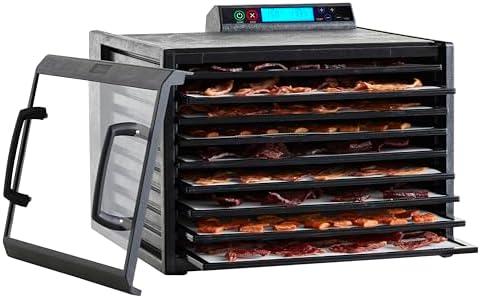
- Large Capacity: Equipped with 9 easy-to-clean Excalibur dehydrator trays, this large food dehydrator boasts 15 square fe…
- Accurate Temperature Control: Features a 48-hour dehydrator timer and an adjustable thermostat with a range of 95 to 165…
- Low & Slow for Immune Boost: The perfect dehydrator for food and jerky, dried fruit leather, fruit roll-up puree, pet tr…
Specs at a glance: 9 (15×15 in) · Drying area: 15 ft² · 600W · 95–165°F · Timer: 48 h, two-stage · Rear airflow · Hits USDA temps: Yes — 165°F
The 3948CDB wins for one feature nothing else here has: a two-stage digital timer. Set stage one to 140°F for eight hours to dry the jerky, and stage two to 165°F for the last stretch to finish it. That’s the USDA Food Safety and Inspection Service sequence, run unattended overnight while you sleep. Full review in my Excalibur 3948CDB review.
Everything else is Excalibur’s usual argument. Nine 15×15 inch trays give 15 square feet, which is about six pounds of chicken breast sliced thin — a month of treats for a medium dog. The rear fan dries every shelf at once, so the top tray and the bottom tray finish together, and you never open the door to rotate. Pull the trays out, and the chamber takes whole sweet potato rounds or thick beef strips.
Pros
- Two-stage timer runs the 140°F dry and the 165°F finish unattended
- 165°F ceiling clears both USDA thresholds
- 15 sq ft on nine trays — a month of treats in one run
- Rear horizontal airflow, removable trays, cheap spare parts
Cons
- Priciest machine here by some distance
- Polypropylene trays, not dishwasher-friendly stainless
- Big, boxy footprint that stays on the counter
Who It’s For
People making treats every week who want the whole cycle to run while they’re asleep. Skip it if the budget is tight — the Magic Mill below does the same job with one more button press. If it isn’t, the Excalibur 3948CDB is the set-and-forget answer.
2. 🥈 Best Stainless (Dishwasher-Safe Trays): Magic Mill MFD-7070 7-Tray

- REAR MOUNTED FAN FOR SUPERIOR HEAT DISTRIBUTION – Dries food evenly, This electric dehydration machine is equipped with …
- DIGITAL THERMOSTAT AND TIMER- AUTOMATIC SHUT OFF WHEN TIMER DONE — An adjustable temperature and timer ensure you to ha…
- SPACIOUS ADJUSTABLE 7 XL STAINLESS STEEL TRAYS – INCLUDED FRUIT ROLL TRAYS! Use the trays for regular food and the mesh …
Specs at a glance: 7 stainless (13×12 in) · Drying area: ~7.6 ft² · 600W · 95–167°F (9° steps) · Timer: 24 h, 30-min steps · Rear airflow · Hits USDA temps: Yes — 167°F
If I had to pick on tray cleanup alone, this is the one. Seven stainless trays at 13×12 inches, about 7.6 square feet, and every one of them goes in the dishwasher after a batch of raw chicken. That matters more for dog treats than for anything else you’ll dry. One spot still needs a hand wipe: the lip at the bottom of the cabinet, where juices can collect. Details in my Magic Mill MFD-7070 review.
The ceiling is 167°F, comfortably past both USDA thresholds, so you can run the finishing step in the machine rather than heating the oven for ten minutes. The clear door earns its keep too: chicken jerky goes from pliable to brittle in under an hour at the end, and you want it bendy, not shattering.
Pros
- 167°F ceiling, past both USDA numbers
- Stainless, dishwasher-safe trays — the right material for raw poultry
- Clear door to catch the moment jerky is done
- Rear horizontal airflow in a footprint that fits a normal kitchen
Cons
- 9°F temperature steps and 30-minute timer steps
- 7.6 sq ft is a good batch, not a huge one
- No two-stage programming — you set the finish manually
Who It’s For
Most people, honestly. Skip it if you want the whole cycle automated or you’re feeding three big dogs. Otherwise the Magic Mill MFD-7070 is the sensible buy on this page.
3. 💎 Best for Big Batches: Weston Pro Series 28-0301-W

- Commercial style, steel alloy cabinet body
- Up to 28 square feet of drying space
- 1600 watt heating element (110 volt, 60 Hz)
Specs at a glance: 10 trays, expandable · Drying area: up to 28 ft² · 1600W · up to 160°F · Timer: 12 h digital · Rear airflow · Hits USDA temps: 160°F only — fine for beef, short for poultry
This is the machine for people who buy chicken in bulk. The Pro Series runs 1600 watts through up to 28 square feet of tray space — roughly four times the Cosori — and the whole thing sits in a steel cabinet rather than a plastic shell. The Weston lineup is compared model by model in Weston Dehydrator Reviews.
At that wattage, a full load of beef strips dries in a fraction of the time a 600-watt machine takes, which is the real argument for it: you’re not running the thing for two days to make one batch. The 12-hour digital timer shuts it off on its own.
Be advised about the ceiling: 160°F. That clears the USDA number for beef but falls 5 degrees short for poultry, so chicken and turkey treats must be pre-heated in the oven or on the hob first. Given that the USDA tells you to do that anyway, it’s less of a problem than it sounds — but know it going in.
Pros
- Up to 28 sq ft — genuinely commercial capacity
- 1600W dries heavy meat loads far faster than 600W machines
- Steel cabinet, built for repeated heavy use
- 12-hour digital timer with auto shut-off
Cons
- 160°F ceiling — 5 degrees short of the poultry number
- Large, heavy, and expensive
- Overkill for one small dog
Who It’s For
Multi-dog households, breeders, and anyone who buys meat by the case. Skip it if you make treats once a month. If you make them every week, the Weston Pro Series turns an all-day job into an afternoon. See also the commercial dehydrator roundup.
4. 🌡️ Best Temperature Control: COSORI 6-Tray Stainless Steel

- 𝗠𝗔𝗫𝗜𝗠𝗜𝗭𝗘 𝗘𝐕𝗘𝗥𝗬 𝗕𝗔𝗧𝗖𝗛: 6 stainless steel trays offer 6.5 ft² of drying space, giving you plenty of room to dehydrate larg…
- 𝗠𝗢𝗥𝗘 𝗣𝗢𝗪𝗘𝗥𝗙𝗨𝗟 & 𝗘𝗙𝗙𝗜𝗖𝗜𝗘𝗡𝗧: Equipped with a 600 W motor, rear-mounted drying fan, and upgraded airflow technology for fas…
- 𝗦𝗨𝗣𝗘𝗥 𝗤𝗨𝗜𝗘𝗧 𝗢𝗣𝗘𝗥𝗔𝗧𝗜𝗢𝗡: Features an advanced brushless motor with noise levels below 48 dB, letting you dehydrate your fo…
Specs at a glance: 6 stainless (12×13 in) · Drying area: ~6.5 ft² · 600W · 95–165°F (1° steps) · Timer: 48 h digital · Rear airflow · Hits USDA temps: Yes — 165°F
The Cosori’s thermostat moves in one-degree steps from 95°F to 165°F, which means you land on 165 exactly rather than picking the nearest preset and hoping. For a machine you’re using to finish poultry treats, that precision is the point. I covered it in depth in my Cosori 6-tray review.
Six stainless trays give 6.5 square feet, the door is glass, and it runs under 48 dB — which matters when the machine is on for ten hours, and the dog sleeps in the same room. Trays are dishwasher-safe, which after raw chicken is not a luxury.
Pros
- One-degree control — hit 165°F exactly
- Stainless, dishwasher-safe trays and a glass door
- Under 48 dB, so a ten-hour run doesn’t dominate the house
- 48-hour timer with auto shut-off
Cons
- 6.5 sq ft means several runs for a large dog
- Only one mesh sheet in the box
- Deep footprint takes most of a counter’s depth
Who It’s For
One-dog households that want precision and quiet. Skip it if you need volume. For everyone else, the Cosori 6-Tray is the easiest machine here to live with. Hard to regret.
5. 📦 Best Compact Stainless: NutriChef NCFD10S 10-Tray

- ELECTRIC PRESERVER: Finally, a multi-tiered countertop electric food dehydrator that can preserve varieties of food. It …
- 10-TIERED DRYER TRAYS: Comes w/ 10 food grade stainless steel trays or dryer rack. Can also be used to dry food without …
- TEMPERATURE CONTROL: Uses electronic probe and temperature control for food preservation (95-170°F). Dehydrates and pres…
Specs at a glance: 10 stainless · Drying area: Not published · 900W · 95–167°F · Timer: Fixed 10-hour cycle · 360° circulation airflow · Hits USDA temps: Yes — 167°F
Ten stainless trays in a countertop box, 900 watts, and a ceiling of 167°F. On paper, that’s more tray count than anything else here under the Weston, and all of it in steel you can scrub properly. My notes are in the NutriChef NCFD10S review.
For dog treats, the appeal is simple: the trays are thin, and there are a lot of them, which suits sliced meat far better than it suits bulky fruit. Ten trays of quarter-inch chicken is a serious batch out of a machine that doesn’t dominate the counter.
Pros
- Ten stainless trays — a lot of thin-slice capacity for the size
- 167°F ceiling, past both USDA numbers
- 900W, more power than most 600W machines this size
- Steel trays that survive repeated raw-poultry batches
Cons
- Fixed 10-hour cycle rather than a true programmable timer
- Total drying area isn’t published
- Stacked thin trays mean no room for thick chews
Who It’s For
Small kitchens that still want real capacity for sliced treats. Skip it if you want a programmable timer or you’re drying thick bones and chews. Otherwise, the NutriChef NCFD10S is a lot of stainless for the money.
6. 🔇 Quietest: Samson Silent 6-Tray

- Very quiet compared to other dehydrators, Easy to reach controls TOP FRONT of the machine
- Push button digital control panel with LCD; is located in top front for easy placement of unit
- 120VAC,, 60 hZ, 400 WATT – Instruction and Care Manual, Includes Food Preparation Chart for over 40
Specs at a glance: 6 (13×12 in), BPA-free plastic · Drying area: 6.5 ft² · Wattage not published · 95–155°F · Timer: 30 min – 19 h · Rear fan airflow · Hits USDA temps: No — 155°F max
The Samson earns its name. It’s the quietest machine I’ve put on a counter, which sounds like a small thing until you realise a batch of treats runs eight to twelve hours, and a nervous dog has to live with the noise. Six trays, 6.5 square feet, a rear fan, a 19-hour timer, and a five-year warranty. Full notes in my Samson Silent 6-tray review.
Here’s the catch, and it’s why this one sits at number six rather than higher: it tops out at 155°F. That’s below the USDA’s 160°F for beef and its 165°F for poultry, so this machine can never finish a meat treat to a safe temperature on its own. You must pre-heat the meat before it goes in — which, to be fair, is what the USDA tells everyone to do regardless of their machine.
Pros
- Genuinely near-silent — the best choice for a nervous dog or an open-plan flat
- 6.5 sq ft on six large trays, rear fan, even drying
- Mesh liners and drip tray included
- Five-year limited warranty
Cons
- 155°F ceiling — cannot reach either USDA temperature
- Pre-heating the meat is mandatory, not optional, with this one
- BPA-free plastic trays rather than stainless steel
Who It’s For
Quiet houses, anxious dogs, and people who will actually do the pre-heat step every time. Skip it if you want the machine to be your safety net. If you don’t, the Samson Silent is the calmest thing on this list.
7. 💰 Best Budget: Presto 06301 Dehydro Digital

- VERSATILE DEHYDRATOR: Dehydrates fruits, vegetables, herbs, spices, and more. Ideal for jerky and fruit roll preparation
- EXPANDABLE CAPACITY: Includes 6 trays, expands to 12 (add-on trays sold separately). Innovative nesting design reduces s…
- PRECISE CONTROL: Digital thermostat and timer with temperatures from 90° to 165°F for customized drying. Shuts off autom…
Specs at a glance: 6 round, expands to 12 · Drying area: ~5 ft² as shipped · 750W · 90–165°F · Timer: Digital · Bottom-mounted airflow · Hits USDA temps: Yes — 165°F
The 06301 is the cheapest honest way into dog treats. Digital thermostat, real timer, and a 165°F ceiling that clears both USDA numbers — which is more than the Samson, three times its price, manages. I went through it in my Presto 06301 review.
Six round trays give about five square feet and expand to twelve, and 750 watts is respectable for the price. The trays nest for storage, so it lives in a cupboard between batches rather than on the counter.
Pros
- 165°F ceiling at the lowest price on this page
- Digital thermostat and a real timer
- Expands from 6 to 12 trays, and the trays nest for storage
- 750W dries a wet load faster than most cheap machines
Cons
- Bottom-mounted fan means rotating trays once per batch
- Plastic trays, hand wash only after raw meat
- Round trays with a centre hole waste usable area
Who It’s For
Anyone finding out whether homemade treats will stick. Skip it if you already know you’ll be making them in bulk. To find out, the Presto 06301 costs less than three bags of the store-bought stuff. Start cheap.
The Safety Step Almost Every Dog-Treat Guide Skips
If you read one section on this page, make it this one. Homemade meat treats carry the same salmonella and listeria risk as any other raw meat, for your dog and for everyone who handles the trays. The fix is simple and takes ten minutes.
Why the dehydrator alone isn’t enough
The USDA Food Safety and Inspection Service is blunt about it: “a dehydrator may not reach temperatures high enough to heat meat to 160°F or 165°F.” A dehydrator is built to move air, not to cook. Set it to 160, and the air around the meat gets there; the meat itself, cooling itself by evaporating water, often doesn’t. That’s the whole problem, and it’s why a high ceiling on a spec sheet is reassurance rather than proof.
The ten-minute fix
Heat the meat before it goes on the trays. USDA’s instruction is to “steam or roast meat to 160°F and poultry to 165°F, as measured with a food thermometer, before dehydrating it,” then dry at 130–140°F.
The National Center for Home Food Preservation gives a second route for strips in marinade: bring the strips and marinade to a boil and boil for five minutes, then drain and dry. Either works. A cheap instant-read thermometer is the only equipment you need, and it’s the best $10 you’ll spend on this hobby.
Forgot to pre-heat? NCHFP’s fallback is to heat the finished strips for ten minutes in an oven preheated to 275°F, and it notes that strips thicker than a quarter inch may need longer to reach 160°F. That’s the step a 165°F machine can help with — but pre-heating first is still the recommended order.
Handling the raw meat
FDA’s safe-handling guidance for pet food is the short list worth following: wash your hands for at least 20 seconds with soap and hot water before and after handling, and wash every bowl, scoop, and utensil with soap and hot water after each use. Add the obvious one for this job — the trays that held raw chicken go through a full wash before anything else touches them. This is the argument for stainless trays in plain terms.
What never goes in the dehydrator for a dog
FDA’s list of items that are dangerous for pets includes grapes and raisins, onions, garlic, macadamia nuts, xylitol, chocolate, caffeine, alcohol, avocado, and salt. Some of those sound harmless dried – a dehydrated grape is a raisin, and raisins are on the list. Don’t.
And skip the seasoning entirely: the marinade that makes human jerky good is mostly salt, soy, and garlic, none of which belongs in a dog treat.
What to Look For in a Dehydrator for Dog Treats
Dog treats reward a short list of features and ignore the rest. Here’s what actually moves the needle.
A ceiling of 160–165°F
Not because it replaces the pre-heat step — it doesn’t — but because it gives you a way to finish a batch properly when you forget, and because a machine that stops at 155°F never can. Check the spec before you buy: several well-reviewed dehydrators, the Samson included, top out below the USDA numbers and no review mentions it.
Trays you can put in a dishwasher
You are going to lay raw poultry on these trays, repeatedly. Stainless goes in the machine and comes out clean. Plastic mesh traps protein in the weave and needs a brush and hot water. It’s the single biggest practical difference between the machines on this page.
Enough capacity to be worth the eight hours
Meat loses roughly two-thirds of its weight drying. Three pounds of chicken breast comes out as about a pound of jerky, which a medium dog goes through in three or four weeks. Six trays get you there in two runs; fifteen square feet get you there in one.
A timer that outlasts the batch
Sliced meat takes 6 to 12 hours at 140°F, depending on thickness and marinade moisture. A 12-hour timer is the minimum; 24 or 48 hours means you never have to think about it. A machine with no timer means you have to set an alarm.
Noise, if the dog is in the room
Ten hours of fan noise is nothing to you and a lot to a dog who doesn’t like the vacuum. Under 50 dB is comfortable; the Samson and the Cosori are the quiet ones here.
Vegetable and Fruit Treats Worth Making
Not everything has to be meat, and the vegetable treats are easier, cheaper, and carry none of the pathogen risk. They’re also where I’d start if you’ve never used a dehydrator.
- Sweet potato chews. The classic. Slice a quarter inch thick for chewy, an eighth for crisp, and dry at 135°F for 8 to 12 hours. Method in how to dehydrate sweet potatoes.
- Carrot sticks. Cheap, keeps forever, and good for dogs who like to crunch. See how to dehydrate carrots.
- Apple rings, cores and seeds removed. Dry at 135°F until leathery. The full method is in dehydrating apples.
- Pumpkin and sweet potato powder. Not a treat exactly, but a spoonful stirred into food is how a lot of people use a dehydrator for their dog. See pumpkin powder and sweet potato powder.
No seasoning, no salt, no oil. Plain is the point.
Making Dog Treats in a Dehydrator: Quick Tips
- Slice thin and slice evenly. A quarter inch is the sweet spot for meat. Partly freezing the chicken for 30 minutes first makes even slices far easier.
- Trim every bit of fat. Fat doesn’t dry; it goes rancid, and it’s what shortens the shelf life of homemade treats more than anything else.
- Pre-heat the meat. 160°F for beef, 165°F for poultry, measured with a thermometer, before it goes on the trays. See the safety section above.
- Dry at 130–140°F, not higher. Hotter doesn’t dry faster; it case-hardens the outside and traps moisture in the middle.
- Bend one to test it. Properly dried jerky cracks when you bend it but doesn’t snap in half. Snapping means over-dried; folding means it needs longer.
- Store it cold. Homemade treats have no preservatives. A week in an airtight jar on the counter, a month in the fridge, longer in the freezer — how long dehydrated food lasts covers the storage rules properly.
New to the machine itself? How to use a food dehydrator covers the basics that apply to every batch, and the jerky buying guide goes deeper on meat.
Best Dehydrator for Dog Treats FAQs
What temperature should I dehydrate dog treats at?
Dry at 130 to 140°F (54 to 60°C), which is what USDA recommends for jerky. The higher number matters at a different moment: the meat itself must reach 160°F for beef or 165°F for poultry, and USDA says to get it there by steaming or roasting before it goes in the dehydrator. Vegetable treats like sweet potato dry fine at 135°F with no pre-heating.
Do I really have to cook the meat before dehydrating it?
USDA says yes. Its guidance is that most dehydrators may not get the meat itself to 160°F or 165°F, because evaporating water keeps the meat cooler than the air around it. Steaming or roasting the meat to temperature first, then drying at 130 to 140°F, removes the guesswork. A cheap instant-read thermometer is all the equipment you need.
Is a 155°F dehydrator good enough for dog treats?
Not on its own. A machine that tops out at 155°F, like the Samson Silent, can never bring meat to the 160°F or 165°F that USDA names. It is perfectly usable if you pre-heat the meat first, which is the recommended order anyway, but it gives you no fallback if you forget. Check the ceiling before you buy.
How long do homemade dehydrated dog treats last?
Less than store-bought, because there are no preservatives. Figure on about a week in an airtight container at room temperature, roughly a month in the fridge, and several months in the freezer. Trimming every scrap of fat before drying makes the biggest difference, because fat goes rancid long before the meat does.
What should never go in a dog treat?
FDA lists grapes and raisins, onions, garlic, macadamia nuts, xylitol, chocolate, caffeine, alcohol, avocado and salt among items dangerous to pets. Skip seasoning and marinades entirely — most jerky marinades are built on salt, soy sauce and garlic. Plain meat, plain vegetables, nothing else.
Can I use the same dehydrator for dog treats and human food?
Yes, as long as you wash the trays properly between uses. FDA advises washing hands for at least 20 seconds with soap and hot water before and after handling pet food, and washing every bowl and utensil with soap and hot water after each use. Dishwasher-safe stainless trays make that straightforward; plastic mesh needs a brush.
Final Verdict: Which Dehydrator for Dog Treats Should You Buy?
- If you want the whole cycle to run while you sleep, get the Excalibur 3948CDB. Two-stage timing does the 140°F dry and the 165°F finish without you.
- If you want the sensible everyday machine, get the Magic Mill MFD-7070. A 167°F ceiling, stainless dishwasher-safe trays, and a clear door, for a fraction of the Excalibur.
- If you’re feeding several dogs, get the Weston Pro Series for up to 28 square feet — and pre-heat poultry, because it stops at 160°F. For precision and quiet in a one-dog house, the Cosori 6-Tray instead.
- If the budget is the first filter, get the Presto 06301. It reaches 165°F, which is more than some machines three times the price can manage.
Personal Tips You Can Steal
I partly freeze the chicken for half an hour before slicing, because cutting thin, even strips from a floppy raw breast is a bad time. I keep one instant-read thermometer next to the dehydrator and use it every single batch, no exceptions. And I make the batch bigger than I need and freeze half, because the only thing worse than an eight-hour run is doing it twice in a fortnight.
More Dehydrator Buying Guides
- Best Dehydrator for Jerky — the meat-specific picks for people, where the same 160°F rule applies.
- Best Dehydrator for Vegetables — sweet potato, carrot and pumpkin all live here too.
- Best Dehydrator for Fruit — capacity and fruit-roll sheets decide that one.
- Best Excalibur Dehydrator — every current Excalibur ranked, if you’ve decided on the brand.
P.S. Make one tray of plain chicken jerky and watch your dog’s face when the machine opens. You will not go back to the bag 🙂