
Mushrooms are about ninety percent water, which makes them the most demanding thing you can put on a tray. A pound of fresh chanterelles comes out as roughly an ounce and a half of dried, and every drop of that water has to move through the machine before it gets there.
So the best dehydrator for mushrooms is the one that moves a lot of air, comes with fine-mesh screens so slices don’t drop through, and has trays you can actually get clean — because mushrooms shed spores onto everything, and they stick.

I’ve dried shiitake, oyster, button, porcini, and more chanterelles than one household needs, in machines from $60 to $300. Below are the seven I’d actually buy for mushrooms, ranked on merit for this job alone, plus two things nobody mentions: the sunlight step that turns them into a real source of vitamin D, and why the soaking water is worth more than the mushrooms. Let’s get that haul into jars.
As an Amazon Associate, I earn from qualifying purchases. If you make a purchase after clicking on a link I may earn a small commission at no extra cost to you if items are purchased.
Quick Picks: The Best Dehydrator for Mushrooms, at a Glance
- 🥇 Best Overall: Magic Mill MFD-1010 – 18 sq ft of stainless and 1000W of rear airflow
- 🍄 Best for Whole Caps: Excalibur 3926TB – pull the trays and you have a 12-inch chamber
- 🌡️ Best Temperature Control: COSORI 6-Tray – one-degree steps and a glass door
- 🥈 Best Stainless for Everyday: Magic Mill MFD-7070 – 7.6 sq ft, clear door, 24-hour timer
- 📦 Best Compact Stainless: NutriChef NCFD10S – ten thin stainless trays, 900W
- 💰 Best Budget: Nesco FD-75A Snackmaster Pro – two mesh screens included, expands to 12 trays
- ✅ Most Mesh Included: L’Equip 528 – six mesh screens in the box, the mycologists’ budget pick
Best Dehydrator for Mushrooms: Comparison Table
| Model | Trays / capacity | Drying area | Watts | Temp range | Timer | Airflow | Fine-mesh screens | Price |
|---|---|---|---|---|---|---|---|---|
| Magic Mill MFD-1010 11-Tray | 11 stainless | 18 ft² | 1000W | 95–167°F (9° steps) | Digital | Rear, horizontal | 1 mesh + 1 non-stick included | $$$ |
| Excalibur 3926TB 9-Tray | 9 (15×15 in), removable | 15 ft² | 600W | 105–165°F | 26 h | Rear, horizontal | Polyscreen insert on all 9 trays | $$$ |
| COSORI 6-Tray Stainless Steel | 6 stainless (12×13 in) | ~6.5 ft² | 600W | 95–165°F (1° steps) | 48 h digital | Rear, horizontal | 1 mesh included | $$ |
| Magic Mill MFD-7070 7-Tray | 7 stainless (13×12 in) | ~7.6 ft² | 600W | 95–167°F (9° steps) | 24 h, 30-min steps | Rear, horizontal | Fruit-roll trays incl.; mesh not listed | $$ |
| NutriChef NCFD10S 10-Tray | 10 stainless | Not published | 900W | 95–167°F | Fixed 10-hour cycle | 360° circulation | Not listed | $$ |
| Nesco FD-75A Snackmaster Pro | 5 round (13.5 in), expands to 12 | ~4 ft² as shipped (0.8 ft² per tray, per Nesco) | 600W | 95–160°F | None | Top-mounted, vertical | 2 mesh + 2 solid included | $ |
| L’Equip 528 Six-Tray | 6 plastic, expands to 12 | 7.2 ft² (14.4 expanded) | 500W | 95–158°F | None | Bottom-mounted, vertical | 6 mesh + 2 solid included | $$ |
Two columns decide it for mushrooms: fine-mesh screens (slices shrink to a third of their size and fall through a bare tray) and drying area, because a good foraging afternoon fills a machine twice over.
How I Picked These
I ranked these purely on how well they handle mushrooms, not on how they scored for fruit or jerky. That means three things: moving enough air to pull ninety percent water out of a full load, holding small slices without losing them through the tray, and cleaning up afterwards. That last one matters more than people expect — the Bay Area Mycological Society points out that dehydrators blow a high volume of spores into the air and that spores deposit themselves all over the trays.
- Move real air. Mushrooms are mostly water. A weak fan turns a six-hour job into a two-day one and risks souring the batch.
- Hold small pieces. Sliced mushrooms curl and shrink dramatically. Fine-mesh screens are not optional here, so a machine that includes them starts ahead.
- Clean properly. Stainless trays rinse clean of spores. Plastic mesh traps them, and the residue is what makes an old dehydrator smell like a cellar.
1. 🥇 Best Overall for Mushrooms: Magic Mill MFD-1010 11-Tray

- NOW WITH 11 TRAYS – Formally with 10 Trays – This Magic Mill Dehydrator Has Been Upgraded to 11 Trays to Add 30 inches o…
- Healthy enjoy the homemade easiest healthiest snacks, preserve foods, without additives, made with BPA free Machine.
- Digital Temperature Control with 95-167 Degree Fahrenheit (with 9 num. increments) Capability with 24 Hour Timer, Horizo…
Specs at a glance: 11 stainless · Drying area: 18 ft² · 1000W · 95–167°F (9° steps) · Timer: Digital · Rear airflow · Fine-mesh screens: 1 mesh + 1 non-stick included
Eleven stainless trays and 18 square feet, the most drying area here. Only one fine-mesh tray and one non-stick tray come in the box, though, so order a few extra mesh sheets with it: sliced caps shrink to a third of their size and drop straight through a bare tray. Full teardown in my Magic Mill MFD-1010 review.
The 1000-watt element is the other reason it wins. Mushrooms are roughly ninety percent water and a full eleven-tray load is a lot of moisture to shift; the difference between 1000W and 600W is hours, not minutes. The rear fan pushes air across every shelf at once, so you never rotate.
Stainless matters here for an unglamorous reason: spores. They settle on everything, and they stain plastic. Steel trays go in the dishwasher and come out neutral, which is why your mushroom powder doesn’t taste of last autumn’s batch.
Pros
- 18 sq ft on eleven stainless trays — a whole foraging haul in one run
- Rear horizontal airflow across every shelf, no rotation
- 1000W, enough air for a load that is mostly water
- Stainless rinses clean of spores; dishwasher-safe
Cons
- 9°F temperature steps, not one-degree control
- The door has no handle — a magnet catch you pry open
- Big and heavy; measure the counter first
- Only one mesh tray in the box; buy a few more for sliced mushrooms
Who It’s For
Foragers, mushroom growers, and anyone who comes home with a basket rather than a punnet. Skip it if your counter is small. Otherwise the Magic Mill MFD-1010 is the one everything else gets measured against. Buy once.
2. 🍄 Best for Whole Caps & Big Hauls: Excalibur 3926TB 9-Tray

- Large Capacity: Equipped with 9 Excalibur dehydrator trays, this large food dehydrator boasts 15 square feet of drying s…
- Versatile Uses: Features a 26-hour dehydrator timer and an adjustable thermostat with a range of 105 to 165 degrees F – …
- Low & Slow for Immune Boost: Cooking foods at no higher than 115-118 degrees in a dehydrator preserves nutrients; it’s t…
Specs at a glance: 9 (15×15 in), removable · Drying area: 15 ft² · 600W · 105–165°F · Timer: 26 h · Rear airflow · Fine-mesh screens: Polyscreen insert on all 9 trays
The Excalibur’s mushroom trick is the one thing no stacking machine can do: take every tray out and you have a clear chamber about twelve inches tall. That’s how you dry whole porcini and big portobello caps without slicing them, which matters because some species hold their flavour far better dried whole. Full review here: Excalibur 3926TB review.
Nine 15×15 inch trays give 15 square feet, and the rear fan dries every shelf evenly. The 105°F floor is irrelevant for culinary mushrooms — you’ll live between 110 and 135°F — and the 26-hour timer covers even whole shiitake, which can take two or three times as long as slices of the same mushroom.
Each of the nine trays ships with a flexible polyscreen insert, so slices have a mesh to sit on out of the box; for crumbs and very small pieces, finer screens or solid ParaFlexx sheets are sold separately. Be aware that the polypropylene trays and inserts hold spore residue longer than steel does.
Pros
- Remove the trays for whole caps — a 12-inch chamber nothing else here offers
- 15 sq ft, rear horizontal airflow, no rotation needed
- 26-hour timer handles whole mushrooms, not just slices
- Made in Sacramento since 1973, cheap spare parts
Cons
- Solid ParaFlexx sheets and finer screens sold separately
- Polypropylene trays hold spore residue longer than stainless
- Big, boxy footprint that lives on the counter
Who It’s For
Anyone drying whole caps or bringing home serious volume. Skip it if you only ever slice. If you don’t, the Excalibur 3926TB is still the benchmark, and every current model is ranked in Best Excalibur Dehydrator.
3. 🌡️ Best Temperature Control: COSORI 6-Tray Stainless Steel

- 𝗠𝗔𝗫𝗜𝗠𝗜𝗭𝗘 𝗘𝐕𝗘𝗥𝗬 𝗕𝗔𝗧𝗖𝗛: 6 stainless steel trays offer 6.5 ft² of drying space, giving you plenty of room to dehydrate larg…
- 𝗠𝗢𝗥𝗘 𝗣𝗢𝗪𝗘𝗥𝗙𝗨𝗟 & 𝗘𝗙𝗙𝗜𝗖𝗜𝗘𝗡𝗧: Equipped with a 600 W motor, rear-mounted drying fan, and upgraded airflow technology for fas…
- 𝗦𝗨𝗣𝗘𝗥 𝗤𝗨𝗜𝗘𝗧 𝗢𝗣𝗘𝗥𝗔𝗧𝗜𝗢𝗡: Features an advanced brushless motor with noise levels below 48 dB, letting you dehydrate your fo…
Specs at a glance: 6 stainless (12×13 in) · Drying area: ~6.5 ft² · 600W · 95–165°F (1° steps) · Timer: 48 h digital · Rear airflow · Fine-mesh screens: 1 mesh included
Mushrooms are the one food where drying too fast genuinely costs you flavour — the Bay Area Mycological Society notes that candy caps in particular lose their scent if pushed. The Cosori’s thermostat moves in one-degree steps from 95°F to 165°F, so you can set it at 110°F for the delicate species and 135°F for button mushrooms without guessing. Full notes in my Cosori 6-tray review.
The glass door is the underrated part. Mushrooms go from leathery to cracker-dry in about an hour at the end, and being able to look without opening the door means you catch it. It runs under 48 dB too, which matters because a mushroom load often runs overnight.
Pros
- One-degree control — sit at 110°F for delicate species
- Stainless dishwasher-safe trays and a glass door
- Under 48 dB, comfortable to run overnight
- 48-hour timer with auto shut-off
Cons
- Only one mesh sheet in the box
- 6.5 sq ft fills fast after a good forage
- Trays are fixed height — no whole caps
Who It’s For
Cooks drying a few trays a week who care about flavour more than volume. Skip it if you forage in bulk. For everyone else the Cosori 6-Tray is the easiest machine here to live with. Hard to regret.
4. 🥈 Best Stainless for Everyday Batches: Magic Mill MFD-7070 7-Tray

- REAR MOUNTED FAN FOR SUPERIOR HEAT DISTRIBUTION – Dries food evenly, This electric dehydration machine is equipped with …
- DIGITAL THERMOSTAT AND TIMER- AUTOMATIC SHUT OFF WHEN TIMER DONE — An adjustable temperature and timer ensure you to ha…
- SPACIOUS ADJUSTABLE 7 XL STAINLESS STEEL TRAYS – INCLUDED FRUIT ROLL TRAYS! Use the trays for regular food and the mesh …
Specs at a glance: 7 stainless (13×12 in) · Drying area: ~7.6 ft² · 600W · 95–167°F (9° steps) · Timer: 24 h, 30-min steps · Rear airflow · Fine-mesh screens: Fruit-roll trays incl.; mesh not listed
The MFD-7070 is the MFD-1010 scaled down to a normal kitchen. Seven stainless trays at 13×12 inches give about 7.6 square feet — enough for a decent haul of oyster mushrooms or a tray each of shiitake, button, and chestnut in one run. I covered it properly in my Magic Mill MFD-7070 review.
Same 167°F ceiling, same rear fan, same stainless trays that rinse clean of spores, and a clear door so you can watch the last hour. The timer runs to 24 hours in half-hour steps, which covers sliced mushrooms comfortably.
Magic Mill lists fruit-roll trays as included but doesn’t list fine-mesh screens, so check the listing before you count on them for thin slices.
Pros
- 7.6 sq ft of stainless in a footprint that fits a normal kitchen
- Clear door — catch the moment slices turn brittle
- Rear horizontal airflow, 95°F floor, 24-hour timer
- Stainless rinses clean of spore residue
Cons
- Mesh screens not clearly listed as included
- 9°F temperature steps and 30-minute timer steps
- Fixed shelf height — slices only, no whole caps
Who It’s For
Households drying mushrooms regularly who want stainless without a commercial footprint. Skip it if you’re processing a forage. Otherwise, the Magic Mill MFD-7070 is the sensible one.
5. 📦 Best Compact Stainless: NutriChef NCFD10S 10-Tray
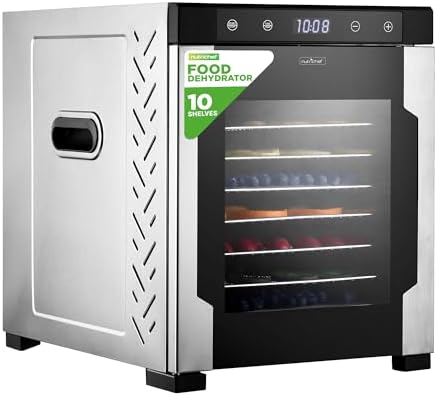
- ELECTRIC PRESERVER: Finally, a multi-tiered countertop electric food dehydrator that can preserve varieties of food. It …
- 10-TIERED DRYER TRAYS: Comes w/ 10 food grade stainless steel trays or dryer rack. Can also be used to dry food without …
- TEMPERATURE CONTROL: Uses electronic probe and temperature control for food preservation (95-170°F). Dehydrates and pres…
Specs at a glance: 10 stainless · Drying area: Not published · 900W · 95–167°F · Timer: Fixed 10-hour cycle · 360° circulation airflow · Fine-mesh screens: Not listed
Ten thin stainless trays, 900 watts, and a ceiling of 167°F in a box that doesn’t take up the whole counter. Thin trays suit mushrooms better than they suit most foods, because sliced caps are flat and you want a lot of surface, not a lot of height. My notes are in the NutriChef NCFD10S review.
900 watts is generous for the size, which matters for a food that is mostly water. All ten trays are steel, so the spore cleanup is a rinse rather than a scrub.
Pros
- Ten stainless trays — a lot of flat surface for sliced mushrooms
- 900W in a compact footprint
- Steel throughout, easy spore cleanup
- 167°F ceiling, useful if you also dry meat
Cons
- Fixed 10-hour cycle rather than a programmable timer
- Total drying area isn’t published
- Thin stacked trays leave no room for whole caps
Who It’s For
Small kitchens that still want real capacity for slices. Skip it if you want a programmable timer. Otherwise, the NutriChef NCFD10S is a lot of stainless for the money.
6. 💰 Best Budget: Nesco FD-75A Snackmaster Pro

- 600‑WATT DRYING SYSTEM WITH CONVERGA‑FLOW AIRFLOW evenly circulates heat without tray rotation, helping home users relia…
- EXPANDABLE FROM 5 UP TO 12 TRAYS lets you dry small portions for quick snacks or scale up for larger batches, making it …
- ADJUSTABLE TEMPERATURE CONTROL (95°F–160°F) allows precise heat selection for different ingredients, ensuring meat dries…
Specs at a glance: 5 round (13.5 in), expands to 12 · Drying area: ~4.5 ft² as shipped · 600W · 95–160°F · Timer: None · Top-mounted airflow · Fine-mesh screens: 2 mesh + 2 solid included
The Snackmaster Pro is the machine most people learn on, and for mushrooms it punches above its price for one reason: it ships with two Clean-A-Screens and two solid sheets. Fine mesh is the one accessory mushrooms genuinely need, and most budget machines make you buy it. Details in my Nesco Snackmaster Pro review, and the family is ranked in Best Nesco Food Dehydrator.
Five 13.5-inch trays give about 4.5 square feet, expandable to twelve as the autumn gets ambitious. The fan sits on top, which the Bay Area Mycological Society specifically prefers over the bottom-fan design, because nothing drips into the motor and the airflow is more even through the stack.
Pros
- Two mesh screens and two solid sheets in the box
- Expands from 5 to 12 trays as the season demands
- Top-mounted fan, the design mycologists prefer
- Cheapest machine here, cheap spare parts
Cons
- No timer — budget for a plug-in one
- Round trays with a centre hole waste usable area
- Plastic trays hold spore residue longer than steel
Who It’s For
First forages, small budgets, and anyone who wants the mesh without the invoice. Skip it if you need a timer or a single big run. Otherwise the Nesco FD-75A Snackmaster Pro is the most machine per dollar here.
7. ✅ Most Mesh Screens Included: L’Equip 528 Six-Tray

- 500-watt dehydrator for drying food, flowers, and herbs
- More Than Just Hot Air
- 6 stacking trays for a total of 12 square feet of drying space
Specs at a glance: 6 plastic, expands to 12 · Drying area: 7.2 ft² (14.4 expanded) · 500W · 95–158°F · Timer: None · Bottom-mounted airflow · Fine-mesh screens: 6 mesh + 2 solid included
The L’Equip 528 is the quiet answer to the mesh problem: six mesh screens and two solid sheets come in the box, one for every tray. Nothing else on this page covers every tray out of the carton. It’s also the budget pick the Bay Area Mycological Society names by model, alongside Excalibur and Nesco. Full write-up in my L’Equip 528 review.
Six trays give 7.2 square feet, more than the Cosori, and it expands to twelve for 14.4 square feet — which for 500 watts is a lot of area to serve, so expect longer runs on a full stack. The range is 95–158°F, plenty for culinary mushrooms.
Pros
- Six mesh screens and two solid sheets — every tray covered
- 7.2 sq ft, expandable to 14.4
- 95–158°F range, fine for every culinary mushroom
- Named by the Bay Area Mycological Society as a budget pick
Cons
- No timer
- Bottom-mounted fan means rotating trays once per batch
- 500W is modest for a fully expanded stack
Who It’s For
People who slice everything and don’t want to buy a single accessory. Skip it if you want stainless or a timer. If you don’t, the L’Equip 528 is the best-equipped box under $150.
Put Them in the Sun First: The Vitamin D Step
Here’s the thing almost no dehydrator guide mentions. Mushrooms contain ergosterol, and ultraviolet light converts it into vitamin D2 — the same reaction your skin runs. Half an hour in the sun before the trays go in turns an ordinary ingredient into a genuine source of a vitamin most people are short of.
The numbers are not small. NIH Office of Dietary Supplements lists half a cup of raw white mushrooms exposed to UV light at 9.2 mcg (366 IU) of vitamin D, against 0.1 mcg (4 IU) for ordinary portabella. And a 2020 review in Trends in Food Science & Technology reports that five grams of fresh shiitake under UV light for fifteen minutes produces an adult’s daily requirement, and that slicing first matters enormously: sliced mushrooms exposed to UV and then dried produced roughly ten times more vitamin D2 than whole ones, because the gills hold far more ergosterol than the stems.
How to actually do it
- Slice first, then expose. Quarter-inch slices, laid out in a single layer. This is the step that does most of the work.
- Gills up, facing the sun. That’s where the ergosterol is concentrated.
- 30 to 60 minutes of direct midday sun, then straight onto the trays. Be honest with yourself about this one: the lab studies use UV-B and UV-C lamps, which are far stronger and more consistent than a garden in October. Sunlight works, but it is slower, and it does nothing through a window — ordinary glass blocks UV-B.
- Dry as normal afterwards. The conversion happens during the sun exposure, not in the machine.
If the sun isn’t cooperating, dry them normally. You lose the vitamin D bonus, not the mushrooms.
Rehydrating: The Soaking Liquid Is the Point
Dried mushrooms taste more intensely of mushroom than fresh ones do, because drying concentrates the compounds that carry that flavour. Most of that ends up in the soaking water, which is why throwing it away is the single most common mistake people make with a jar of dried porcini.
- Hot water, not boiling, and 20 to 30 minutes. Boiling water cooks them before they’ve rehydrated and muddies the flavour.
- Strain the liquid through a coffee filter or a cloth. Grit sinks, and mushrooms carry a surprising amount of it. What comes through is a dark, savoury stock.
- Use it as the stock. Risotto, gravy, braises, a soup base. It’s worth more than the mushrooms in most dishes — pair it with dehydrated bone broth for a pantry that cooks itself.
- Or skip rehydrating entirely. Blitz the dried caps into mushroom powder and stir a spoonful straight into whatever you’re cooking. Most of the time that’s what I do.
What to Look For in a Dehydrator for Mushrooms
Mushrooms reward a short list of features and ignore the rest. Here’s what actually moves the needle.
Fine-mesh screens, ideally included
This is the mushroom-specific one. Slices lose two-thirds of their volume and curl as they go, and anything smaller than a coin drops through a standard tray. The Nesco and the L’Equip ship with several screens; the Magic Mill MFD-1010 and the Cosori give you one; the Excalibur puts a polyscreen insert on every tray; the NutriChef’s listing doesn’t mention any. Add $20–60 for extras where you need them.
Enough airflow for a load that is mostly water
A full tray of sliced mushrooms holds more water than a full tray of almost anything else. Wattage and fan size are what turn that into a six-hour job instead of an eighteen-hour one, and a slow, damp run is how a batch sours.
Trays you can get properly clean
The Bay Area Mycological Society puts it plainly: spores deposit themselves all over your trays. Stainless rinses; plastic mesh traps them in the weave. If you dry mushrooms often, this is the difference between a machine that stays neutral and one that smells like a cellar after two seasons.
Height between the trays, if you dry whole caps
Whole porcini, big portobello and shiitake caps need clearance. Only the horizontal machines with removable trays give you that — the Excalibur is the obvious one here. Thin-stacked machines are slices only, which is fine if that’s all you do.
Somewhere to put it that isn’t the kitchen
This is the warning nobody prints on the box. The Bay Area Mycological Society advises drying mushrooms away from living areas, because dehydrators blow a high volume of spores into the air and that’s an allergy risk. A garage, utility room or covered porch is ideal. It also means noise matters less than it would otherwise — which frees you to buy on airflow rather than decibels.
A temperature range of 95–160°F
Culinary mushrooms dry at 110–135°F. You don’t need a high ceiling, and you don’t need one-degree precision, but a real thermostat beats a three-position dial — drying too fast costs flavour in the delicate species.
How to Dehydrate Mushrooms: Quick Tips
- Brush, don’t wash. Mushrooms are already ninety percent water; soaking them adds hours to the run. A soft brush or a damp cloth takes off the grit. Full method in how to dehydrate mushrooms.
- Slice a quarter inch, evenly. Thin enough to dry fast, thick enough to have texture when rehydrated. Mixed thicknesses on one tray is why half a batch is leathery.
- Don’t crowd the trays. Slices curl as they dry and need air on both sides. Leave a slice’s width between pieces.
- Run 110–135°F. The low end for delicate species, the high end for button mushrooms and anything watery.
- Dry to cracker-dry, not leathery. A properly dried slice snaps. Anything that bends still holds water and will mould in the jar.
- Cool completely, then jar. Glass with a rubber seal, away from light. How long dehydrated food lasts covers the storage rules; mushrooms keep about a year that way.
- Grind the broken bits. Stems, crumbs and misshapen slices become mushroom powder, which is the most-used jar in my cupboard.
Recipe ideas once the machine arrives: 7 mushroom jerky recipes, 10 best vegetables for homemade soups and 8 dehydrated soup mix recipes.
Best Dehydrator for Mushrooms FAQs
What temperature should I dehydrate mushrooms at?
Culinary mushrooms dry well at 110 to 135°F (43 to 57°C). Use the low end for delicate species whose aroma you want to keep, and the high end for button mushrooms and anything especially wet. Mushrooms carry no pathogen risk that demands a high temperature, so precision matters less here than it does with meat — but drying too fast does cost flavour.
How long does it take to dehydrate mushrooms?
Quarter-inch slices usually take 6 to 10 hours. Whole caps take far longer, often two to three times as long as slices of the same mushroom, because the moisture has much further to travel. Thickness, how wet the mushrooms were and how full the machine is all shift the number, so judge by feel: a finished slice should snap, not bend.
Should I wash mushrooms before dehydrating them?
Brush them instead. Mushrooms are about ninety percent water already, and soaking adds more that the machine then has to remove, which can add hours to the run. A soft brush or a barely damp cloth takes off dirt. If a mushroom genuinely needs rinsing, do it quickly and pat it dry before slicing.
Do dried mushrooms really contain vitamin D?
They do if you expose them to ultraviolet light first. Ergosterol in the mushroom converts to vitamin D2 under UV. NIH lists half a cup of UV-exposed white mushrooms at 9.2 mcg (366 IU) against 0.1 mcg for untreated portabella. Slice them, lay them gills up in direct midday sun for 30 to 60 minutes, then dry as normal. Sunlight through a window does not work — glass blocks UV-B.
Do I need fine-mesh screens for mushrooms?
For sliced mushrooms, yes. Slices shrink to about a third of their size and curl as they dry, and small pieces fall straight through a standard tray. The Nesco Snackmaster Pro and the L’Equip 528 include several screens; the Magic Mill MFD-1010 and the Cosori include one; the Excalibur has a polyscreen insert on every tray; the NutriChef’s listing doesn’t mention any. Extra screens cost roughly $20 to $60.
Where should I put the dehydrator when drying mushrooms?
Somewhere other than the room you sit in. The Bay Area Mycological Society warns that dehydrators blow a high volume of spores into the air, which is an allergy risk. A garage, utility room, basement or covered porch is ideal. The upside is that machine noise stops mattering, so you can buy on airflow rather than decibels.
Final Verdict: Which Dehydrator for Mushrooms Should You Buy?
- If you forage or grow and want the biggest capacity, get the Magic Mill MFD-1010. Eighteen square feet of stainless and 1000W; add a few mesh sheets.
- If you dry whole caps, get the Excalibur 3926TB. Pull the trays, and nothing else here gives you that twelve-inch chamber — just budget for the mesh screens.
- If you dry a few trays a week, get the Cosori 6-Tray for one-degree control and a glass door, or the Magic Mill MFD-7070 for more stainless area in the same kind of footprint.
- If the budget is the first filter, get the Nesco FD-75A for the cheapest way in with mesh included, or the L’Equip 528 if you’d rather have a screen on every one of six trays.
Personal Tips You Can Steal
I sun the slices on the mesh screen itself, gills up, then carry the whole screen to the machine — no second handling, no losing half of them to the grass. I dry stems separately and grind them, because they never rehydrate as well as caps and they make better powder anyway. And I run the machine in the garage, which I started doing for the spores and kept doing because the house stops smelling like a forest floor for two days.
More Dehydrator Buying Guides
- Best Dehydrator for Vegetables — carrots, peppers and onions, where blanching changes everything.
- Best Dehydrator for Fruit — capacity and fruit-roll sheets decide that one.
- Best Dehydrator for Herbs — why a 95°F floor matters more than capacity for basil.
- Best Dehydrator for Jerky — the meat picks, where the 160°F rule changes everything.
P.S. Sun a tray of sliced shiitake this weekend, dry them, then make a risotto with the soaking water in January. That’s the whole argument for owning one of these 🙂