
Cosori sells 5 food dehydrators, and two of them are called the same thing. There is a ten-tray Cosori with 16.2 square feet of drying space and a ten-tray Cosori with 7.4 square feet — the same tray count, more than double the area, and listings that look almost identical at a glance.
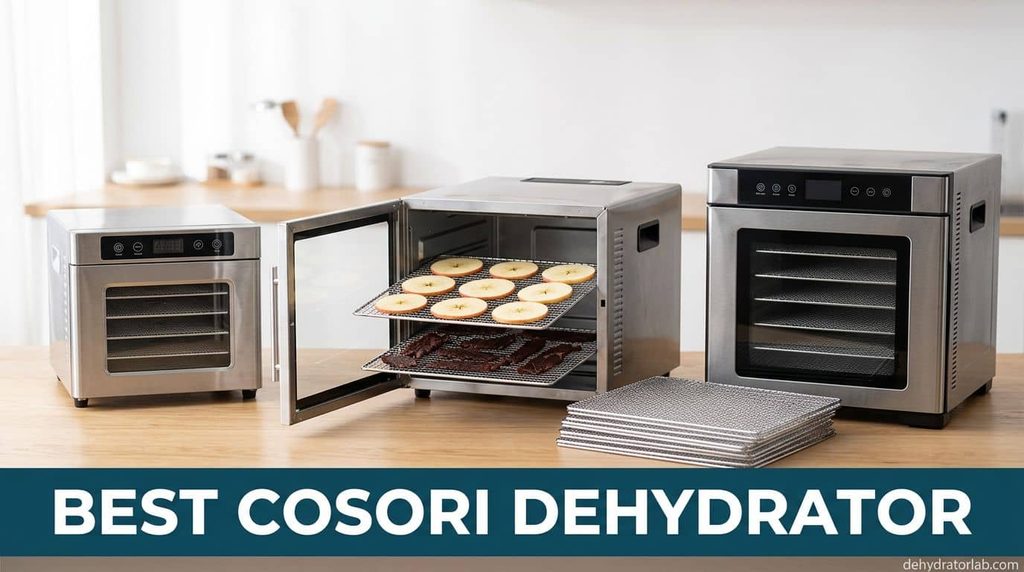
That is the one thing you actually need to know before buying, and nowhere does the brand set the two side by side. Cosori’s own buying guide walks through four machines one at a time, in prose, with no comparison grid — and the fifth, the smaller ten-tray, is not in that guide at all.
So here are the models ranked, with a column the brand does not publish — drying area per tray — because on this line that single number sorts the range properly and exposes the ten-tray trap in one row. If you are choosing the best Cosori dehydrator, that column is the whole argument.
As an Amazon Associate, I earn from qualifying purchases. If you make a purchase after clicking on a link I may earn a small commission at no extra cost to you if items are purchased.
Quick Picks: The Best Cosori Dehydrator, at a Glance
- 🥇 Best Overall: Premium 6-Tray (CP267-FD) – 6 stainless trays, 6.5 sq ft, and an independently measured 48 dB
- 💎 Biggest: Premium Pro 10-Tray – 16.2 sq ft and 1000W, the largest Cosori by a wide margin
- 🎯 Best for Jerky: Premium Mini 5-Tray – the only Cosori dehydrator that reaches 176°F, and it is the smallest one
- 💰 Best Budget: Pioneer 5-Tray – 350W and plastic trays, at about a third of the price
Cosori Dehydrator Comparison Table
| Model | Trays | Drying area | Area per tray | Watts | Temp range | Timer | Price |
|---|---|---|---|---|---|---|---|
| Cosori Premium 6-Tray (CP267-FD) | 6 stainless | 6.5 ft² | 1.08 ft² | 600W | 95–165°F (1° steps) | 48 h | $$ |
| Cosori Premium Pro 10-Tray (CFD-P101-SUS) | 10 stainless | 16.2 ft² | 1.62 ft² | 1000W | 95–165°F (1° steps) | 48 h | $$$ |
| Cosori Premium Mini 5-Tray (CFD-P501-SUS) | 5 stainless (9.8×9.1 in) | 3.1 ft² | 0.62 ft² | 480W | 95–176°F (1° steps) | 48 h | $$ |
| Cosori Pioneer 5-Tray (CFD-N051-W) | 5 BPA-free plastic | Not published | Not published | 350W | 95–165°F | 48 h | $ |
| Cosori 10-Tray (CFD-P103-KUS) — direct only | 10 stainless | 7.4 ft² | 0.74 ft² | Not published | Not published | Not published | $$ |
Read the fourth column rather than the second. Two machines on this list have ten trays, and one of them gives each tray more than twice the space of the other — 1.62 square feet against 0.74. A tray count on its own tells you almost nothing here.
How I Ranked Them
Inside one brand most of the usual criteria cancel out: four of the five machines have stainless trays, all of them run a rear fan with horizontal airflow, and every one of them has a 48-hour timer. So the ranking comes down to usable area, the temperature ceiling — 165°F or 176°F decides how comfortable you are with meat – and what the machine costs per square foot of drying space. Price breaks the ties, and how to use a food dehydrator is the primer if this would be your first machine.
1. 🥇 Best Overall: Cosori Premium 6-Tray (CP267-FD)

- 𝗠𝗔𝗫𝗜𝗠𝗜𝗭𝗘 𝗘𝐕𝗘𝗥𝗬 𝗕𝗔𝗧𝗖𝗛: 6 stainless steel trays offer 6.5 ft² of drying space, giving you plenty of room to dehydrate larg…
- 𝗠𝗢𝗥𝗘 𝗣𝗢𝗪𝗘𝗥𝗙𝗨𝗟 & 𝗘𝗙𝗙𝗜𝗖𝗜𝗘𝗡𝗧: Equipped with a 600 W motor, rear-mounted drying fan, and upgraded airflow technology for fas…
- 𝗦𝗨𝗣𝗘𝗥 𝗤𝗨𝗜𝗘𝗧 𝗢𝗣𝗘𝗥𝗔𝗧𝗜𝗢𝗡: Features an advanced brushless motor with noise levels below 48 dB, letting you dehydrate your fo…
Specs at a glance: 6 stainless · Drying area: 6.5 ft² (1.08 ft² per tray) · 600W · 95–165°F (1° steps) · Timer: 48 h, 30-min steps · Price: $$
This is the machine that made Cosori’s name in dehydrating, and it is still the one to default to. Six stainless trays give 6.5 square feet — 1.08 per tray, which is more room than most six-tray cabinets — behind a clear door with the fan at the back, so a full load finishes together and nothing needs rotating halfway. My long-form notes are in the Cosori 6-tray review.
What sets it apart from the rest of the line is control. Temperature moves in single-degree steps from 95 to 165°F rather than in presets, which is unusual at this price and genuinely useful if you dry herbs at 95°F one day and jerky at 160°F the next. The timer runs to 48 hours in half-hour increments.
It also has the only independent measurements in the line. BestDehydrator ran the 6-tray and the Mini through more than a hundred hours of drying and measured 48 dB on this one, with temperature holding within about 3°F across all six trays — 134.2°F average against a 135°F setting, and 161.5°F against 160°F. That is closer than most machines manage, and it is the reason this sits at the top rather than the bigger one.
The complaint in that same test is the one I would make: the included accessories are thin. One mesh screen and one fruit-roll sheet, for six trays. If you plan on fruit leather or anything small enough to fall through, order a full set with the machine. Here are extra mesh and solid sheets that fit, with the cut sizes for its 12 × 13 in trays.
Pros
- 6.5 sq ft across six stainless dishwasher-safe trays
- Single-degree temperature control, 95–165°F
- Measured at 48 dB and within ~3°F across trays by an independent test
- Rear fan and clear door — no tray rotation
Cons
- One mesh screen and one roll sheet for six trays
- 165°F ceiling, where the Mini reaches 176°F
- Mid-size — a big harvest will need two runs
Who It’s For
Almost everyone buying a Cosori. Skip it if you are drying a garden, or if the only thing you make is jerky and you want the higher ceiling. Otherwise the Premium 6-Tray is the safe answer. The one to default to.
2. 💎 Biggest: Cosori Premium Pro 10-Tray (CFD-P101-SUS)
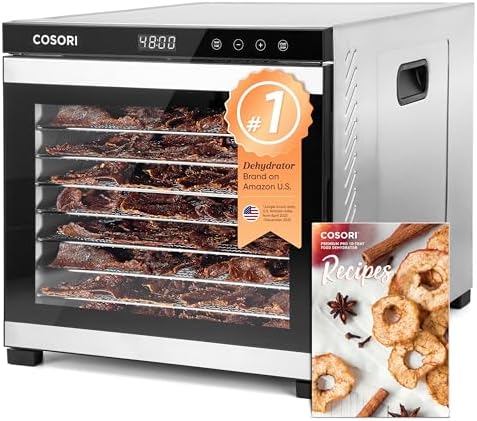
- 𝐒𝐏𝐀𝐂𝐈𝐎𝐔𝐒 𝐂𝐀𝐏𝐀𝐂𝐈𝐓𝐘: With 10 spacious trays, each measuring 𝟭𝟱.𝟲 ” 𝘅 𝟭𝟱 “, this dehydrator offers a generous 16.2 ft² dryi…
- 𝐅𝐀𝐌𝐈𝐋𝐘-𝐅𝐑𝐈𝐄𝐍𝐃𝐋𝐘 𝐒𝐍𝐀𝐂𝐊𝐒: Create an array of healthy homemade snacks like dried fruits, veggies, and jerky, preserving 𝟵𝟮%…
- 𝐅𝐎𝐎𝐃 𝐒𝐀𝐅𝐄𝐓𝐘: Following USDA jerky safety guidelines, we maintain a maximum temperature of 165 °F, and all our accessorie…
Specs at a glance: 10 stainless · Drying area: 16.2 ft² (1.62 ft² per tray) · 1000W · 95–165°F (1° steps) · Timer: 48 h, 30-min steps · Price: $$$
Sixteen point two square feet over ten stainless trays is the most drying space Cosori sells, and 1.62 square feet per tray is the largest individual tray in the line — half again the size of the 6-tray’s. A thousand watts drives it. This is a harvest machine, and it earns its place in the large-capacity guide alongside the biggest cabinets from other brands.
Cosori’s own listing for it gives 55 quarts of capacity and an external footprint of 16.9 by 21.3 by 16.4 inches, which is worth measuring against your counter before you order — it is closer to a small oven than a kitchen appliance. The controls are the same as the 6-tray: single-degree steps from 95 to 165°F, 48-hour timer in half-hour steps.
Ten trays also changes how you load. With 16.2 square feet you are drying a whole flat of apples or a full batch of mushrooms in one run, and the temptation is to overfill — a packed tray with no airflow gap dries unevenly no matter how good the fan is. 6 essential dehydrating tips covers the loading habits that matter more than the machine.
The box is as thin as the 6-tray’s: one fruit-roll sheet and one mesh screen for ten trays. On a machine at this price that is genuinely stingy. At the same money the obvious alternative is Excalibur’s nine-tray, and I cover how it stacks up against the Excalibur 3926TB on a page of its own.
Pros
- 16.2 sq ft — more than double the 6-tray
- 1.62 sq ft per tray, the largest trays Cosori makes
- 1000W, enough to drive a full wet load
- Same single-degree control and 48-hour timer as the 6-tray
Cons
- Roughly twice the price of the 6-tray
- 16.9 × 21.3 × 16.4 in — it needs permanent space
- One roll sheet and one mesh screen for ten trays
Who It’s For
Gardens, hunting seasons and anyone who has run out of trays twice. Skip it if a couple of trays a week is your normal — you would be paying for space you never fill. Otherwise the Premium Pro 10-Tray is the volume answer. The big one, and clearly labelled as such.
3. 🎯 Best for Jerky: Cosori Premium Mini 5-Tray (CFD-P501-SUS)
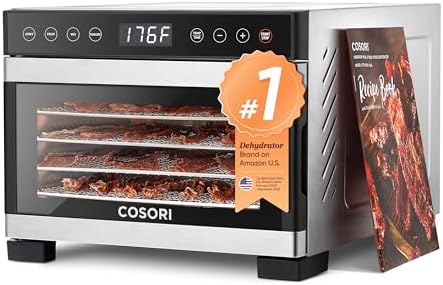
- 𝟭𝟳𝟲 °𝗙 𝗠𝗔𝗫 𝗧𝗘𝗠𝗣𝗘𝗥𝗔𝗧𝗨𝗥𝗘: Adjust the dehydrator between 95-176°F in 1°F increments. Higher temps ensure safer beef jerky. …
- 𝗙𝗨𝗟𝗟𝗬 𝗘𝗤𝗨𝗜𝗣𝗣𝗘𝗗: Includes 5 trays, recipe cookbook, mesh screen, and fruit roll sheet. Search for ‘Cosori Dehydrator Acce…
- 𝗖𝗨𝗦𝗧𝗢𝗠 𝗣𝗥𝗘𝗦𝗘𝗧𝗦: Enjoy 4 user-friendly presets (jerky, fruit, vegetables, yogurt) and adjust them to your preferred time …
Specs at a glance: 5 stainless (9.8×9.1 in) · Drying area: 3.1 ft² (0.62 ft² per tray) · 480W · 95–176°F (1° steps) · Timer: 48 h, 30-min steps · Price: $$
Here is the oddity of the range: the smallest machine has the highest temperature ceiling. Every other Cosori dehydrator stops at 165°F. The Mini goes to 176°F, which is the only one in the line with real headroom above the 160°F that jerky asks for. Five stainless trays at 9.8 by 9.1 inches give 3.1 square feet, so it is genuinely small — but for meat it is the most capable box Cosori sells.
It is also built to a different standard inside. Cosori advertises no plastic contact with the food at all, which on a brand whose cheapest machine uses plastic trays is a real distinction — and the reason it appears in the stainless steel guide. Four presets cover apple chips, beef jerky, yogurt and herbs, with single-degree control underneath if you want to override them.
The same hundred-hour test that measured the 6-tray put the Mini at 45 dB, the quietest of the pair. At 480 watts across 3.1 square feet it has more power per square foot than any machine here with a published drying area, which is why it dries fast for its size.
Be clear about the size, though. Three point one square feet is under half the 6-tray’s area and less than a fifth of the Pro’s — a couple of trays of fruit at a time, no more. If you dry in volume this is the wrong machine however good the ceiling is.
Pros
- 176°F ceiling — the only Cosori dehydrator with headroom for meat
- No plastic in contact with the food
- Measured at 45 dB, the quietest in the line
- Four presets plus single-degree manual control
Cons
- 3.1 sq ft — the smallest drying area here
- 0.62 sq ft per tray, so long items do not lie flat
- Costs more than the 6-tray per square foot by a wide margin
Who It’s For
Jerky makers with a small kitchen, and anyone who wants steel everywhere without the Pro’s footprint. Skip it if you dry fruit and vegetables in batches. Otherwise the Premium Mini is the specialist pick. Small box, highest ceiling.
4. 💰 Best Budget: Cosori Pioneer 5-Tray (CFD-N051-W)

- 𝗠𝗔𝗫 𝗧𝗘𝗠𝗣𝗘𝗥𝗔𝗧𝗨𝗥𝗘 𝟭𝟲𝟱 °𝗙: Compared to 158 °F, the Cosori Compact Food Dehydrator Machine ensures safer beef jerky with hig…
- 𝗘𝗫𝗣𝗔𝗡𝗗𝗔𝗕𝗟𝗘 𝗧𝗢 𝟳 𝗧𝗥𝗔𝗬𝗦: The Fruit and Herb Dehydrator comes with 5 large BPA-Free trays (Outer Diameter 12.2″, Inner Diam…
- 𝗦𝗢𝗟𝗜𝗗 𝗠𝗔𝗧𝗘𝗥𝗜𝗔𝗟: Our Meat Dehydrator is built with solid material, ensuring durability compared to fragile clear shells. …
Specs at a glance: 5 BPA-free plastic · Drying area: Not published · 350W · 95–165°F · Timer: 48 h · Price: $
At around a third of the 6-tray’s price this is the way into the brand, and it is honest about what it is. Five BPA-free plastic trays, 350 watts, the same 95 to 165°F range and the same 48-hour timer as the machines above it. My notes are in the Cosori 5-tray review. It’s also the Best Budget pick in my under-$100 guide.
Two things to know. The trays are plastic, not steel — the only Cosori on this page where that is true, and it matters if you dry garlic, onion or anything strongly flavoured, because plastic holds the smell in a way steel does not. And Cosori does not publish a drying area for it, so the table above says so rather than guessing.
The Amazon listing is also one of the ones that prints no model number: you buy “Cosori Food Dehydrator, 5 BPA-Free Trays, 165°F Temperature Control, 350W” and have to match it to the Pioneer yourself. The specification is what identifies it, which is the running theme of this page.
For a first machine, a few trays of fruit and some dried herbs, it is fine, and 350 watts is enough for that. For a full wet load it is slow, and you will be swapping trays around.
Pros
- The cheapest way into Cosori by a wide margin
- Same 95–165°F range and 48-hour timer as the bigger models
- Small enough to store in a cupboard between uses
- Digital control and auto shut-off at this price
Cons
- Plastic trays, where the rest of the line is stainless
- 350W — the least power here
- Drying area is not published anywhere
Who It’s For
First-timers finding out whether the habit sticks. Skip it if you already know you will use it weekly, or if you dry anything pungent. Otherwise the Pioneer 5-Tray answers the question cheaply. A way in, not a keeper.
The Two Cosori Ten-Trays, and How to Tell Them Apart
This is the section that should be on Cosori’s own site. The brand sells two ten-tray dehydrators, and the difference between them is not a detail:
- Premium Pro 10-Tray (CFD-P101-SUS) — 16.2 ft² of drying space by its Amazon listing, 1000W, around $300. That is 1.62 ft² per tray.
- Cosori 10-Tray (CFD-P103-KUS) — 7.4 ft² of drying space on Cosori’s own site, sold direct at around $200, wattage not published. That is 0.74 ft² per tray.
Same tray count. Same brand. Same stainless trays. And one of them gives you more than twice the drying surface of the other for roughly fifty per cent more money — which, per square foot, makes the expensive one the better deal by a distance. Nothing in either product name tells you that.
The practical test is wattage and price together. The Pro is the 1000W machine at about $300; if a ten-tray Cosori is listed cheaper than that and does not state 16.2 square feet, assume it is the smaller one and check before ordering. The number to look for on any listing is the square footage, not the tray count — the same lesson the Magic Mill line teaches, one brand over.
It is worth saying plainly that neither machine is bad. The smaller ten-tray is a perfectly good mid-size cabinet at its price. The problem is entirely that you cannot tell which one you are looking at from the name, and a buyer comparing “the Cosori 10-tray” against a commercial unit may be comparing the wrong machine.
What “Premium” Means on a Cosori Box
The word appears on three machines that have almost nothing in common, and the model codes come from two different families. Here is the whole range, decoded:
- CP267-FD — the Premium 6-Tray, 6.5 ft². The oldest code on the list and the only one starting CP. Walmart lists the same machine as CP267-FD-RXS in silver, so a suffix here is a finish, not a different dehydrator.
- CFD-P501-SUS — the Premium Mini 5-Tray, 3.1 ft². Smallest machine, highest temperature ceiling.
- CFD-P101-SUS — the Premium Pro 10-Tray, 16.2 ft². Largest machine in the line.
- CFD-P103-KUS — sold as plain “Cosori Food Dehydrator, 10 Stainless Steel Trays”, 7.4 ft². No “Premium” on it at all, despite sitting between two machines that carry the word.
- CFD-N051-W — the Pioneer 5-Tray, the budget machine with plastic trays. The only N code.
So “Premium” spans 3.1 to 16.2 square feet and tells you nothing about size, while the machine that is not called Premium sits in the middle of that range. The letters do carry some signal — P for the stainless Premium machines, N for the plastic-tray Pioneer — but the digits after them are product codes rather than specifications.
On Amazon, several of these sell under descriptive titles with no model code printed at all. That is not dishonest, but it does mean the only reliable way to identify a Cosori is the specification block: square footage, wattage, temperature ceiling, tray material. Every row in the table above is built from exactly those four.
Cosori Dehydrator FAQs
Which Cosori dehydrator is the best one?
The Premium 6-Tray (CP267-FD) for most people — 6.5 square feet across six stainless trays, single-degree temperature control from 95 to 165°F, and an independent test measured it at 48 dB with temperature holding within about 3°F across all six trays. Step up to the Premium Pro 10-Tray only if you are drying a harvest, and down to the Pioneer only to find out whether you will use one at all.
What is the difference between the two Cosori 10-tray dehydrators?
Drying area, and it is a large difference. The Premium Pro (CFD-P101-SUS) lists 16.2 square feet and 1000W at around $300; the plainly-named CFD-P103-KUS lists 7.4 square feet at around $200 on Cosori’s own site. Both have ten stainless trays, so the tray count tells you nothing — check the square footage on the listing before ordering.
Does any Cosori dehydrator reach 160°F for jerky?
All of them reach 165°F, and the Premium Mini reaches 176°F. The Mini is the only one with real headroom above the 160°F usually recommended for meat, which is an odd thing to find on the smallest machine in the range, but it is what the specifications say.
Are Cosori dehydrator trays stainless steel?
On four of the five, yes — the Premium 6-Tray, the Premium Mini, the Premium Pro 10-Tray and the direct-sold 10-tray all use stainless trays. The budget Pioneer 5-Tray uses BPA-free plastic trays instead, which is the main thing separating it from the rest of the line besides power.
Is the Cosori dehydrator loud?
Not by the measurements available. An independent test that ran both machines for more than a hundred hours recorded 48 dB for the 6-tray and 45 dB for the Mini, which is quiet enough to leave running overnight in an open-plan kitchen. Cosori’s own listing for the 6-tray claims under 48 dB, so the two agree.
Cosori or Magic Mill?
Cosori gives you single-degree temperature control and published drying areas; Magic Mill gives you bigger machines — 18 square feet at the top against Cosori’s 16.2 — and stepped temperatures in nine-degree jumps. If you want precision, Cosori. If you want the largest stainless cabinet you can get for the money, Magic Mill. Both lines share the same flaw: model numbers that do not describe the machine.
Final Verdict: Which Cosori Should You Buy?
- If you want one machine and a normal kitchen, get the Premium 6-Tray. Six stainless trays, single-degree control, and independent measurements behind it.
- If you are drying a harvest, get the Premium Pro 10-Tray for its 16.2 square feet — and measure your counter first, because its longest side is 21.3 inches.
- If jerky is most of what you make, get the Premium Mini for the 176°F ceiling and the all-steel food path, accepting that 3.1 square feet is genuinely small.
- If you are finding out whether you will use one at all, get the Pioneer 5-Tray and spend the difference on trays for whatever you buy next.
- If a ten-tray Cosori is listed under $250, stop and check the square footage — it is probably the 7.4 ft² machine rather than the 16.2 ft² one.
Personal Tips You Can Steal
I screenshot the listing’s specification block before I order, because titles get edited and the square footage is the only thing that identifies a Cosori later.
I buy the mesh screens and roll sheets at the same time as the machine – the stainless models here each ship exactly one of each, whatever the tray count, and stopping food sticking to the trays starts with having the right sheet under it.
And on the single-degree models, I set 135°F and leave it, rather than chasing the presets; consistency beats precision when the real variable is how thick you sliced.
More Dehydrator Buying Guides
- Best Large Capacity Dehydrator — how the Premium Pro compares with the biggest cabinets from other brands.
- Best Magic Mill Dehydrator — the other big stainless line, and the same model-number problem.
- Best Stainless Steel Dehydrator — what is actually steel across the brands, and what is not.
- Best Dehydrator for Jerky — the meat picks, and why the ceiling matters more than the wattage.
- Best Dehydrator for Beginners — if this would be your first machine of any kind.
P.S. Whichever one you order, read the square footage on the listing rather than the tray count. On this brand, ten trays can mean either 16.2 square feet or 7.4, and only one of those numbers is on the box 🙂