
Tray count is the number on the box, and it is close to meaningless. A twenty-tray dehydrator can hold less food than a nine-tray one, because trays are not the same size and round trays have a hole in the middle.
If you are buying for a harvest or a hunting season, the number you want is square feet – and then one more that nobody prints at all.
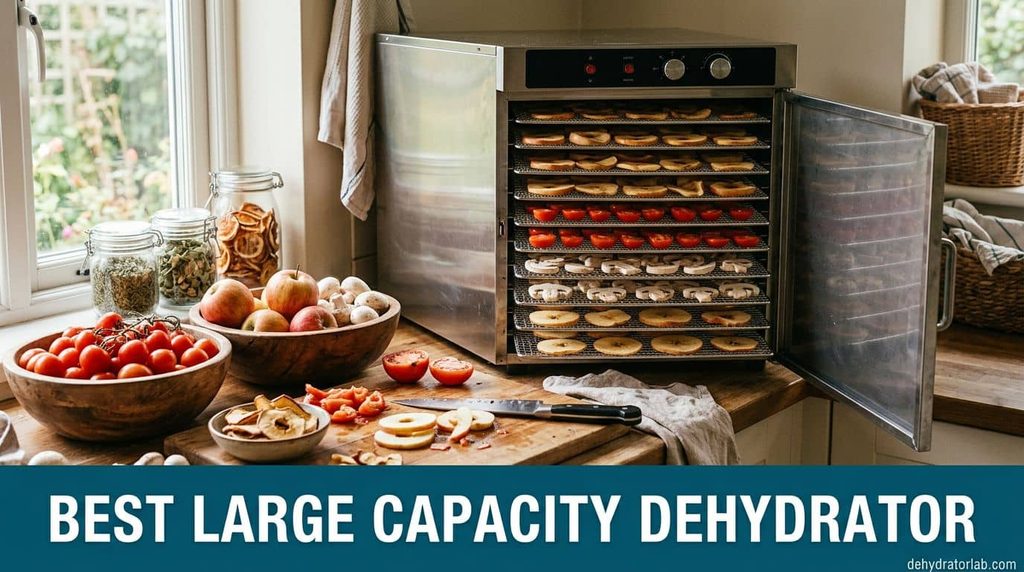
So this page compares the seven biggest machines worth owning on drying area per tray and on watts per square foot. The first tells you whether “ten trays” means anything. The second tells you whether the machine can actually drive a full load of wet food, which is what goes wrong when people scale up.
The best large-capacity food dehydrator has the most usable area and enough power behind it. Below are seven, ranked on exactly that — including a nine-tray machine that holds what fourteen trays of the biggest expandable one hold. Let’s do the arithmetic.
As an Amazon Associate, I earn from qualifying purchases. If you make a purchase after clicking on a link I may earn a small commission at no extra cost to you if items are purchased.
Quick Picks: The Best Large Capacity Dehydrator, at a Glance
- 🥇 Best Overall: Magic Mill MFD-1010 – 18 sq ft, the most usable area here
- 🎯 Best Value: Septree 10-Tray – the biggest trays on this page, at 1.70 sq ft each
- 🏔 Best Built: Excalibur 3926TB – nine big square trays that hold what fourteen round ones do
- 📦 Most Expandable: Nesco FD-1040 Gardenmaster – grows to 20 trays and roughly 22 sq ft
- ⚡ Most Power per Sq Ft: STX International Dehydra – 1200W across 16 sq ft, the highest ratio here
- 🌡️ Best Digital Control: COSORI 10-Tray – 16.2 sq ft and a 48-hour timer
- 💰 Best Budget: L’Equip 528 – 14.4 sq ft when expanded, for the least money
Best Large Capacity Food Dehydrator: Comparison Table
| Model | Trays | Total area | Area per tray | Watts (per sq ft) | Temp range | Timer | Airflow | Price |
|---|---|---|---|---|---|---|---|---|
| Magic Mill MFD-1010 11-Tray | 11 stainless (15.5×15.3 in) | 18 ft² | 1.64 ft² | 1000W (56 W/ft²) | 95–167°F (9° steps) | 24 h digital | Rear, horizontal | $$$ |
| Septree 10-Tray | 10 stainless (15.7×15.7 in) | ~17 ft² | 1.70 ft² | 1000W (59 W/ft²) | 68–194°F (5° steps) | 24 h, 30-min steps | Rear, horizontal | $$$ |
| Excalibur 3926TB 9-Tray | 9 square (15×15 in) | 15 ft² | 1.67 ft² | 600W (40 W/ft²) | 105–165°F | 26 h | Rear, horizontal | $$$ |
| Nesco FD-1040 Gardenmaster | 4 round, expands to 20 (15.5 in) | ~22 ft² at 20 trays | 1.10 ft² | 1000W (45 W/ft²) | 90–160°F | 48 h digital | Top-mounted, Converga-Flow | $$ |
| STX International Dehydra | 10 stainless (304) | 16 ft² | 1.60 ft² | 1200W (75 W/ft²) | Up to 165°F | 15 h, auto shut-off | Rear, 7-in fan | $$$ |
| COSORI 10-Tray | 10 stainless | 16.2 ft² | 1.62 ft² | 1000W (62 W/ft²) | 95–165°F | 48 h digital | Rear, horizontal | $$$ |
| L’Equip 528 Six-Tray | 6, expands to 12 | 14.4 ft² at 12 trays | 1.20 ft² | 500W (35 W/ft²) | 95–158°F | None | Bottom-mounted, vertical | $$ |
Read the fourth column and the marketing falls apart. The Nesco’s twenty trays and the Septree’s thirteen cover the same food. The Excalibur’s nine trays hold what fourteen Nesco trays hold, and come within a square foot of the Cosori’s ten. Every round-tray machine here loses roughly a third of each tray to the hole and the smaller diameter, and no listing mentions it.
How I Picked These
Three numbers, in this order. None of them is the one on the front of the box.
- Total rated drying area. The only figure that compares one machine to another. Everything on this page is at least 14 square feet, which is roughly triple a normal household dehydrator.
- Area per tray. Rated area divided by tray count. It tells you whether a high tray number is real capacity or just thinner shelves, and how often you will be loading and washing.
- Watts per square foot. A full load of wet produce is mostly water, and the first hours are where an underpowered machine falls behind. Under about 40, it feels slow when full — and over-drying is the mistake at the other extreme.
After that, rear horizontal airflow, because rotating ten loaded trays at midnight is nobody’s idea of a harvest. Every pick here has it except two, and both say so.
1. 🥇 Best Overall for Big Batches: Magic Mill MFD-1010 11-Tray

- NOW WITH 11 TRAYS – Formally with 10 Trays – This Magic Mill Dehydrator Has Been Upgraded to 11 Trays to Add 30 inches o…
- Healthy enjoy the homemade easiest healthiest snacks, preserve foods, without additives, made with BPA free Machine.
- Digital Temperature Control with 95-167 Degree Fahrenheit (with 9 num. increments) Capability with 24 Hour Timer, Horizo…
Specs at a glance: 11 stainless (15.5×15.3 in) · Total area: 18 ft² · Per tray: 1.64 ft² · 1000W (56 W/ft²) · 95–167°F (9° steps) · Timer: 24 h digital · Rear airflow
Eighteen square feet is the most usable area on this page, and it comes from eleven genuinely big trays — 15.5 by 15.3 inches, square, no centre hole. A thousand watts behind it gives 56 watts per square foot, comfortably in the range where a full load of wet produce still finishes overnight. Full write-up in my Magic Mill MFD-1010 review.
For a harvest it changes the arithmetic. Eighteen square feet takes a bushel of apples or a whole bed of tomatoes and peppers in one run instead of three, and rear airflow means you load it and come back — no rotating eleven loaded trays halfway through.
Two caveats. The temperature moves in 9-degree steps, so the useful settings are 113, 122, and 131°F. And Magic Mill’s listing puts one non-stick tray and one fine-mesh tray in the box, so order more sheets if you dry anything small or liquid.
Pros
- 18 sq ft — the most usable drying area here
- Eleven square stainless trays at 1.64 sq ft each
- 56 W/sq ft, enough to drive a full wet load
- Rear horizontal airflow, so nothing needs rotating
Cons
- 9°F temperature steps rather than single degrees
- Only one non-stick and one mesh tray included
- Large and heavy — it needs permanent shelf space
Who It’s For
Gardens, hunting seasons and anyone who has run out of trays twice. Skip it if you need an exact temperature. Otherwise the Magic Mill MFD-1010 is the most food per run on this page. The volume answer.
2. 🎯 Best Value: Septree 10-Tray

- 【Large Capacity & Abundant Accessories】Our food dehydrator machine for food and jerky with 10 healthy and durable food g…
- 【Stainless Steel & Double Row Vents】Our jerky dehydrator is made of food-grade stainless steel and glass front door. Our…
- 【Precise Settings & Smart Shutoff】The fruit dehydrator Equipped with adjustable thermostat allows you to adjust the temp…
Specs at a glance: 10 stainless (15.7×15.7 in) · Total area: ~17 ft² · Per tray: 1.70 ft² · 1000W (59 W/ft²) · 68–194°F (5° steps) · Timer: 24 h, 30-min steps · Rear airflow
One square foot less than the Magic Mill on ten trays rather than eleven — which means the biggest individual trays here, 1.70 square feet each. Fewer, larger trays is the better trade when you load by the bowlful, because every tray is a thing you fill, pull, empty and wash.
It is also the most flexible here by temperature: 68 to 194°F in five-degree steps, from raw food at the bottom to a fast jerky finish at the top, and nothing else goes that low or that high. Tempered glass door, rear airflow, under 50 dB, a 24-hour timer, two silicone sheets and a drip tray. Stablemates in the commercial dehydrator roundup.
The trade is that it is unapologetically a commercial box — heavy, deep and not going back in a cupboard between harvests.
Pros
- 1.70 sq ft per tray — the biggest trays on this page
- ~17 sq ft total at 59 W/sq ft
- 68–194°F in 5° steps, the widest range here
- Tempered glass door, silicone sheets and a drip tray included
Cons
- A commercial-size box that needs permanent space
- Listed drying area varies between sellers
- 24-hour timer rather than 48
Who It’s For
Anyone who would rather fill ten big trays than thirteen small ones. Skip it if your counter cannot take a machine this deep. Otherwise the Septree 10-Tray is the best area-per-dollar here. Fewer trays, more food.
3. 🏔 Best Built: Excalibur 3926TB 9-Tray

- Large Capacity: Equipped with 9 Excalibur dehydrator trays, this large food dehydrator boasts 15 square feet of drying s…
- Versatile Uses: Features a 26-hour dehydrator timer and an adjustable thermostat with a range of 105 to 165 degrees F – …
- Low & Slow for Immune Boost: Cooking foods at no higher than 115-118 degrees in a dehydrator preserves nutrients; it’s t…
Specs at a glance: 9 square (15×15 in) · Total area: 15 ft² · Per tray: 1.67 ft² · 600W (40 W/ft²) · 105–165°F · Timer: 26 h · Rear airflow
Here is the point of this page in one machine. The 3926TB has nine trays — fewer than every other pick — and 15 square feet, which is what fourteen of the Nesco’s round trays hold and within a square foot of the ten-tray Cosori. Nine square 15-inch trays at 1.67 square feet each go a very long way. Full write-up in my Excalibur 3926TB review, and the range is compared in Best Excalibur Dehydrator.
It is also the most even machine here, which matters more at this size than any other. A batch is only as safe as its wettest piece, and on nine loaded trays good airflow is the difference between the top tray finishing with the bottom one or not. Trays slide out like drawers.
The honest weakness is the other derived column: 600 watts across 15 square feet is 40 per square foot, second-lowest here. Fully loaded with something wet it is slower than the thousand-watt machines. It gets there evenly — it just takes longer.
Pros
- Nine trays and 15 sq ft — 1.67 sq ft each, second only to the Septree
- The most even drying on this page, which matters most when full
- Trays slide out individually like drawers
- 26-hour timer and a proven, repairable design
Cons
- 40 W/sq ft — slower than the 1000W machines on a wet load
- Solid sheets sold separately and you need several
- 105°F floor is high if you also dry herbs
Who It’s For
People who care more about the batch being even than about it being fast. Skip it if you routinely load fifteen pounds of wet tomato. Otherwise the Excalibur 3926TB is the one that proves tray count is a marketing number. Nine that beat ten.
4. 📦 Most Expandable: Nesco FD-1040 Gardenmaster

- 1000-WATT DRYING POWER WITH CONVERGA-FLOW AIRFLOW SYSTEM: Delivers fast, even dehydration without tray rotation, helping…
- EXPANDABLE FROM 4 UP TO 20 BPA-FREE TRAYS: Allows users to start small or scale up drying capacity as needed, making it …
- DIGITAL TIMER AND ADJUSTABLE TEMPERATURE RANGE: Timer programmable up to 48 hours and adjustable temperature range from …
Specs at a glance: 4 round, expands to 20 (15.5 in) · Total area: ~22 ft² at 20 trays · Per tray: 1.10 ft² · 1000W (45 W/ft²) · 90–160°F · Timer: 48 h digital · Top-mounted airflow
The only machine here that lets you buy capacity gradually. It ships as four trays and takes up to twenty, reaching roughly 22 square feet — the largest total here — with a thousand watts to drive them. Details in my Nesco FD-1040 Gardenmaster review.
But this is where the fourth column earns its place. Those twenty trays are 15.5-inch rounds with a hole in the middle, so each is about 1.10 square feet against the Septree’s 1.70 — twenty Nesco trays hold roughly what thirteen Septree trays do. Not a criticism of the machine, a correction to the box: twenty trays is a lot more loading and washing for the same food.
What it does better than anything here is scale down: a small batch runs on four trays without heating an empty chamber, which no fixed 17-square-foot box can do. The line is ranked in Best Nesco Food Dehydrator.
Pros
- Expands from 4 to 20 trays — roughly 22 sq ft, the largest total here
- Scales down to a small batch without heating an empty chamber
- 1000W and a 48-hour digital timer
- Top-mounted fan keeps drips away from the motor
Cons
- 1.10 sq ft per tray — twenty trays hold what thirteen big ones do
- Twenty trays is twenty things to load, empty and wash
- Extra trays are an ongoing cost as you expand
Who It’s For
Anyone whose batch size varies wildly, and anyone spreading the cost. Skip it if you want the capacity in one box. Otherwise the Nesco FD-1040 Gardenmaster goes furthest — just count square feet, not trays. Buy it a few trays at a time.
5. ⚡ Most Power per Square Foot: STX International Dehydra

- The STX Dehydra Model 1200W-XLS is an Extra Large Stainless Steel Commercial Grade Food & Jerky Dehydrator with Ten 100%…
- This Dehydrator also Features 1200 Watts of Dehydrating/Heating Power with 7 Preset Heat Temperatures that Range from 97…
- The Control Panel on the Top of this Unit is 100% Digital and has a 15 Hour Shut Off Timer. The Time Setting, which show…
Specs at a glance: 10 stainless (304) · Total area: 16 ft² · Per tray: 1.60 ft² · 1200W (75 W/ft²) · Up to 165°F · Timer: 15 h, auto shut-off · Rear airflow
Twelve hundred watts across 16 square feet is 75 watts per square foot — the highest ratio on this page by a clear margin, and the reason this machine is here. Ten 304-stainless racks, a seven-inch rear fan and heater, a stainless drip tray and two silicone mats in the box. It sits with the other heavy machines in the commercial roundup.
Power per square foot matters in exactly one situation, and it is the situation this page is about: a machine loaded to capacity with something that is mostly water. Ten trays of sliced tomato or mushrooms put a load on the element that a 600-watt machine meets by taking another six hours. This one does not.
The catch is the timer. Fifteen hours is the shortest here, and a full load of wet produce can want more, which means getting up to restart it. Fine for jerky and vegetables; an irritation on a deep load of fruit.
Pros
- 75 W/sq ft — the most power per square foot here
- Ten 304-stainless racks and 16 sq ft
- Horizontal rear airflow from a 7-inch fan
- Stainless drip tray and two silicone mats included
Cons
- 15-hour timer is the shortest on this page
- No mesh screens included
- Heavy and frankly industrial-looking
Who It’s For
Hunters, big jerky runs and anyone who loads wet and wants it done. Skip it if your batches routinely pass fifteen hours. Otherwise the STX International Dehydra is the workhorse. Power where it counts.
6. 🌡️ Best Digital Control: COSORI 10-Tray
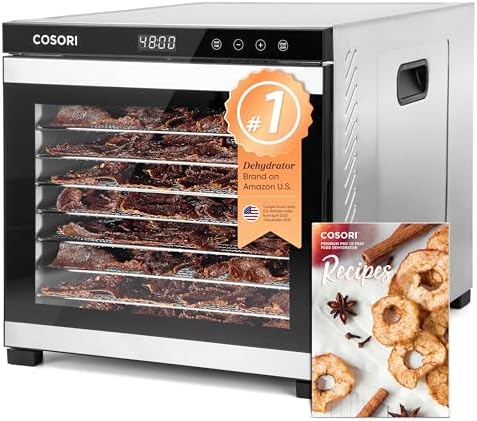
- 𝐒𝐏𝐀𝐂𝐈𝐎𝐔𝐒 𝐂𝐀𝐏𝐀𝐂𝐈𝐓𝐘: With 10 spacious trays, each measuring 𝟭𝟱.𝟲 ” 𝘅 𝟭𝟱 “, this dehydrator offers a generous 16.2 ft² dryi…
- 𝐅𝐀𝐌𝐈𝐋𝐘-𝐅𝐑𝐈𝐄𝐍𝐃𝐋𝐘 𝐒𝐍𝐀𝐂𝐊𝐒: Create an array of healthy homemade snacks like dried fruits, veggies, and jerky, preserving 𝟵𝟮%…
- 𝐅𝐎𝐎𝐃 𝐒𝐀𝐅𝐄𝐓𝐘: Following USDA jerky safety guidelines, we maintain a maximum temperature of 165 °F, and all our accessorie…
Specs at a glance: 10 stainless · Total area: 16.2 ft² · Per tray: 1.62 ft² · 1000W (62 W/ft²) · 95–165°F · Timer: 48 h digital · Rear airflow
Sixteen point two square feet across ten stainless trays, a thousand watts, and the longest timer here at 48 hours. If you know how Cosori builds things from the six-tray model, this is that at big-batch scale. It sits with the other large boxes in the commercial roundup.
Sixty-two watts per square foot is comfortably mid-pack, and the 48-hour timer is the real advantage over the Septree and the Magic Mill: a deep load of apple or pear can want more than twenty-four hours, and this is the only big machine here that sits through it unattended.
What you give up is the smaller Cosori’s single-degree control, and there are no sheets or screens in the box at all — a recipe book, and that is it.
Pros
- 16.2 sq ft across ten stainless trays
- 48-hour timer — the longest here, and it matters on deep loads
- 62 W/sq ft and rear horizontal airflow
- Steel body and glass door, like the smaller Cosori
Cons
- No sheets or screens included at all
- Loses the single-degree control of the 6-tray model
- 1.62 sq ft per tray — middling for its size
Who It’s For
Anyone running long, deep loads who does not want to restart a timer. Skip it if you want the accessories included. Otherwise the COSORI 10-Tray is the safe, well-made choice. The one that runs longest.
7. 💰 Best Budget: L’Equip 528 Six-Tray

- 500-watt dehydrator for drying food, flowers, and herbs
- More Than Just Hot Air
- 6 stacking trays for a total of 12 square feet of drying space
Specs at a glance: 6, expands to 12 · Total area: 14.4 ft² at 12 trays · Per tray: 1.20 ft² · 500W (35 W/ft²) · 95–158°F · Timer: None · Bottom-mounted airflow
Fourteen point four square feet at twelve trays is the cheapest way onto this page, and the L’Equip gets there the same way the Nesco does — by expanding. Six trays out of the box, twelve at full size. Write-up in my L’Equip 528 review.
It also solves the accessory problem better than anything here: six mesh screens and two solid sheets included, one screen per shipped tray. Nothing else on this page covers every tray out of the carton, and at this size that is real money.
The number to check before you buy is the last column. Five hundred watts across 14.4 square feet is 35 per square foot, the lowest here, and a bottom-mounted fan means a full twelve-tray stack wants rotating. Half-loaded it is excellent, and drying herbs is where it makes most sense.
Pros
- 14.4 sq ft expanded, for well under the price of the others
- Six mesh screens and two solid sheets included
- Expands from 6 to 12 trays as you need it
- Simple controls with nothing to misread
Cons
- 35 W/sq ft — the lowest here, and it shows when full
- Bottom-mounted fan means rotating a full stack
- No timer at all
Who It’s For
Anyone who wants real area without the commercial price. Skip it if you will run it full of wet produce every week. Otherwise the L’Equip 528 is the value entry. Big, cheap, patient.
Why Tray Count Is the Wrong Number
Every listing on this page leads with a tray count and none leads with a tray size. That is not an accident: tray count is the number that can be increased cheaply, square feet is the number that costs money.
Round trays lose the middle
Vertical-airflow machines stack round trays around a central column, so every tray has a hole in it. The hole is where the air goes, so it cannot be removed — but it is also where food is not. Add the smaller diameter and a 15.5-inch round tray is about 1.10 square feet against 1.70 for a 15.7-inch square one. Over ten trays that is six square feet, which is most of a second machine.
It is why the Nesco needs twenty trays to reach what the Septree does on thirteen, and why nine Excalibur trays hold what fourteen Nesco trays hold. None of it is visible from a product title.
The second number: watts per square foot
Nobody publishes this one at all, and it matters exactly when you scale up. A small dehydrator is rarely power-limited because there is not much water in it. Load eighteen square feet with sliced tomato and the machine has to evaporate several litres, at a speed set by how much heat there is per square foot.
Across this page the range runs from 35 to 75 — more than a factor of two. That does not make the low ones bad; the Excalibur at 40 is one of the best machines here. It means a fully loaded Excalibur takes noticeably longer than a fully loaded STX, and planning around that is the whole use of the number.
Treat both as rough comparisons rather than specifications — airflow design, tray spacing and how thinly you slice all matter too. But as a first filter they separate these seven far better than tray count does.
And the number you will actually hit
Rated area assumes the tray is covered, and you will never cover it — pieces need air on all sides, so a tray holds perhaps two-thirds of its rating in food. That applies to every machine here equally, so it does not change the ranking, but it changes your planning: eighteen rated square feet is more like twelve of actual apple.
What Changes When You Scale Up
A big machine solves one problem and creates three smaller ones, all manageable if you know first.
- Prep becomes the bottleneck, not drying. Filling 17 square feet with a kitchen knife takes longer than the machine takes to dry it. A mandoline is the upgrade that makes a big dehydrator worth owning, and uniform slices are what make a big batch finish evenly.
- One wet corner ruins a jar, not a tray. Dried food spoils from the wettest piece in the container, and a big batch means more chances. Condition fruit afterwards the way Utah State University Extension recommends — jars two-thirds full, stirred daily for a week. How long dehydrated food lasts has the storage timeline.
- Storage has to be ready before the machine is. Eighteen square feet of apple is a surprising number of jars, and warm food cannot go into them. Sort containers, labels and shelf space before you start slicing.
And plainly: a big dehydrator is only cheaper per pound if you fill it. Ten trays holding three trays of food costs the same electricity as a full run. If your batches are small most of the year, the expandable machines here beat the fixed ones — and the beginners guide covers the smaller end.
Best Large Capacity Dehydrator FAQs
How many trays do I actually need?
Ask for square feet instead. A household dehydrator is 4 to 7 square feet; everything on this page is 14 or more. Tray count tells you nothing on its own — the Nesco’s twenty round trays and the Septree’s thirteen square ones hold about the same food, because a round tray with a hole in the middle is roughly 1.10 square feet against 1.70 for a square one.
Is a 10-tray dehydrator always bigger than a 9-tray one?
Not necessarily. The nine-tray Excalibur 3926TB has 15 square feet against the ten-tray Cosori’s 16.2 — one extra tray buys barely a square foot, because the Excalibur’s trays are bigger. Against a round-tray machine the gap closes entirely: nine Excalibur trays hold what fourteen Nesco trays hold. Divide rated area by tray count before you compare anything.
Does wattage matter on a large dehydrator?
More than on a small one. A full load of wet produce is mostly water and the machine has to evaporate all of it. Across this page the figure runs from 35 to 75 watts per square foot. A low figure does not make a machine bad — the Excalibur is excellent at 40 — but it takes noticeably longer when full.
Do I need horizontal airflow at this size?
It helps a great deal. Rear-fan machines finish a full load at roughly the same time; bottom-fan machines dry the lowest trays first and need rotating. Rotating two trays is nothing — rotating twelve loaded trays at midnight is why people stop using a machine.
How much food does 17 square feet actually hold?
Less than the number suggests, because you cannot cover a tray completely — pieces need air on all sides. Reckon on about two-thirds of the rated area being food. Seventeen rated square feet is roughly a bushel of apples in one overnight run.
Is it cheaper to buy one big dehydrator or two small ones?
One big one, usually, as long as you fill it. Two machines mean two motors, two elements and two things to store. The exception is a batch size that varies a lot — there an expandable machine like the Nesco or the L’Equip gives you both without paying to heat an empty chamber.
Final Verdict: Which Big Dehydrator Should You Buy?
- If you want the most food per run, get the Magic Mill MFD-1010 — 18 sq ft across eleven square trays, with the power to drive them.
- If you would rather fill ten big trays than thirteen small ones, get the Septree 10-Tray. The biggest trays here and the widest temperature range.
- If an even batch matters more than a fast one, get the Excalibur 3926TB — nine big square trays and the best airflow here.
- If your batch size varies, get the Nesco FD-1040 Gardenmaster and add trays as you need them — just count square feet, not trays.
- If you load wet and want it finished, get the STX Dehydra for 75 W per square foot, or the COSORI 10-Tray if you need a timer that runs 48 hours.
- If the budget is the constraint, get the L’Equip 528. Fourteen square feet expanded, with every tray covered out of the box.
Personal Tips You Can Steal
I load the bottom tray first and the top last, because by the time I reach the top I am tired and slicing thicker — and the top of most machines dries fastest.
I weigh one tray before and after, once per food, because knowing apples lose about 80 per cent beats poking them. And I never start a big run after lunch: a fourteen-hour batch begun at two ends at four in the morning.
More Dehydrator Buying Guides
- Best Dehydrator for Vegetables — the harvest guide, and where blanching changes the timings.
- Best Dehydrator for Jerky — the meat picks, and the 160°F pre-heat rule.
- Best Stainless Steel Dehydrator — what is actually steel on the big machines, and what is not.
- Best Dehydrator for Beginners — the other end of the scale, if this is your first machine.
P.S. Before you order, divide the rated square feet by the tray count and write the number down. It takes ten seconds, and it will change which machine you buy 🙂