
Most dehydrators are a plastic box with a heater in it, running at 140 to 160°F for twelve hours at a stretch. If that sentence is why you are here, you are asking a reasonable question — and almost every page that answers it gets one thing wrong.
“Stainless steel dehydrator” is a marketing phrase, not a specification. On most machines sold under that label, the trays are steel, and the door, the chamber walls, or the included screens are not. And the parts that get left out are usually the ones sitting directly underneath your food.
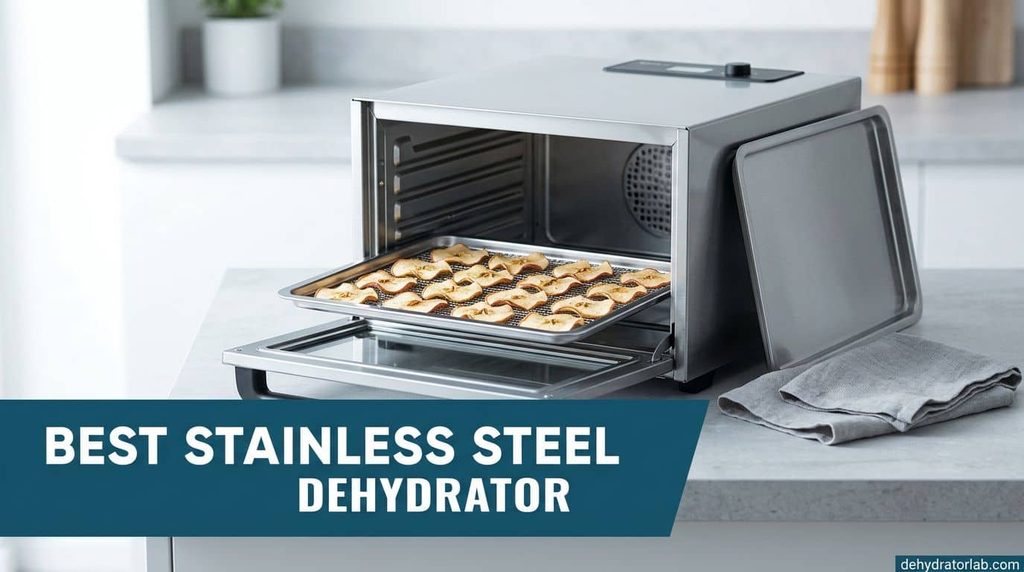
So this page ranks on a column no other roundup prints: what is actually stainless, and what still touches the food. Seven machines below, one of which has no plastic in the chamber at all, plus a straight look at what the regulators actually say about BPA — because they do not agree with each other. Let’s read the spec sheet properly.
As an Amazon Associate, I earn from qualifying purchases. If you make a purchase after clicking on a link I may earn a small commission at no extra cost to you if items are purchased.
Quick Picks: The Best Stainless Steel Dehydrator, at a Glance
- 🥇 Best Overall: TSM Products D-5 – 304 steel cabinet, door and trays, with no plastic anywhere in the chamber
- 🎯 Best Value: Septree 10-Tray – steel trays, steel body, glass door, and silicone sheets instead of plastic
- 💎 Biggest Capacity: Magic Mill MFD-1010 – 18 sq ft across eleven steel trays
- 🌡️ Best Temperature Control: COSORI CP267-FD – single-degree steps and a glass door
- 📦 Best Big Cosori: COSORI 10-Tray – 16.2 sq ft and a 48-hour timer
- 🥈 Best Mid-Size: Magic Mill MFD-7070 – seven steel trays at a sensible price
- 🏭 Most Power: STX International Dehydra – 1200W and industrial-grade steel
Best Stainless Steel Dehydrator: Comparison Table
| Model | Trays | Drying area | Watts | Temp range | What’s actually steel | Sheets & screens included | Timer | Price |
|---|---|---|---|---|---|---|---|---|
| TSM Products D-5 | 5 shelves (14.5×16 in) | 8 ft² | 800W | 90–165°F | Cabinet, door and trays (304) | Nothing included | 27 h, plus constant-on | $$$$ |
| Septree 10-Tray | 10 (15.7×15.7 in) | ~17 ft² | 1000W | 68–194°F (5° steps) | Trays (304), body (201), glass door | 2 silicone sheets + drip tray | 24 h, 30-min steps | $$$ |
| Magic Mill MFD-1010 | 11 (15.5×15.3 in) | 18 ft² | 1000W | 95–167°F (9° steps) | Trays and body | 1 plastic mesh + 1 non-stick tray | 24 h digital | $$$ |
| COSORI CP267-FD 6-Tray | 6 (12×13 in) | ~6.5 ft² | 600W | 95–165°F (1° steps) | Trays and body, glass door | 1 plastic mesh + 1 plastic sheet | 48 h digital | $$ |
| COSORI 10-Tray | 10 stainless | 16.2 ft² | 1000W | 95–165°F | Trays and body, glass door | Recipe book only | 48 h digital | $$$ |
| Magic Mill MFD-7070 | 7 (13×12 in) | ~7.6 ft² | 600W | 95–167°F (9° steps) | Trays and body | Fruit-roll trays | 24 h, 30-min steps | $$ |
| STX International Dehydra | 10 stainless | ~16 ft² | 1200W | Up to 165°F | Trays and housing | Drip tray | 15 h, auto shut-off | $$$ |
Read those two columns and the category splits in three. One machine is steel everywhere, door included. Four have steel trays and a steel body behind a glass door, which is fine — glass is inert. And every machine except the Septree and the TSM ships a plastic part that sits between the steel and the food.
How I Picked These
One rule, applied honestly: I looked at what the manufacturer’s own listing says, not at what the product title says.
- Steel where the heat and the food are. Trays first, then the chamber walls, then the door. A steel shell around a plastic interior is a finish, not a specification, and it matters most on the long batches raw food and herbs are built around.
- What comes in the box. Mesh screens and fruit-roll sheets sit directly under the food, and on most “stainless” machines they are plastic. That is the single most overlooked line on this page.
- Everything a dehydrator still has to do. Steel is worth nothing if the machine dries unevenly. Every pick here has rear horizontal airflow and a usable temperature range, and 6 essential dehydrating tips covers the habits that matter more than any material.
One machine you will see on other stainless roundups is missing here, deliberately. The Excalibur 3926TB is an excellent dehydrator and it is not stainless — its trays and housing are plastic, and its Paraflexx sheets are a PTFE-coated material rather than steel. It belongs on the raw food guide, not on this page. Any roundup that lists it as a stainless machine has copied a product title rather than read a spec sheet.
1. 🥇 Best Overall (No Plastic At All): TSM Products D-5

- Excellent for raw food diets or making natural snacks like jerky fruit leathers apple chips or any of your favorite drie…
- 5 stainless steel shelves 22ga – 304 food grade stainless steel housing, will not rust
- 800 watt heating element and fan creates horizontal air flow Maintains even dehydrating temperatures Adjustable thermost…
Specs at a glance: 5 shelves (14.5×16 in) · Drying area: 8 ft² · 800W · 90–165°F · Timer: 27 h, plus constant-on · Rear airflow · Steel: Cabinet, door and trays (304) · In the box: Nothing included
This is the only machine here with no plastic in the chamber at all. The cabinet, the removable door and all five shelves are 22-gauge 304 food-grade stainless — the same grade used in commercial kitchens. No window, no trim, no included screens, because there is nothing that is not steel. Full notes in my TSM Products D-5 review.
It is also a properly built dehydrator rather than a novelty. An 800-watt heater and fan sit in the rear panel for horizontal airflow, the thermostat covers 90°F to 165°F — low enough for raw work, high enough for jerky — and the timer runs to 27 hours with a constant-on position beyond it. The back panel and the door both detach for cleaning, which no plastic machine lets you do.
Two things before you commit. It costs roughly three times a good consumer machine, and nothing is included — no inserts, no sheets, no drip tray — so budget for stainless mesh and silicone liners in the same order.
Pros
- The only pick here with a steel door as well as steel trays and cabinet
- 22-gauge 304 food-grade steel throughout, made in the USA
- Door and rear panel both detach, so the cabinet cleans properly
- 90–165°F and a 27-hour timer with a constant-on setting
Cons
- By far the most expensive machine on this page
- Nothing in the box — no screens, sheets or drip tray
- Only 8 sq ft, and it is heavy at 31 lb
Who It’s For
Anyone whose reason for buying is the material rather than the capacity. Skip it if the budget is the constraint or you need more than 8 square feet. Otherwise the TSM Products D-5 is the only machine here that fully answers the question you came with. No compromise, at a price.
2. 🎯 Best Value (Silicone, Not Plastic): Septree 10-Tray

- 【Large Capacity & Abundant Accessories】Our food dehydrator machine for food and jerky with 10 healthy and durable food g…
- 【Stainless Steel & Double Row Vents】Our jerky dehydrator is made of food-grade stainless steel and glass front door. Our…
- 【Precise Settings & Smart Shutoff】The fruit dehydrator Equipped with adjustable thermostat allows you to adjust the temp…
Specs at a glance: 10 (15.7×15.7 in) · Drying area: ~17 ft² · 1000W · 68–194°F (5° steps) · Timer: 24 h, 30-min steps · Rear airflow · Steel: Trays (304), body (201), glass door · In the box: 2 silicone sheets + drip tray
If the TSM is the answer without a budget, this is the answer with one. The ten trays are 304 stainless, the body 201 stainless, the door tempered glass — so the only things in the chamber are steel, glass and food, at roughly a third of the TSM’s price.
The detail that moves it above the Magic Mills and Cosoris is smaller and more telling: the two non-stick sheets in the box are silicone, not plastic. Every other machine here that includes a sheet includes a plastic one. Silicone is the material you would buy separately anyway, and it is the part that sits under a fruit purée for eight hours.
The rest is capable: ten 15.7-inch trays for roughly 17 square feet, 1000 watts, and 68°F to 194°F in 5-degree steps with a 24-hour timer — the widest span here by a distance. Rear airflow, under 50 dB, drip tray included. Its stablemates are in the commercial dehydrator roundup.
Pros
- 304 steel trays, 201 steel body, tempered glass door — no plastic in the chamber
- The two included sheets are silicone rather than plastic
- ~17 sq ft, 1000W, and 68–194°F in 5° steps
- 24-hour timer, drip tray included, under 50 dB
Cons
- A big commercial-style box that needs permanent space
- The control panel has a PVC-finished fascia
- Listed drying area varies between sellers — count the trays, not the claim
Who It’s For
Almost everyone reading this page. Skip it if counter space is genuinely tight. Otherwise the Septree 10-Tray gets you steel, glass and silicone for the price of a mid-range plastic machine. The one I would actually buy.
3. 💎 Biggest Capacity: Magic Mill MFD-1010

- NOW WITH 11 TRAYS – Formally with 10 Trays – This Magic Mill Dehydrator Has Been Upgraded to 11 Trays to Add 30 inches o…
- Healthy enjoy the homemade easiest healthiest snacks, preserve foods, without additives, made with BPA free Machine.
- Digital Temperature Control with 95-167 Degree Fahrenheit (with 9 num. increments) Capability with 24 Hour Timer, Horizo…
Specs at a glance: 11 (15.5×15.3 in) · Drying area: 18 ft² · 1000W · 95–167°F (9° steps) · Timer: 24 h digital · Rear airflow · Steel: Trays and body · In the box: 1 plastic mesh + 1 non-stick tray
Eighteen square feet across eleven steel trays is the most drying area here, and 1000 watts moves air through all of it. For anyone drying a whole garden or a freezer’s worth of meat in one run, this is the volume pick. Full write-up in my Magic Mill MFD-1010 review.
It also illustrates this page’s point. Magic Mill’s own listing describes the box as eleven stainless racks plus “1 plastic fine mesh tray” and one non-stick tray — so the machine you bought for its steel arrives with a plastic screen, the exact part you put under anything small. A five-dollar stainless insert fixes it, but you should know to buy one.
Mechanically it is sound: rear airflow, 95°F to 167°F, a 24-hour digital timer, and a door that deliberately does not seal so moisture vents. Temperature moves in 9-degree steps, which matters if you dry to a precise number.
Pros
- 18 sq ft across eleven steel trays — the most capacity here
- 1000W with rear horizontal airflow, so no tray rotation
- 95–167°F and a 24-hour digital timer
- Steel trays shrug off garlic, onion and marinade
Cons
- The included fine-mesh tray is plastic, by the maker’s own listing
- 9°F temperature steps rather than single degrees
- Large, heavy, and it needs a permanent home
Who It’s For
Big harvests, big jerky batches, and anyone who runs out of trays. Skip it if you want everything in the box to be steel. Otherwise the Magic Mill MFD-1010 is the capacity pick — just order a stainless mesh insert with it. Most trays, one caveat.
4. 🌡️ Best Temperature Control: COSORI CP267-FD 6-Tray
- NOW WITH 11 TRAYS – Formally with 10 Trays – This Magic Mill Dehydrator Has Been Upgraded to 11 Trays to Add 30 inches o…
- Healthy enjoy the homemade easiest healthiest snacks, preserve foods, without additives, made with BPA free Machine.
- Digital Temperature Control with 95-167 Degree Fahrenheit (with 9 num. increments) Capability with 24 Hour Timer, Horizo…
Specs at a glance: 6 (12×13 in) · Drying area: ~6.5 ft² · 600W · 95–165°F (1° steps) · Timer: 48 h digital · Rear airflow · Steel: Trays and body, glass door · In the box: 1 plastic mesh + 1 plastic sheet
The smallest machine here and the most precise. Six steel trays in a steel body behind a glass door, with a thermostat moving in single degrees from 95°F to 165°F — nothing else here can be set to an exact number. My notes are in the Cosori 6-tray review.
Buy it if six and a half square feet is enough, because everything else is thoughtful: a 48-hour timer, rear airflow, under 48 dB, and a glass door you can watch a batch through. For kale chips or a tray of mushrooms it is more machine than the bigger boxes.
The same asterisk applies. Cosori’s replacement screens for this model are sold as BPA-free plastic mesh, and the fruit roll sheet is plastic too. The steel is real; the accessories are not.
Pros
- Single-degree control from 95°F to 165°F — the most precise here
- Steel trays, steel body and an inert glass door
- 48-hour timer, rear airflow, under 48 dB
- The smallest footprint on this page
Cons
- Both included accessories — mesh screen and fruit roll sheet — are plastic
- 6.5 sq ft is one batch at a time
- Deep footprint for its capacity
Who It’s For
Small kitchens, and anyone who dries to a specific temperature. Skip it if you need volume. Otherwise the Cosori CP267-FD is the most pleasant machine here to use — swap the screen for a steel one. Precision in a small box.
5. 📦 Best Big Cosori: COSORI 10-Tray
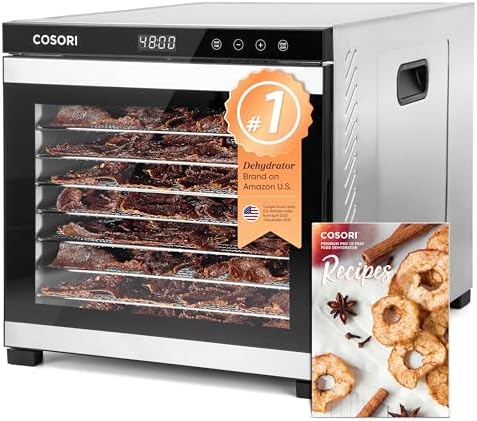
- 𝐒𝐏𝐀𝐂𝐈𝐎𝐔𝐒 𝐂𝐀𝐏𝐀𝐂𝐈𝐓𝐘: With 10 spacious trays, each measuring 𝟭𝟱.𝟲 ” 𝘅 𝟭𝟱 “, this dehydrator offers a generous 16.2 ft² dryi…
- 𝐅𝐀𝐌𝐈𝐋𝐘-𝐅𝐑𝐈𝐄𝐍𝐃𝐋𝐘 𝐒𝐍𝐀𝐂𝐊𝐒: Create an array of healthy homemade snacks like dried fruits, veggies, and jerky, preserving 𝟵𝟮%…
- 𝐅𝐎𝐎𝐃 𝐒𝐀𝐅𝐄𝐓𝐘: Following USDA jerky safety guidelines, we maintain a maximum temperature of 165 °F, and all our accessorie…
Specs at a glance: 10 stainless · Drying area: 16.2 ft² · 1000W · 95–165°F · Timer: 48 h digital · Rear airflow · Steel: Trays and body, glass door · In the box: Recipe book only
The 6-tray scaled up: ten stainless trays for 16.2 square feet, 1000 watts, a 48-hour timer, the same steel-and-glass build. If you like how Cosori builds things but the small one is too small, this is the answer, and it sits with the other big boxes in the commercial roundup.
It lands in the same bracket as the Septree, and that comparison is the useful one: the Cosori has the better-known brand and the longer timer, the Septree the wider temperature range and silicone sheets rather than none at all. This box ships with a recipe book.
Pros
- 16.2 sq ft across ten steel trays
- Steel body and glass door, like the smaller Cosori
- 1000W and a 48-hour timer — the longest here
- Rear horizontal airflow across all ten trays
Cons
- No sheets or screens included at all
- Big, and priced accordingly
- Loses the single-degree control of the 6-tray
Who It’s For
People who want Cosori’s build at ten-tray scale. Skip it if you want the accessories included. Otherwise the COSORI 10-Tray is a solid, boring, well-made choice. Scaled up, nothing surprising.
6. 🥈 Best Mid-Size: Magic Mill MFD-7070

- REAR MOUNTED FAN FOR SUPERIOR HEAT DISTRIBUTION – Dries food evenly, This electric dehydration machine is equipped with …
- DIGITAL THERMOSTAT AND TIMER- AUTOMATIC SHUT OFF WHEN TIMER DONE — An adjustable temperature and timer ensure you to ha…
- SPACIOUS ADJUSTABLE 7 XL STAINLESS STEEL TRAYS – INCLUDED FRUIT ROLL TRAYS! Use the trays for regular food and the mesh …
Specs at a glance: 7 (13×12 in) · Drying area: ~7.6 ft² · 600W · 95–167°F (9° steps) · Timer: 24 h, 30-min steps · Rear airflow · Steel: Trays and body · In the box: Fruit-roll trays
Seven steel trays and about 7.6 square feet puts this between the two Cosoris, and it is the cheapest steel-tray machine here with a rear fan and a clear door. I covered it in my Magic Mill MFD-7070 review.
The case for it is practical rather than ideological: plastic trays hold the smell of onion and marinade and stain from beetroot; steel rinses clean. If that is the problem you are actually solving, this solves it for the least money.
It shares the MFD-1010’s 95°F floor and its 9-degree steps, and the fruit-roll trays that come with it are the usual non-stick plastic.
Pros
- Seven dishwasher-safe steel trays, ~7.6 sq ft
- Rear horizontal airflow and a clear door
- 95–167°F and a 24-hour timer
- The cheapest steel-tray machine here
Cons
- 9°F steps and 30-minute timer increments
- The included fruit-roll trays are plastic
- Mid-size, so it will not do a whole harvest
Who It’s For
Anyone whose real complaint is that plastic trays smell. Skip it if you want steel everywhere. Otherwise the Magic Mill MFD-7070 is the sensible middle of this page. Solves the everyday problem.
7. 🏭 Most Power: STX International Dehydra

- The STX Dehydra Model 1200W-XLS is an Extra Large Stainless Steel Commercial Grade Food & Jerky Dehydrator with Ten 100%…
- This Dehydrator also Features 1200 Watts of Dehydrating/Heating Power with 7 Preset Heat Temperatures that Range from 97…
- The Control Panel on the Top of this Unit is 100% Digital and has a 15 Hour Shut Off Timer. The Time Setting, which show…
Specs at a glance: 10 stainless · Drying area: ~16 ft² · 1200W · Up to 165°F · Timer: 15 h, auto shut-off · Rear airflow · Steel: Trays and housing · In the box: Drip tray
Twelve hundred watts is the most power here, across ten trays and about 16 square feet of industrial-grade stainless. Horizontal airflow, a 15-hour timer with auto shut-off, a drip tray, and a build aimed at people drying in quantity. It is among the heavier machines in the commercial roundup.
Extra wattage changes how fast a wet load dries, not how well — but on ten loaded trays the first three hours are where it shows. The 165°F ceiling covers meat, and the guide to jerky cuts has the safety step that goes with it.
Pros
- 1200W — the most power here, and it shows on wet loads
- Ten steel trays, ~16 sq ft, industrial-grade housing
- Horizontal airflow and a drip tray included
- Auto shut-off timer
Cons
- 15-hour timer is the shortest here — long raw batches need a restart
- No mesh screens or solid sheets included
- Heavy and unapologetically industrial-looking
Who It’s For
Hunters, homesteaders, and anyone loading ten wet trays at once. Skip it if your batches run past fifteen hours. Otherwise, the STX International Dehydra is the workhorse here. Power over polish.
What “BPA-Free” Does and Doesn’t Tell You
Most people searching for a steel dehydrator are not reacting to the look of plastic. They are worried about what hot plastic does over twelve hours. That deserves a straight answer rather than reassurance or alarm — and the straight answer is that the two agencies best placed to judge have reached opposite conclusions.
The regulators disagree, and that is the honest headline
The US Food and Drug Administration states plainly that “BPA is safe at the current levels occurring in foods.” BPA remains authorised there for food-contact use. The two places it was removed — baby bottles and infant formula linings — were removed because manufacturers had already stopped using it, not because the agency found it unsafe.
The European Food Safety Authority reached the opposite conclusion in 2023. It cut its tolerable daily intake for BPA from 4 micrograms per kilogram of body weight per day to 0.2 nanograms — a reduction of roughly twenty thousand times, as the UK Committee on Toxicity summarises — and concluded that dietary exposure to BPA is a health concern.
Two competent regulators, broadly the same literature, opposite answers. Anyone who tells you this is settled, in either direction, is telling you more than they know. What follows reasonably is that the uncertainty is real, and that reducing hot-plastic contact is rational if it is cheap — which here it is.
“BPA-free” answers a narrower question than you think
A BPA-free label tells you one compound is absent. It says nothing about what replaced it — commonly BPS or BPF, structurally similar and far less studied — and nothing about the other additives in the part. If the uncertainty bothers you, “buy a different plastic” is a weaker move than “have less hot plastic”.
The part that undoes the upgrade
This is the practical point, and the reason this page has a column no other roundup prints. On most machines sold as stainless, the mesh screens and fruit-roll sheets are plastic – and those are the parts that sit directly under the food for the full twelve hours. The steel tray beneath them never touches anything. It is most obvious on fruit leather, where a purée sits on the sheet the entire time.
Magic Mill’s own listing for the MFD-1010 describes the box as eleven stainless racks plus one plastic fine mesh tray. Cosori sells the CP267-FD replacement screens as BPA-free plastic mesh. Both are honest listings, and both undo most of the reason someone bought a steel machine. Of the seven here, only the TSM ships nothing plastic — because it ships nothing at all — and only the Septree includes silicone sheets instead.
The fix costs very little: stainless mesh inserts exist for every tray size here, and silicone sheets replace plastic liners for a few dollars. Buy them with the machine — this guide explains the sticking problem they were there to solve.
What Steel Actually Buys You Day to Day
Set the chemistry aside, because there are three ordinary reasons steel is nicer — and they are the ones owners mention first.
- It does not keep the smell. Plastic trays hold onion, garlic, and marinade for weeks, and a batch of sun-dried tomatoes after a batch of jerky tastes of both. Steel rinses clean.
- It does not stain. Beetroot, berries, turmeric and tomato mark plastic permanently. A steel tray looks the same after two years as it did new.
- It goes in the dishwasher and does not warp. Plastic trays soften and bow over repeated hot cycles, which is how a stack stops sitting flat — and a flat stack is what keeps airflow even.
None of that is about toxicity, and all of it is about whether you still like the machine in year three — for most people, the stronger of the two arguments.
Best Stainless Steel Dehydrator FAQs
Are any dehydrators completely stainless steel?
A few, and they are expensive. The TSM Products D-5 has a 304 stainless cabinet, door and shelves with nothing plastic in the chamber — but it costs roughly three times a good consumer machine and ships with no accessories. Most machines sold as stainless have steel trays and a steel body with a glass door, which is also fine, since glass is inert.
Is a plastic dehydrator actually unsafe?
Nobody can tell you that with confidence, because the regulators disagree. The US Food and Drug Administration says BPA is safe at the levels found in food. The European Food Safety Authority cut its tolerable daily intake roughly twenty thousand times in 2023 and called dietary exposure a health concern. Reducing hot-plastic contact is a reasonable response; panic is not.
Does BPA-free plastic solve the problem?
Only the narrow version. A BPA-free label means one compound is absent and says nothing about its replacement, often BPS or BPF — structurally similar, much less studied. Less hot plastic is a more direct answer than a different hot plastic.
Why does my stainless dehydrator come with plastic screens?
Because moulding steel costs more than moulding plastic. Magic Mill’s own listing for the MFD-1010 includes a plastic fine mesh tray, and Cosori sells the CP267-FD screens as BPA-free plastic. Those parts sit directly under the food, so if the steel was the point, swap them for stainless mesh inserts and silicone sheets.
Is the Excalibur 3926TB a stainless steel dehydrator?
No. Its trays and housing are plastic, and its Paraflexx sheets are a PTFE-coated material. It is a very good dehydrator and it belongs on a different list. Several stainless roundups include it anyway, which is a good sign they have copied a product title rather than read a specification.
Do steel trays dry food differently from plastic ones?
Not meaningfully. Airflow, temperature and how thickly you load the trays decide the result, not the tray material. What steel changes is ownership: it does not stain, does not hold the smell of garlic, goes in the dishwasher and does not warp out of flat over years of hot cycles.
Final Verdict: Which Stainless Dehydrator Should You Buy?
- If you want no plastic in the chamber at all, get the TSM Products D-5 — steel cabinet, steel door, steel shelves — and budget for stainless inserts, because nothing is included.
- If you want the same idea at a third of the price, get the Septree 10-Tray. Steel trays, steel body, glass door and silicone sheets rather than plastic ones.
- If capacity is the deciding factor, get the Magic Mill MFD-1010 for 18 sq ft, or the COSORI 10-Tray for 16.2 and a longer timer.
- If the kitchen is small or the temperature has to be exact, get the Cosori CP267-FD — single-degree control and the smallest footprint here.
- If you just want trays that stop smelling of garlic, get the Magic Mill MFD-7070. It is the cheapest steel-tray machine on this page.
- If you load ten wet trays at a time, get the STX International Dehydra for its 1200 watts — as long as your batches finish inside fifteen hours.
Personal Tips You Can Steal
I order stainless mesh inserts with the machine rather than after it, because the first batch you want them for is always the first batch you run. I keep one silicone sheet permanently on the bottom tray as a drip catcher. And I never wash steel trays alongside aluminium, because the two react and the trays come out dull.
More Dehydrator Buying Guides
- Best Dehydrator for Raw Food — where the temperature floor matters more than the material.
- Best Dehydrator for Jerky — the meat picks, and the 160°F pre-heat rule that goes with them.
- Best Dehydrator for Vegetables — big harvests, where capacity decides it.
- Best Dehydrator for Backpacking Meals — meals dried for a pack, where solid sheets decide it.
- Best Dehydrator for Beginners — if this is your first machine of any kind.
P.S. Whatever you buy, look up what the mesh screen is made of before you order. It takes thirty seconds and it is the one line the product title never mentions 🙂