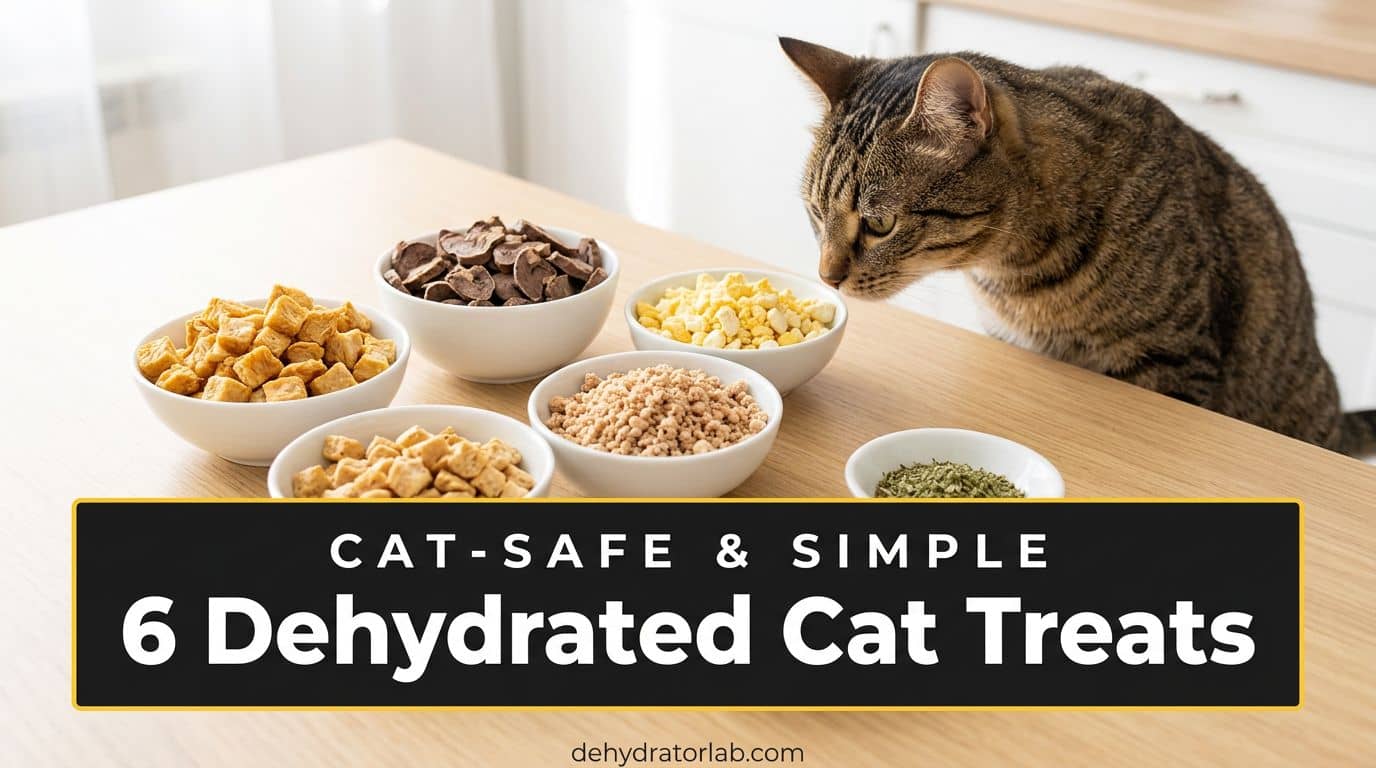
Ever stared at the heel of a parmesan wedge and wondered if the dehydrator could turn it into something crunchy?
It can, and the results are worth the effort. Dairy is also the one food group where I slow down and talk safety first, because it spoils faster than fruit or jerky. Here are six dehydrated cheese and dairy recipes, and the rules I follow to make them well.

As an Amazon Associate, I earn from qualifying purchases. If you make a purchase after clicking on a link I may earn a small commission at no extra cost to you if items are purchased.
In this article:
TL;DR: Key Takeaways
- 🧀 Hard, aged cheeses like parmesan and extra-sharp cheddar dry best. Soft, wet cheeses turn oily and stay damp.
- 🌡️ Dehydrator air at 135°F (57°C) sits inside the USDA’s 40–140°F (4–60°C) Danger Zone, so thin, small pieces and short batches matter.
- 🧊 Dried cheese and yogurt are fridge or freezer foods in my kitchen, not pantry foods.
- 🍿 Crisps, bites, and a seasoning dust cover the cheese side of the list.
- 🥄 Yogurt works as a dip powder and as a coating on dried fruit.
- 📝 None of these are tested by the USDA or a university, and I say so below.
I’ve already written two dairy guides, so I built this list around new uses. My guide to dehydrating cheese covers cheese powder and homemade mac and cheese in detail, and my Greek yogurt chips cover the plain chip. If you want a faster cheese crisp, my air fryer cheese chips are one option.
One thing you should know up front: I could not find a tested home procedure for drying cheese or yogurt from the USDA, the National Center for Home Food Preservation, or a university extension. The times and storage lengths below are my own home estimates. I explain the safety rules I use in the Dairy Safety Rules section after the recipes, so please read that part before you start.
A food processor makes the powders much easier, and I use one like the model below. For storage, I like small glass jars for the fridge and freezer pouches for the freezer.

- LARGE CAPACITY: 10-cup food processing container provides ample space for preparing family-sized portions of chopped veg…
- VERSATILE ATTACHMENTS: Includes stainless steel shredding blade and disc stand, and food pusher for various food prepara…
- POWERFUL PERFORMANCE: 500-watt motor with 2 speed settings and pulse function allows precise control for different proce…
1. Parmesan Crisps
Aged parmesan is the easiest cheese I know to dry. It’s hard and low in water, so it doesn’t sweat the way cheddar does. Start with a wedge straight from the fridge, and shave about 4 ounces into thin curls with a vegetable peeler.
Spread the curls in a single layer on a solid tray liner, with no overlap. Dry at 135°F (57°C) for about 3 to 5 hours. Blot the surface with a paper towel at the 2-hour mark, because a little oil will bead up. They’re done when a cooled curl snaps cleanly.
These shine on soup, salads, and roasted vegetables, and they make a tidy snack by themselves. I keep them in a jar in the fridge and eat them within about 2 weeks. Thin curls, crisp snap.
- Chill the cheese before you shave it.
- Keep the curls paper-thin and the same size.
- Cool completely, then jar and refrigerate.

2. Cheddar-Chive Crunch Bites
Extra-sharp cheddar gives the crunchiest result, because aged cheddar holds less moisture than a mild block. Slice a cold block about 1/8 inch (3 mm) thick and cut the slices into 1-inch squares. Toss them with 1 teaspoon of dried chives per 4 ounces. My dehydrated herb blends are an easy way to stock the chives.
Dry at 135°F (57°C) for about 4 to 8 hours, and blot twice with a paper towel to lift the oil. The squares go from soft to leathery to brittle, so check one at the 4-hour mark. A finished bite snaps, and it shouldn’t bend.
Mild cheddar stays chewy and greasy, so I save it for the air fryer instead. If the oil keeps beading up, that cheese is too wet for this recipe. Sharp, salty, and crunchy.

3. Smoky Gouda Popcorn Dust
This is a cheese powder with a new job. Use an aged gouda, which is firmer than young gouda, and shave about 4 ounces thin. Dry the shavings at 135°F (57°C) for about 3 to 5 hours, blotting once, until they snap. For the full cheese-powder method, my guide to dehydrating cheese walks through every step.
Grind the crisp shavings in a food processor with 1/2 teaspoon of smoked paprika and 1/4 teaspoon of garlic powder per 1/2 cup. Pulse in short bursts and sift out any chunks. Powder has a lot of surface area, so it picks up moisture fast.
Sprinkle it over hot, buttered popcorn. If you like building seasonings, my dehydrated seasoning recipes have more ideas. I keep this dust in a small jar in the fridge and use it within about 2 weeks. Smoky and cheesy.

4. Yogurt Ranch Dip Powder
Plain Greek yogurt makes a surprisingly good ranch base once it’s dried. Pipe thick, full-fat Greek yogurt into 3/4 inch (2 cm) dots and dry at 135°F (57°C) for about 6 to 8 hours, until the dots snap. My Greek yogurt chips guide covers that part in detail.
Grind the dots to a powder with 1 teaspoon of dried dill, 1 teaspoon of dried chives, 1/2 teaspoon of onion powder, 1/4 teaspoon of garlic powder, 1/2 teaspoon of salt, and a pinch of black pepper. To make dip, stir 2 tablespoons of the powder into 1/2 cup of fresh Greek yogurt or sour cream and let it rest for 10 minutes.
I use the fresh yogurt dip within a couple of days and keep the dry powder in the fridge for about 2 weeks. If the powder clumps, it’s picked up moisture, so toss it. Tangy, herby, and quick.

5. Yogurt-Dipped Strawberry Chips
This is the sweet one. Start with crisp strawberry chips made the way I describe in how to dehydrate strawberries. Whisk 1/2 cup of thick Greek yogurt with 1 tablespoon of honey, and dip each chip about halfway.
Set the dipped chips on a silicone sheet and dry at 135°F (57°C) for about 3 to 5 hours, until the coating turns matte and firm. The fruit pulls a little moisture from the yogurt, so a full re-dry matters.
These are a snack for the fridge and the freezer, not a trail mix. They work well on my dessert toppings list too, and the same trick works on dried banana chips. Tart, sweet, and crisp.

6. Trail Mac and Cheese Sauce Mix
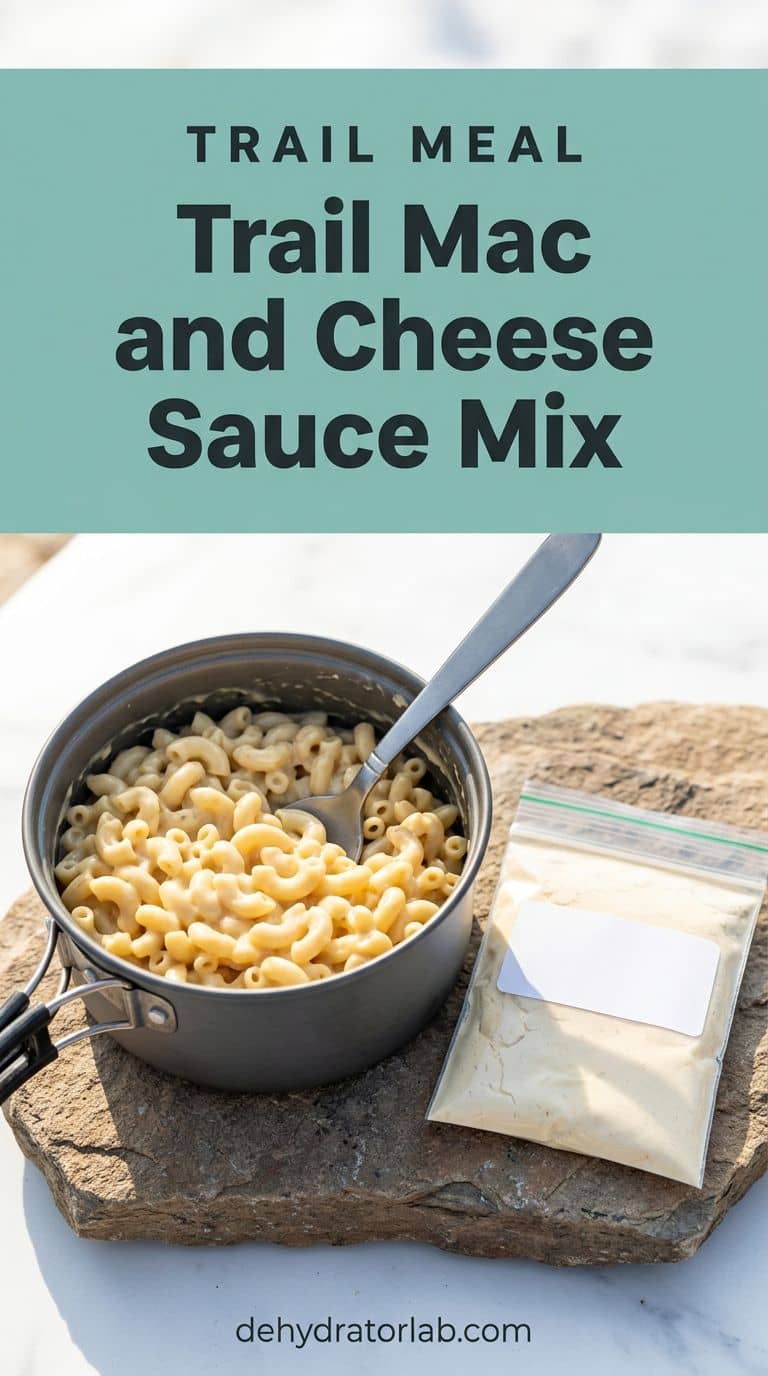
This mix is for a short trip, and it leans on store-bought dry milk powder, which is made commercially. Whisk together 1/2 cup of nonfat dry milk, 1/4 cup of the gouda or parmesan dust from recipe 3, 2 tablespoons of cornstarch, 1 teaspoon of mustard powder, 1/2 teaspoon of garlic powder, and 1/2 teaspoon of salt.
For one serving, cook about 3/4 cup of elbow macaroni, drain, and keep a splash of hot pasta water. Stir 1/3 cup of mix with that water into a smooth paste, then fold it into the pasta. It thickens as it sits.
Because the cheese dust isn’t a shelf-stable product, I only pack this for a trip of one or two nights and keep it cool. For a longer trip, swap in a store-bought powdered cheese instead. My one-pot trail meals and hiking soup recipes have more ideas for the pot. Cheesy and campsite-ready.
Quick Reference: Dry, Time, and Keep
| Recipe | Dry at | Time | Keeps |
|---|---|---|---|
| Parmesan crisps | 135°F (57°C) | 3–5 h | Fridge, about 2 weeks |
| Cheddar-chive crunch bites | 135°F (57°C) | 4–8 h | Fridge, about 2 weeks |
| Smoky gouda popcorn dust | 135°F (57°C) | 3–5 h, then grind | Fridge, about 2 weeks |
| Yogurt ranch dip powder | 135°F (57°C) | 6–8 h, then grind | Fridge, about 2 weeks |
| Yogurt-dipped strawberry chips | 135°F (57°C) | 3–5 h after dipping | Fridge or freezer, 1–2 weeks |
| Trail mac sauce mix | Mix only (cheese dust from recipe 3) | None extra | Cool, 1–2 nights |
These are my own home estimates, not tested values. They shift with slice thickness, the cheese you pick, humidity, and how full the trays are. When in doubt, dry longer and store colder.
The Dairy Safety Rules I Follow
The USDA Food Safety and Inspection Service defines the Danger Zone as 40–140°F (4–60°C) and says bacteria can double in as little as 20 minutes in that range. Dehydrator air at 135°F (57°C) is inside that band, and dairy is a perishable food. Drying removes water, which slows bacterial growth, but I haven’t found a tested home procedure that proves a given batch is safe.
So I follow a short list of rules. I use only pasteurized dairy. I start cold from the fridge, cut thin and even, and keep batches small so the food dries fast. I choose hard, aged cheeses and thick, full-fat yogurt, and I skip cream cheese, ricotta, fresh mozzarella, and milk. I never sample a batch that smells sour, looks slimy, or shows mold, and I toss it.
If you’re pregnant, immunocompromised, or feeding small children, I’d skip these recipes and buy commercially made dried dairy instead. This is a hobby guide from a home dehydrator user, and it’s no substitute for advice from your doctor or your local extension office.
Storing Dried Dairy
Cheese keeps best in the refrigerator, according to an Extension expert answer, and some cheeses freeze successfully. Michigan State University Extension lists hard cheese at 3 to 4 weeks after opening and soft cheese at 1 to 2 weeks when refrigerated. Those numbers are for regular cheese, so my 2-week estimate for dried versions is intentionally conservative.
Cool every batch completely before it goes in a jar, because warm food sweats and the moisture works against you. For longer storage, pack small portions in freezer pouches and press out the air. My notes on how long dehydrated food lasts cover the non-dairy side.
Personal Tips You Can Steal
I always chill the cheese for 30 minutes before I slice or shave it, because cold cheese cuts thinner. I label every jar with the date and the word “fridge,” so no one mistakes it for pantry food. I make half batches, since a small tray dries faster and I’d rather make it again than store it.
I press a clean paper towel on the first crisps of every batch to see how oily the cheese is. I snap one piece from the center of each tray before I call the batch done. I keep a small jar of the popcorn dust by the stove and use it up fast.
Final Thoughts
Dehydrated cheese and dairy are worth trying when you treat them with care. Start with the parmesan crisps, since they’re the simplest, then move on to the dip powder and the popcorn dust.
Related reading: 7 dehydrated egg recipes for camping, 10 trail mix recipes, 8 dehydrated soup mix recipes, and best dehydrators for backpacking meals.
P.S. If a batch ever looks or smells off, don’t taste it. Toss it and start fresh. 🙂