
You spent a weekend drying a garden’s worth of tomatoes, carrots, and apples. Now they’re in zip-top bags in the pantry, and a month later the apple chips have gone soft. The drying wasn’t the problem. Air and moisture got back in.
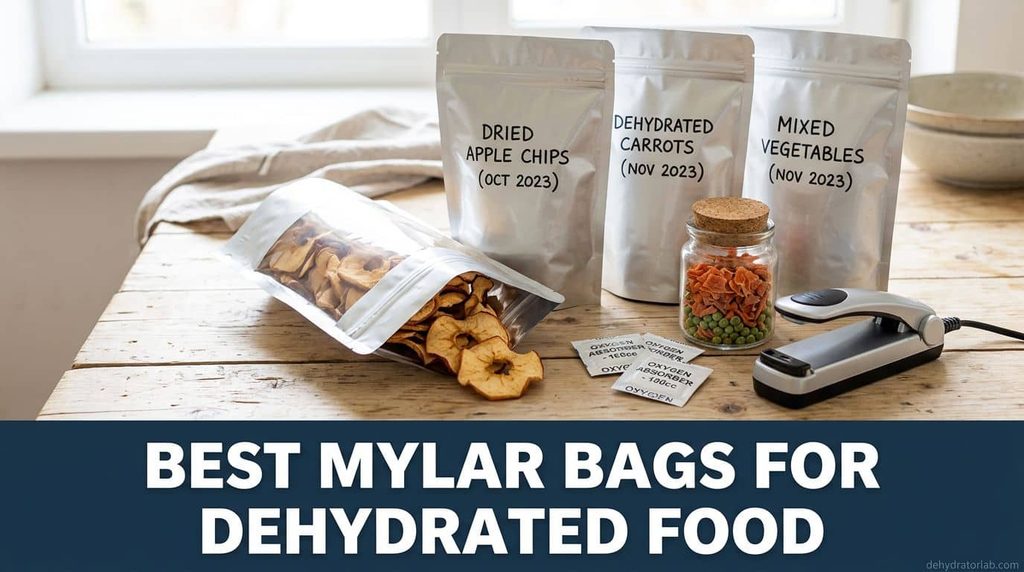
Mylar bags with oxygen absorbers fix that, but only if you pick the right bags, size the absorbers correctly, and know which foods don’t belong in them.
The best mylar bags for dehydrated food list below covers seven picks: bags in three sizes, a bulk absorber pack, a proper sealer, and a desiccant for the foods absorbers can’t handle. I based the sizing and safety rules on university extension guidance, not prepper folklore.
One honest note up front: home-dried food isn’t a 25-year product, even in Mylar. More on that below. Let’s get into it.
As an Amazon Associate, I earn from qualifying purchases. If you make a purchase after clicking on a link I may earn a small commission at no extra cost to you if items are purchased.
Quick Picks: Our Top 7 Best Mylar Bags for Dehydrated Food
- 🥇 Best Overall: Wallaby 1-Gallon Stand-Up Mylar Bags: thick, stand-up, resealable, with absorbers included.
- 🎯 Best for Small Batches: PackFreshUSA Mylar Variety Pack: pint, quart and gallon bags with matched absorbers.
- 📦 Best for Big Batches: Wallaby 5-Gallon Mylar Bags: bucket liners for bulk rice, beans and powders.
- 🥈 Runner-Up: 30-Pack 1-Gallon 15 Mil Mylar Bags: a no-name gallon pack that covers the basics.
- ✅ Best Value: O2frepak 200cc Oxygen Absorbers: 100 absorbers with an oxygen indicator, for refills.
- 🔧 Best for Beginners: Metronic 8-Inch Impulse Sealer: an impulse sealer for a seal you can trust.
- 💰 Best Budget: wisedry 10g Food-Grade Silica Gel: food-grade silica gel for foods that shouldn’t get absorbers.
Best Mylar Bags for Dehydrated Food Comparison Table
| Product | Type | In the box | Thickness | Sizes | Absorbers | Resealable | Price |
|---|---|---|---|---|---|---|---|
| Wallaby 1-Gallon Stand-Up Mylar Bags | Mylar bags | 30 bags, labels | 7.5 mil per side (15 mil total) | 1 gallon, 10 × 14 in | 30 × 400cc | Zip, stand-up | $ |
| PackFreshUSA Mylar Variety Pack | Mylar bags | 100 bags | 7 mil per side | Pint, quart, gallon | 100, 300 and 500cc | Zip | $ |
| Wallaby 5-Gallon Mylar Bags | Mylar bags | 15 bags | 5 mil per side (10 mil total) | 5 gallon, 20 × 30 in | 2500cc | Zip | $ |
| 30-Pack 1-Gallon 15 Mil Mylar Bags | Mylar bags | 30 bags, labels | 15 mil (as listed) | 1 gallon, 10 × 15 in | 400cc | Zip, stand-up | $ |
| O2frepak 200cc Oxygen Absorbers | Oxygen absorbers | 100 packets | n/a | n/a | 200cc each, with indicator | n/a | $ |
| Metronic 8-Inch Impulse Sealer | Impulse sealer | Sealer + repair kit | n/a | 8 in seal | n/a | n/a | $ |
| wisedry 10g Food-Grade Silica Gel | Silica gel | 30 × 10 g packets | n/a | n/a | Desiccant, not an absorber | n/a | $ |
How I Picked These
Storage gear is boring until it fails, so I picked on the three things that actually decide whether your dried food survives the pantry. I checked each listing’s thickness, sizes and absorber count, and matched them against Utah State University Extension’s sizing guidance.
- Thick, opaque bags. Around 7 mil per side blocks light and resists punctures from sharp dried pieces.
- Correctly sized absorbers. Included absorbers have to match the bag size, or you’re buying a placebo.
- A seal you can verify. A bag is only as good as its heat seal, so I included a real sealer, not just a hair straightener tip.
1. 🥇 Best Overall: Wallaby 1-Gallon Stand-Up Mylar Bags

- 3 in 1 BUNDLE – Includes 30 7.5 Mil thick, heat-sealable, 1 gallon Mylar bags, 30 oxygen absorber packets (400cc each) a…
- MAXIMUM PROTECTION – Engineered with an added internal layer of aluminum, which provides superior durability and punctur…
- RESEALABLE AIRTIGHT ZIPPER – Our stand up pouches have a convenient zipper that can be sealed, opened, and re-sealed. Th…
Bags: 30 × 1 gallon, 10 × 14 in · Thickness: 7.5 mil per side · Absorbers: 30 × 400cc · Style: stand-up, zip top, labels included · Price: $
Wallaby is the name that comes up again and again in storage guides, and this stand-up gallon pack is the one I’d start with. The bags are thick and opaque, they stand on a shelf instead of slumping, and the zip top lets you reseal after opening instead of cutting a new seal every time.
Each bag comes with a 400cc absorber. That’s more than the 300cc Utah State suggests for a gallon container, which gives you a margin if you open the absorber pack slowly. Fill with bone-dry food, press out the air, drop in an absorber, then heat-seal above the zipper: the zip is for later, the heat seal is what keeps oxygen out.
For dried vegetables, powders and cooked-and-dried rice or beans, a gallon bag is a practical size: big enough for a week of meals, small enough that you aren’t exposing a year’s supply every time you open one. My guide to dehydrating cooked rice pairs well with these.
Pros
- Thick 7.5 mil per side
- Stand-up bags store neatly
- Zip top for resealing after opening
- Absorbers included and generously sized
Cons
- Only one bag size in the pack
- You still need a heat source to seal
Who It’s For
Anyone starting long-term storage of home-dried vegetables, powders and staples. Skip it if you mostly store small amounts; the variety pack below suits that better.
Check the Wallaby stand-up Mylar bags on Amazon. Start here.
2. 🎯 Best for Small Batches: PackFreshUSA Mylar Variety Pack

- ncludes 100 Mylar bags in three practical sizes — 30 pint (6" x 8"), 40 quart (8" x 12"), and 30 gallon (10" x 14") — pl…
- Multi-layer Mylar material helps reduce exposure to light, moisture, and air, making these bags ideal for storing rice, …
- 7 mil thick per side, durable construction offers added strength compared to thinner bags and is built to handle bulk st…
Bags: 100, in pint, quart and gallon sizes · Thickness: 7 mil per side · Absorbers: 100, 300 and 500cc · Price: $
Most home dehydrators produce small batches: a tray of herbs, a few quarts of veggie chips. Stuffing those into gallon bags wastes space and leaves more air for the absorber to fight. PackFreshUSA’s variety box gives you pints and quarts alongside gallons, with absorbers in three sizes to match.
Small bags are also safer for food you’ll open often. Once a bag is open, its absorber is done, so a pint of dried onions you use in a month is better than a gallon you’ll open twenty times. My vegetable dehydrator guide has the machines that make those small batches.
The trade-off is planning: keep the absorber sizes straight, and match each to its bag size from the chart below.
Pros
- Three bag sizes in one box
- Absorbers in matching sizes
- Thick 7 mil per side
- Less waste for small batches
Cons
- Mixed sizes mean more sorting and labeling
- Fewer gallon bags than a gallon-only pack
Who It’s For
Herb growers, small households and anyone storing a little of a lot. Skip it if you store in bulk.
See the PackFreshUSA variety pack on Amazon. Right-sized storage.
3. 📦 Best for Big Batches: Wallaby 5-Gallon Mylar Bags

- 3 in 1 BUNDLE – Includes 30 5 Mil thick, heat-sealable, 1 gallon Mylar bags, 30 oxygen absorber packets (400cc each) and…
- MAXIMUM PROTECTION – Engineered with an added internal layer of aluminum, which provides superior durability and punctur…
- LIGHT & AIR TIGHT – At 5 Mil thickness, Wallaby bags PREVENT light and air penetration. Sell flimsy, thin, and poorly ma…
Bags: 15 × 5 gallon, 20 × 30 in · Thickness: 5 mil per side · Absorbers: 2500cc · Style: zip top · Price: $
For bulk dry goods, the standard setup is a 5-gallon Mylar liner inside a food-grade bucket. The bucket protects against pests and punctures; the Mylar blocks oxygen and light. Utah State’s guidance is about 1,500cc of absorbers for a 5-gallon container, and these come with 2,500cc.
This is for staples you dry or buy in bulk and don’t open often: dehydrated beans, rice, vegetable powders, dried corn; my dehydrated black beans are a good example. It isn’t for things you dip into every week. Every opening resets the clock.
If your dehydrator can’t keep up with bucket-sized batches, my large-capacity dehydrator guide has the 10-tray machines.
Pros
- Fits standard 5-gallon buckets
- Generous absorber capacity
- Zip top
- Good value per gallon stored
Cons
- Thinner than the gallon bags
- Needs a bucket for protection
- Too big for frequently used foods
Who It’s For
Preppers and big-garden households storing staples for the long haul. Skip it if you store small batches.
Check the Wallaby 5-gallon bags on Amazon. Bucket-ready.
4. 🥈 Runner-Up: 30-Pack 1-Gallon 15 Mil Mylar Bags

- [SIZE & QUANTITY] . Pack of 30 mylar bags of 1 gallon for long term food storage – With 400cc oxygen absorbers (30) & St…
- [MULTI USAGE] Our Zipper & heat sealable mylar bags are used mainly to store dehydrate food, including grains, beans, oa…
- [FOOD GRADE & AIR TIGHT] Our oxygen absorbers 400 cc (6 Packs of 5 = 30 Pcs) will efficiently remove oxygen after sealin…
Bags: 30 × 1 gallon, 10 × 15 in · Thickness: 15 mil (as listed) · Absorbers: 400cc · Style: stand-up, zip top, labels · Price: $
This no-name pack is a solid alternative if the Wallaby gallon bags are out of stock. It has the same basics: stand-up gallon bags, zip tops, labels and a 400cc absorber per bag.
Be advised that thickness figures on no-name listings vary between sellers and aren’t independently verified, so I rank it below the Wallaby. Do the same checks you’d do with any bag: hold it to a light, and if you can see light through it, it isn’t blocking enough.
Pros
- Stand-up gallon bags with zip tops
- Absorbers and labels included
- Easy backup option
Cons
- No brand behind the specs
- Thickness claims vary between listings
Who It’s For
Anyone who wants a gallon pack now and doesn’t care about the brand. Skip it if you want a name you can come back to.
See the 30-pack 1-gallon Mylar bags on Amazon. Good backup.
5. ✅ Best Value: O2frepak 200cc Oxygen Absorbers

- O2frepak Oxygen Absorbers Packets help Food extend shelf life
- O2frepak Oxygen Absorber is the highest quality in the industry for Long-Term Food Storage , and have Anti oil function …
- Even our packet material was tested under strict regulation for food and 3 times oxygen absorption capacity.
Packets: 100 × 200cc · Extras: oxygen indicator · Packaging: vacuum-sealed · Price: $
Absorbers that come with bags run out fast, and spare ones are the thing you’ll reorder most. O2frepak sells 200cc packets in a 100-count bag with an oxygen indicator that changes color if air has got in, so you can tell before you use them that they’re still good.
200cc is a handy building block: one for a quart-size container or smaller, two for a gallon bag. Open the pack, use what you need within about 15 minutes, and reseal the rest in a jar. My moisture vs oxygen absorbers guide explains the difference between these and silica gel.
Pros
- 100 packets in a flexible size
- Oxygen indicator included
- Arrives vacuum-sealed
Cons
- You need to combine packets for bigger bags
- Leftovers must be resealed quickly
Who It’s For
Anyone reusing bags or buying bags without absorbers. Skip it if your bag kit already includes plenty.
Check the O2frepak absorbers on Amazon. Refill, don’t guess.
6. 🔧 Best for Beginners: Metronic 8-Inch Impulse Sealer

- Adjustable Temperature Setting Heat Sealer:The impulse bag sealer has a temperature adjustment dial, adjustable heat set…
- Easy to Use: The heat sealing no warm up time needed, keep the handle pressed down for 3-5 seconds to get seals optimal …
- Durable and Sturdy:Our impulse sealer made with high quality iron material, pure copper coil, reduces heat and work loss…
Type: manual impulse sealer · Seal width: 8 in · Extras: repair kit · Price: $
Here’s the step most guides skip. Many blogs tell you to seal Mylar with a clothes iron or a hair straightener, and plenty of people do. The LDS Church’s emergency-preparedness manual, a widely used storage guide, specifically says to use an impulse sealer and not an iron, because a household iron may not give an adequate seal.
An impulse sealer heats only for a set moment, so the seal is consistent bag after bag. An 8-inch bar covers a pint or quart bag in one press and a gallon bag in two overlapping presses. Test a few seals on an empty bag first: push on the sealed bag and make sure no air escapes.
If you don’t have one yet, my guide on sealing food without a vacuum sealer covers stopgap methods.
Pros
- Consistent, repeatable seals
- Short heat cycle, less risk of melting through
- Repair kit included
Cons
- Gallon and 5-gallon bags need overlapping seals
- Takes a few test bags to dial in
Who It’s For
First-time Mylar users who want to get the seal right. Skip it if you already own an impulse sealer.
See the Metronic impulse sealer on Amazon. The seal is the system.
7. 💰 Best Budget: wisedry 10g Food-Grade Silica Gel

- ✅ [ Moisture Indicating Desiccant ] – Contains orange indicating silica gel that enables users to quickly determine when…
- ✅ [ Reusable Desiccant Packets ] – Rejuvenated by microwave or oven, microwave at DEFROST with several mins, oven temp s…
- ✅ [ Safe Double Packing & Easy Storage ] – 10 grams x 30 packs, hermetically packed inside, a zip lock bag sealed outsid…
Packets: 30 × 10 g · Type: food-grade silica gel, color-indicating, rechargeable · Price: $
Silica gel isn’t an oxygen absorber. It pulls moisture, not oxygen, which makes it the right tool for different jobs: dried herbs in a jar you open often, or sugar-based mixes that oxygen absorbers can harden.
These 10-gram food-grade packets change color when they’re saturated and can be recharged in a low oven, per the maker. Use them in jars and short-term containers. Don’t use them to make moist food safe; if a food is too moist for an oxygen absorber, it belongs in the fridge or freezer.
Pros
- Cheap and reusable
- Color indicator shows when it’s spent
- Good for jars you open often
Cons
- Doesn’t remove oxygen
- Not a fix for under-dried food
Who It’s For
Anyone storing herbs, spice blends or powders in jars. Skip it if you only use Mylar with absorbers.
Check the wisedry silica gel on Amazon. Moisture control, cheap.
Oxygen Absorber Sizing Chart
Utah State University Extension gives a simple rule of thumb for oxygen absorber sizes (USU Extension fact sheet). Denser foods leave less air in the bag; light, airy foods like veggie chips leave more, so round up for those.
| Container | USU guidance | What I use for airy dried foods |
|---|---|---|
| Quart bag or jar | 50cc | 100cc |
| Gallon bag or #10 can | 300cc | 300–400cc |
| 5-gallon bucket liner | 1,500cc (three 500cc) | 1,500–2,000cc |
What You Can (and Shouldn’t) Store in Mylar
This is the part that matters most. Oxygen absorbers create a low-oxygen bag, and low oxygen plus moisture is exactly where botulism bacteria can grow. Utah State says foods should be below 10% moisture for storage with absorbers, and Oregon State notes that C. botulinum can grow at room temperature in low-acid, moist foods kept without oxygen (Oregon State Extension).
| Good in Mylar with absorbers | Keep out of Mylar with absorbers |
|---|---|
| Bone-dry vegetables (carrots, peas, onions, corn) | Home-made jerky: too moist and fatty; freeze it instead |
| Vegetable powders and soup mixes | Chewy or leathery fruit (raisins, apricots, fruit leather) |
| Crisp fruit chips that snap | High-fat foods: nuts, granola, trail mix |
| Cooked-and-dried rice, beans and lentils | Sugar and salt: absorbers can turn them hard |
| Dried herbs (or store in jars with silica gel) | Anything that still bends or feels tacky |
For jerky, my guide on how long dehydrated food lasts covers fridge and freezer storage. Dry first, seal second.
What to Look For in Mylar Bags for Dehydrated Food
Thickness
Aim for about 5–7.5 mil per side. Thicker bags resist punctures from sharp dried pieces like broken pasta or crisp veggie chips. Watch the wording: some sellers quote the total of both sides, so a “15 mil” bag may be 7.5 mil per side.
Size
Match the bag to how fast you’ll use the food. Once a bag is opened, its absorber is spent. Pints and quarts suit herbs and powders; gallons suit meal staples; 5-gallon liners suit bulk storage.
Included absorbers
Check that the included absorbers match the bag size from the chart above. If a gallon kit comes with 100cc absorbers, it’s under-sized.
Zip top or flat
A zip top doesn’t replace the heat seal, but it lets you reseal after opening. Flat bags are cheaper and fine for single-use packs.
Opacity
Light degrades color and nutrients in dried food. Good Mylar is fully opaque; skip clear-window bags for long-term storage.
How to Store Dehydrated Food in Mylar: Quick Tips
- Make sure it’s bone dry. Vegetables should snap or rattle; fruit chips should crunch.
- Condition first. Seal the dried food in a jar for a few days and shake daily. Any condensation means it needs more drying.
- Work fast with absorbers. Open the packet bag only when your bags are filled, use them within about 15 minutes, and reseal the rest.
- Seal, then check. Heat-seal above the zipper, then press the bag; it shouldn’t leak air. Within a day or so it often pulls in slightly.
- Label everything. Food name and date on every bag.
- Store cool, dark and dry. Heat shortens shelf life no matter how good the bag is.
- Vacuum sealing is a different tool. For short-term and freezer storage, see my vacuum sealer guide.
How Long Does Dehydrated Food Last in Mylar?
Less than the internet says, for home-dried food. The National Center for Home Food Preservation gives 4 months to 1 year as the recommended storage time for dried foods, and notes that most dried fruit keeps about 1 year at 60°F (16°C) but only 6 months at 80°F (27°C). Mylar and absorbers help you reach the long end of that range by blocking oxygen, light and moisture.
The 20- and 25-year figures you see online come from commercial, low-moisture staples like white rice and dry beans packed under controlled conditions. Home-dried vegetables and fruit hold more moisture and vary more, so plan around a year and rotate. My emergency food prep recipes are built around that rotation. For trail meals, my backpacking meals guide covers how long they keep.
Best Mylar Bags for Dehydrated Food FAQs
Do I need oxygen absorbers with Mylar bags?
For long-term storage, yes. Mylar blocks oxygen from getting in, but the air already inside the bag still holds oxygen. An absorber removes it. For short-term storage of food you’ll use within a few months, a well-sealed bag or jar without an absorber is fine.
What size oxygen absorber do I need for a gallon Mylar bag?
Utah State University Extension suggests 300cc for a gallon container and 50cc for a quart. Light, airy dried foods leave more air in the bag, so many people use 300 to 400cc for a gallon of veggie chips or dried fruit.
Can I store jerky in Mylar bags with oxygen absorbers?
Not for long-term room-temperature storage. Home-made jerky usually holds too much moisture and fat for low-oxygen packaging, which raises botulism risk. Keep jerky in an airtight container for short-term use, and refrigerate or freeze it for longer.
How long does dehydrated food last in Mylar bags?
Plan on about a year for home-dried fruit and vegetables stored cool and dark. The National Center for Home Food Preservation recommends 4 months to 1 year for dried foods. Longer figures apply to commercial staples like white rice and dry beans.
Can I seal Mylar bags with an iron?
Many people do, using a clothes iron or a flat hair straightener. The LDS Church emergency-preparedness manual recommends an impulse sealer instead, because a household iron may not give an adequate seal. Whatever you use, press the sealed bag to check for leaks.
Can I reuse Mylar bags?
Yes, if you cut just below the old seal and the bag is still long enough to seal again. Use a fresh oxygen absorber each time, because opened absorbers are spent. Don’t reuse bags that held strong-smelling foods for something delicate.
Final Verdict: Which Mylar Bags Should You Buy?
- If you’re starting out → get the Wallaby stand-up gallon bags and the Metronic impulse sealer.
- If you store small batches of herbs and powders → get the PackFreshUSA variety pack.
- If you store staples in buckets → get the Wallaby 5-gallon bags plus spare O2frepak absorbers.
Whichever bags you buy, the drying matters more than the bag. Bone dry, then seal.
Personal Tips You Can Steal
- I write the date and the absorber size on the label; when I reopen a bag months later, I know what to replace it with.
- I store one-week portions instead of one big bag, so most bags stay sealed.
- I keep opened absorbers in a small jar with a tight lid and use them within the day.
- I put Mylar bags inside a bin, never loose on a shelf. Sharp corners and mice both find loose bags.
More Dehydrator Buying Guides
- Best Food Vacuum Sealer: for short-term and freezer storage.
- Best Dehydrator for Backpacking Meals: for trail food you’ll pack in Mylar.
- Best Large Capacity Dehydrator: when you’re drying enough to fill buckets.
- Best Dehydrator for Vegetables: the machines behind your storage pantry.
P.S. Open one test bag after a month. If the food still snaps and smells fresh, your system works. If not, dry longer next time. 🙂