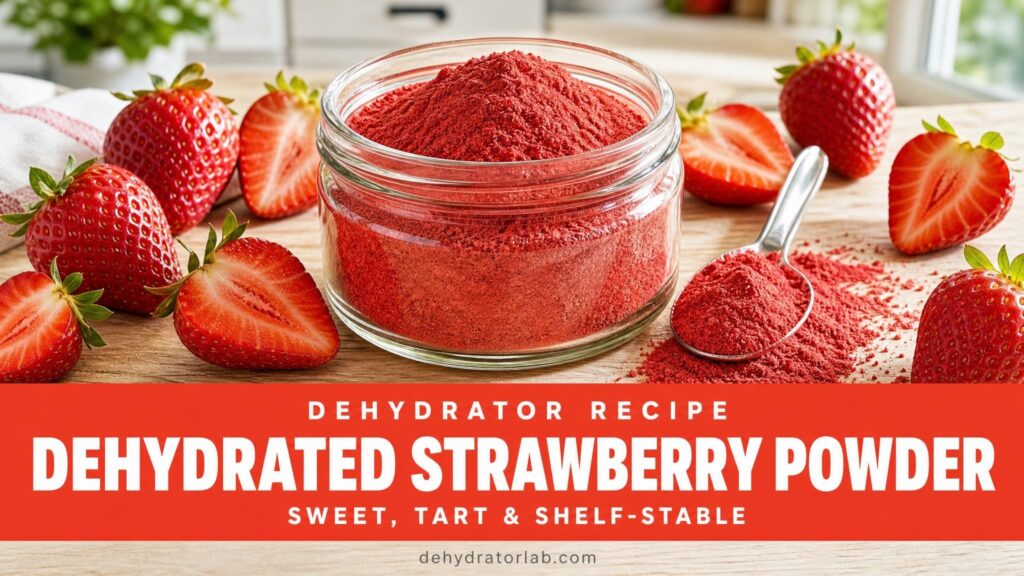
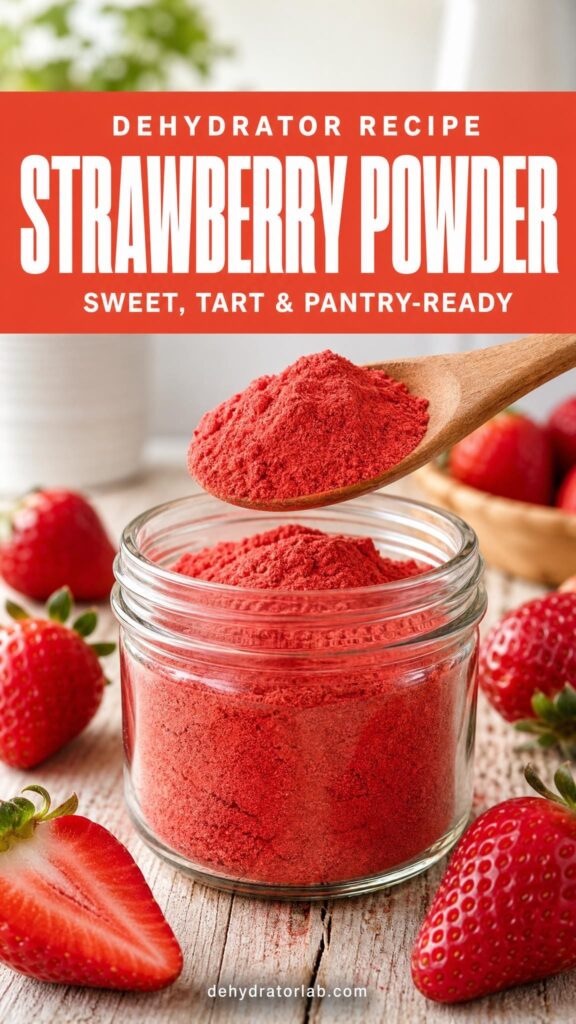
Ever buy a flat of strawberries with big plans, then watch half of it go soft before you get through it? Dehydrated strawberry powder solves that. You dry a whole batch down to a fine, bright red powder that keeps for months and tastes like concentrated summer.
It dissolves into smoothies, dusts over yogurt and oatmeal, and tints frosting a natural pink without a drop of food coloring. Ready to stop losing berries to the fridge drawer and start stocking a jar that never goes bad?
In this article:
TL;DR (Too Long; Didn’t Read): Key Takeaways
- 🍓 Fresh, ripe strawberries give the deepest color and sweetest powder.
- 🔪 Slice thin and uniform so every piece dries at the same rate.
- 🌡️ Dry at 135–140°F until slices shatter, not bend.
- ⏲️ Expect 8–14 hours depending on slice thickness and your machine.
- 🫙 Grind cool, condition for a few days, and store airtight for months.
Why This Recipe Works
Strawberries are over 90 percent water, and that’s exactly what your food dehydrator is built to remove. What’s left behind is concentrated fruit sugar, fiber, and color that grinds into a powder with a shelf life fresh berries could never match.
I make a batch every time strawberries go on sale in early summer, and I keep grinding down whatever slices didn’t get eaten as chips. Either way, you end up with a jar of bright red powder that outlasts the fruit by months.
- No added sugar, syrup, or preservatives — just fruit.
- One small jar replaces a whole flat of berries in the pantry.
- Blends into batters and frostings for natural pink color.
The Best Strawberries To Use
Ripe, deep red strawberries give you the sweetest powder and the brightest color. Pale or underripe berries dry into a duller, more tart powder — still usable, just less vivid.
- Choose berries that are fully red with no white or green shoulders.
- Skip any with soft spots or mold — one bad berry can taint a whole tray.
- Frozen strawberries work too; thaw and pat dry before slicing for less drying time.
Ingredients
- 4 cups fresh strawberries, hulled (or frozen, thawed and drained)
- That’s it — no sugar, no lemon juice, no additives needed
FYI, this is one of the shortest ingredient lists on the whole site. Strawberries do all the work themselves.
My Go-To Workflow (Step-By-Step)
- Wash and hull. Rinse berries and pat dry, then cut off the green tops. A melon baller or strawberry huller makes quick work of it.
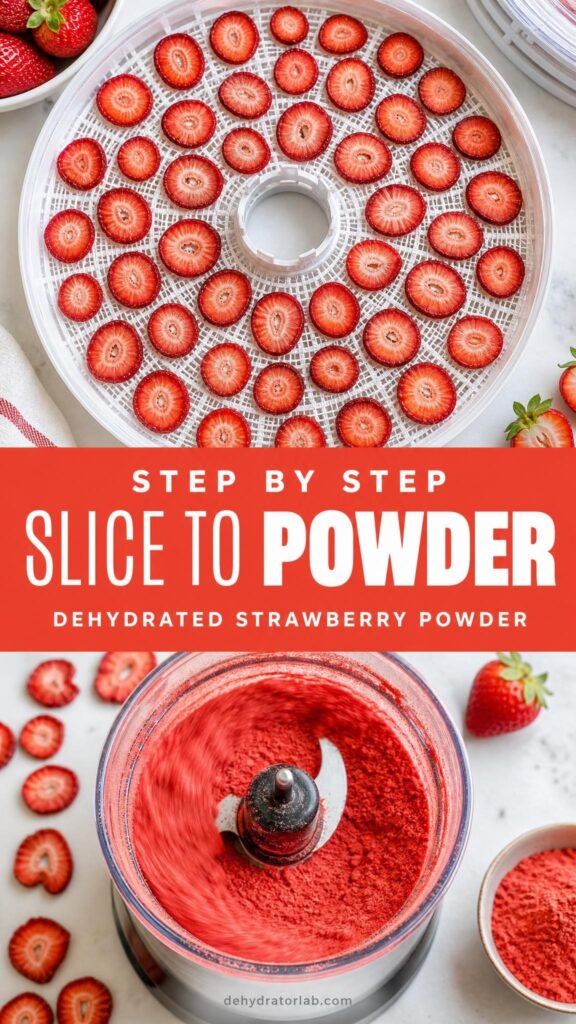
- Slice thin and even. Cut into 1/8–1/4-inch slices. Thinner slices dry faster and grind easier, but keep every slice the same thickness for even drying.
- Load your trays. Spread slices in a single layer with no overlap on a mesh liner or fruit-leather sheet — strawberries get sticky as they dry, and a liner keeps them from fusing to the tray.
- Set your dehydrator. Run at 135–140°F (57–60°C). A home oven works on its lowest setting, propped open a crack for airflow, though it runs less even than a dedicated machine.
- Rotate your trays. Swap trays top to bottom around the halfway mark, especially if your machine runs hotter on one side.
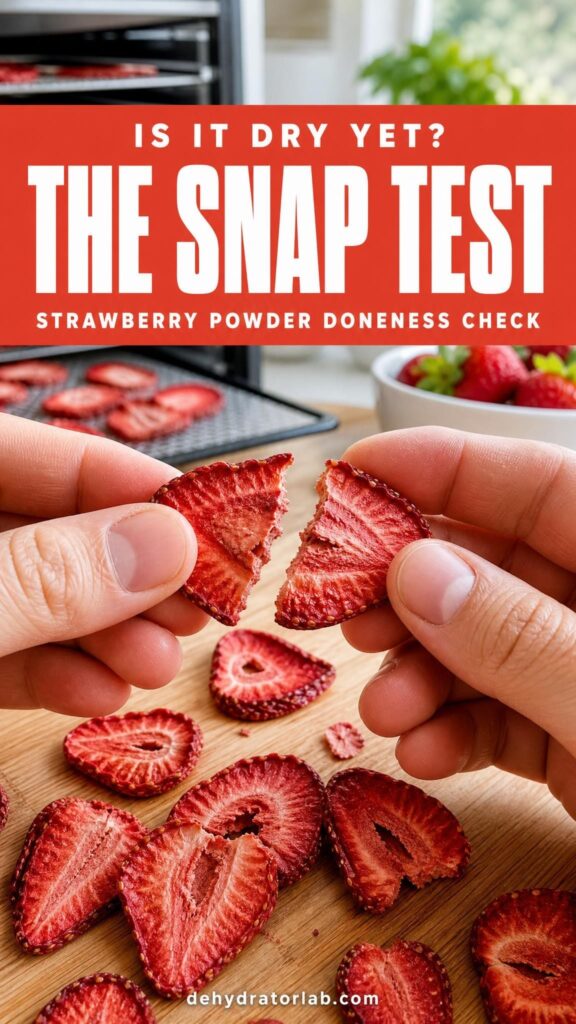
- Dry past “chip stage.” For snacking chips, you’d stop when they’re crisp but still a little pliable. For powder, keep going until slices are fully brittle and shatter when snapped. That’s your cue they’re bone dry.
- Cool completely. Let the dried slices come down to room temperature for 20–30 minutes before grinding. Warm pieces release steam inside a sealed grinder, and that steam turns into clumps.
- Grind in short pulses. Use a spice grinder or high-speed blender and pulse rather than run continuously. Sift out any coarse bits and regrind them for a finer powder.
- Condition before you seal it. Fill a jar loosely, no more than halfway, and shake once a day for 2–3 days. Any clumping means there’s still moisture hiding — spread it back on a tray for another 30–60 minutes.
- Label and store. Write the date on the jar so future you knows exactly how old it is. Rotate oldest first.
Dehydrator Settings That Work
| Slice Thickness | Temperature | Typical Time |
|---|---|---|
| 1/8-inch | 135–140°F (57–60°C) | 8–10 hours |
| 1/4-inch | 135–140°F (57–60°C) | 10–14 hours |
| Frozen, thawed and patted dry | 135–140°F (57–60°C) | 10–13 hours |
| Whole small berries, halved | 135–140°F (57–60°C) | 12–16 hours |
Your exact time swings with slice thickness, berry ripeness, humidity, and your specific machine. Check early, check often, and trust your hands over the clock.
The Dryness Test You Can Trust
Ever wonder why some batches of powder clump in the jar within a week? The secret lies in drying past “chewy” into truly bone dry. Strawberries hold moisture in the center longer than the edges show.
- Bend a slice — it should snap cleanly, not fold like leather.
- Squeeze one between your fingers — it should shatter, never squish or leave moisture on your skin.
- Break one in half — no dark, wet center, all the way through to fully dry.
Storage That Actually Lasts
- Airtight or nothing: a glass jar with a tight lid or a vacuum-sealed bag keeps humidity and oxygen out.
- Cool, dark, dry: a pantry shelf works; a spot near the stove or a sunny window does not.
- Shelf life: 6–12 months at room temperature, longer in the freezer. Check the jar in week one for any condensation — that’s a sign it wasn’t dry enough.
Label with the date every time. Future you will say thanks when you’re rotating jars a year from now.
How To Actually Use It
A tablespoon or two goes a long way since the powder is concentrated fruit. Stir it into liquids for flavor and color, or use it dry in baking and frostings.
- Stir into smoothies, overnight oats, or yogurt for instant strawberry flavor.
- Whisk with a little water into a quick jam-like paste for toast or pancakes.
- Fold into frosting, cake batter, or pancake mix for natural pink color and real fruit flavor.
To rehydrate for a paste, combine 1 part powder with about 2 parts cool water and let it sit for 5 minutes to thicken. It won’t be identical to fresh fruit, but it’s close enough for topping pancakes on a Tuesday.

Common Mistakes To Avoid
- Slicing unevenly. Thick and thin slices on the same tray finish at different times, so thin pieces scorch while thick ones stay tacky.
- Grinding while warm. Warm powder traps steam in the jar, and steam turns into clumps within days.
- Stopping at “chip stage.” Chewy, pliable slices still hold too much moisture for powder — keep drying until brittle.
- Skipping conditioning. A few days of shaking the jar catches hidden moisture before it becomes mold.
Frequently Asked Questions
Can I make strawberry powder without a dehydrator?
Yes. Use your oven’s lowest setting, prop the door open slightly for airflow, and expect a similar or slightly longer time. Watch closely since ovens run less even than a dedicated machine.
Do I need to add lemon juice first?
Not really. Strawberries don’t brown the way avocados or bananas do, so you can skip the acid step entirely and go straight to slicing.
Why is my powder clumping?
Leftover moisture is almost always the cause. Spread the powder on a tray and run it another 30–60 minutes at a low setting, cool fully, then reseal.
Can I use freeze-dried strawberries instead?
Yes, and it skips the drying step entirely. Freeze-dried berries are already brittle, so you can go straight to grinding. Our air fryer freeze-dried strawberry chips use the same starting point if you want a snack instead of a powder.
How much powder does one batch make?
Four cups of fresh strawberries typically grinds down to about 1/2 to 3/4 cup of fine powder, since you’re removing nearly all the water weight.
Is dehydrated strawberry powder healthy?
Strawberries are well known for their vitamin C and antioxidant content, and drying concentrates the fiber and much of that natural nutrition into a smaller volume. Some heat-sensitive vitamin C is lost in the process, which is normal for any dried fruit.
Personal Tips You Can Steal
I slice with a mandoline when I have a big batch going, because uniform slices mean I’m not babysitting three different finish times. I always run one extra hour past “looks done” because strawberries hide moisture better than most fruit. I keep an unlabeled “test jar” going for a few days before committing a full batch to permanent storage, since a hidden clump early on saves the whole jar later. I grind in short 5-second pulses instead of one long blend because it keeps the powder from heating up and going gummy.
Wrap-Up
Dehydrated strawberry powder turns a perishable flat of berries into a pantry staple that’s ready whenever you are. A few cups of strawberries, some patience in the dehydrator, and a quick grind gets you a jar of concentrated flavor that outlasts anything in your fridge. Pair it with a batch of dehydrated avocado powder for smoothie day, or dust it over air fryer strawberry chips for extra flavor.
If you’d rather dry your berries whole first and decide on powder later, check out the full guide to dehydrating strawberries. And if you’re new to the whole process, our beginner’s guide to using a food dehydrator covers the basics before you start.
P.S. Keep a small “working jar” in the kitchen and the big batch sealed in the back of the pantry. You’ll use the powder more often when it’s within arm’s reach 🙂
Want just the essential recipe details without scrolling through the article? Get our printable recipe card with just the ingredients and instructions.
Related reading: dehydrated pumpkin powder, dehydrated tomato powder, fruit leather in a dehydrator, and 15 best fruits to dehydrate at home.
Printable Recipe Card
Want just the essential recipe details without scrolling through the article? Get our printable recipe card with just the ingredients and instructions.