
Most Excalibur vs Cosori comparisons are not a fair fight. They put the $300 nine-tray Excalibur against the $150 six-tray Cosori, and then act surprised when the Excalibur has more room. Of course it does — it costs twice as much.
So this page compares the two machines that actually sit at the same price: the Excalibur 3926TB, nine trays and 15 square feet, against the Cosori Premium Pro 10-Tray (CFD-P101-SUS), ten trays and 16.2 square feet. Both are around $300, both blow air horizontally from a rear fan, and both are the biggest thing their maker sells.
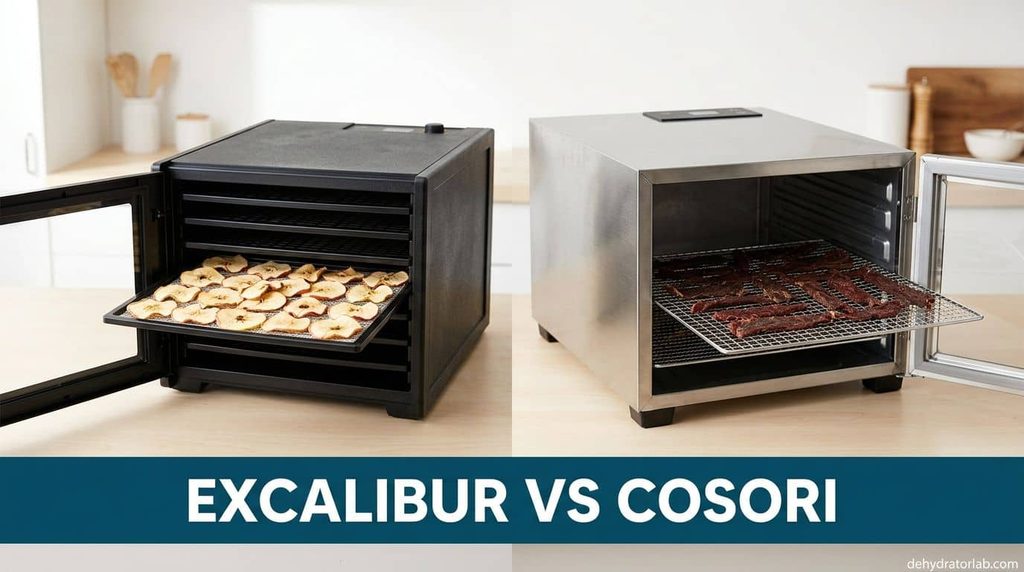
One is built in Sacramento out of plastic trays with a ten-year warranty; the other is built abroad out of stainless steel with a two-year warranty and a thermostat that reads in single degrees. That is the real decision.
As an Amazon Associate, I earn from qualifying purchases. If you make a purchase after clicking on a link I may earn a small commission at no extra cost to you if items are purchased.
Quick Verdict: Excalibur vs Cosori in 60 Seconds
- 🥇 For most people: the Cosori Premium Pro. More rated area, stainless trays, single-degree control down to 95°F, and a 48-hour timer.
- 🛠 For the long haul: the Excalibur 3926TB. Made in Sacramento, a ten-year warranty against Cosori’s two, and shelves that come out for tall loads.
- 🌡 Get the Cosori if you dry herbs, ferments, or anything delicate — the Excalibur’s thermostat stops at 105°F, ten degrees above the Cosori’s floor.
- 🍞 Get the Excalibur if you want to pull shelves out and dry something tall, or if a decade of warranty matters more to you than a digital display.
- ⚖️ Closer than the spec sheets suggest: 15 sq ft against 16.2, and both dry a full load without rotating a single tray.

- Large Capacity: Equipped with 9 Excalibur dehydrator trays, this large food dehydrator boasts 15 square feet of drying s…
- Versatile Uses: Features a 26-hour dehydrator timer and an adjustable thermostat with a range of 105 to 165 degrees F – …
- Low & Slow for Immune Boost: Cooking foods at no higher than 115-118 degrees in a dehydrator preserves nutrients; it’s t…
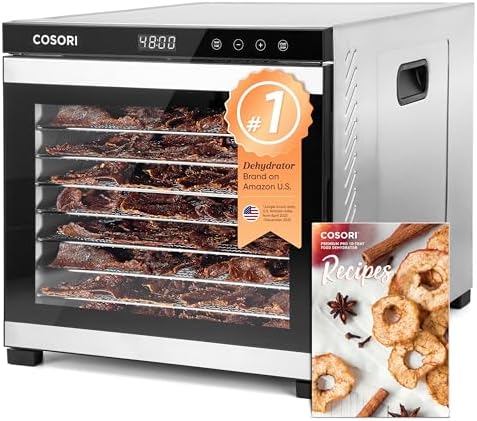
- 𝐒𝐏𝐀𝐂𝐈𝐎𝐔𝐒 𝐂𝐀𝐏𝐀𝐂𝐈𝐓𝐘: With 10 spacious trays, each measuring 𝟭𝟱.𝟲 ” 𝘅 𝟭𝟱 “, this dehydrator offers a generous 16.2 ft² dryi…
- 𝐅𝐀𝐌𝐈𝐋𝐘-𝐅𝐑𝐈𝐄𝐍𝐃𝐋𝐘 𝐒𝐍𝐀𝐂𝐊𝐒: Create an array of healthy homemade snacks like dried fruits, veggies, and jerky, preserving 𝟵𝟮%…
- 𝐅𝐎𝐎𝐃 𝐒𝐀𝐅𝐄𝐓𝐘: Following USDA jerky safety guidelines, we maintain a maximum temperature of 165 °F, and all our accessorie…
Excalibur vs Cosori: Side-by-Side Specs
| Spec | Excalibur 3926TB | Cosori Premium Pro 10-Tray |
|---|---|---|
| Trays | 9 | 10 |
| Tray size | 15 × 15 in | Not published |
| Drying area (rated) | 15 ft² | 16.2 ft² |
| Area per tray | 1.67 ft² | 1.62 ft² |
| Watts | 600W heater + 72W fan | 1000W |
| Watts per sq ft | 40 | 62 |
| Temp range | 105–165°F, analog dial | 95–165°F, 1° steps |
| Timer | 26 h | 48 h, 30-min steps |
| Airflow | Rear 7-in fan, horizontal | Rear fan, horizontal |
| Tray material | BPA-free polypropylene | Stainless steel |
| Door | Clear polycarbonate, detachable | Glass, see-through |
| Footprint (W×D×H) | 17 × 19 × 12.5 in | 16.9 × 21.3 × 16.4 in |
| Weight | Not published | 36 lb |
| Warranty | 10 years, limited | 2 years |
| Price | $$$ | $$$ |
Two numbers in that table decide most of the argument, and neither is the tray count. The first is watts per square foot — 40 against 62 — which is how hard each machine works a full load. The second is the temperature floor: 105°F against 95°F, which decides whether some foods are on the menu at all.
Design & Build Quality
The Excalibur is a black box with a detachable clear door and nine square shelves that slide on rails. It has looked like that for decades, and Excalibur has been building it in Sacramento since 1973. The design’s one structural advantage is that the shelves come out — take five of them away and you have a tall open cavity for rising dough, a whole head of something, or anything that will not lie down.
The catch is what the trays are made of. They are BPA-free polypropylene with flexible poly-screen inserts, and the door is polycarbonate. Nothing in the food path is metal. For a machine at this price that is the one thing that makes people hesitate, and it is why the Excalibur does not appear in my stainless steel guide.
The Cosori answers exactly that. Ten stainless trays, a glass door you can see through without opening, and a heavier build — 36 pounds against a machine you can lift with one hand. Steel does not stain from beetroot, does not hold the smell of garlic, and does not go cloudy after two years of garlic and onion. What it will not do is come apart to make room for a tall load: the Cosori’s trays are its shelving.
So it depends which kind of solid you mean. The Excalibur is solid in the sense that it is simple, serviceable and made close to home. The Cosori is solid in the sense that the parts touching your food are metal.
Winner: Excalibur — for buildability and the shelves that come out. If “build quality” means steel rather than plastic, flip this one to the Cosori.
Capacity & Drying Area
Rated area goes to the Cosori: 16.2 square feet against 15. That is an eight per cent difference, which is less than the extra tray suggests, because Excalibur’s trays are individually bigger — 1.67 square feet each against 1.62.
There is a wrinkle worth knowing. Excalibur’s trays measure 15 by 15 inches, and nine of those is 14.1 square feet of actual tray surface, a little under the 15 the box claims. Cosori does not publish a tray dimension for this model, so I cannot run the same arithmetic on it — which is why the table above compares rated figure to rated figure and says where each number came from.
In practice both machines are in the same class, and it is a large one. Either will take a full flat of apples, a hunting season’s worth of jerky, or a garden glut in one run. If you want the honest ranking of that whole category, it is in the large-capacity guide, where both of these sit near the top.
Where the Excalibur pulls ahead is shape rather than size. Nine square trays with nothing in the middle, and the option to remove some, handles awkward loads that a fixed ten-tray rack cannot.
Winner: Cosori — more rated area, and its figure is the one I can take at face value.
Airflow & Drying Evenness
Both machines do the same thing: a rear-mounted fan pushes heated air horizontally across every shelf at once, so the top tray and the bottom tray finish together and nothing needs rotating. Excalibur named its version Parallexx and got there first — most of the cabinet dehydrators sold today, this Cosori included, are working from that idea. The airflow comparison explains why it matters more than any other design choice.
The measurable difference is not the fan, it is the power behind it. The Excalibur puts 600 watts of heater behind 15 square feet — 40 watts per square foot. The Cosori puts 1000 watts behind 16.2 — 62. On a half-empty machine you will not notice. On a full load of something wet, the Cosori has half as much power again to move the same water.
That does not automatically make it cheaper to run. Drying a given weight of food takes roughly the energy it takes to evaporate that water, whichever box you do it in; a machine with more watts mostly finishes sooner rather than using less. What the extra power buys you is time — your kitchen is occupied for fewer hours — and that is a real benefit if you dry in volume, just not a saving on the bill.
Neither machine has a problem with evenness. Both are the design that fixed that problem.
Winner: A draw on airflow — Excalibur for inventing it, Cosori for putting more power behind it.
Temperature Range & Controls
This is the section that decides it for a lot of people, and it is not close. The Excalibur has an analog thermostat dial running from 105°F to 165°F. The Cosori has a digital panel running from 95°F to 165°F in single degrees, per its own manual.
Ten degrees at the bottom of the range is not a rounding difference. Ninety-five is the setting for herbs, for delicate leaves, for yoghurt and ferments, and it is the floor most raw food recipes are written around. The Excalibur simply will not go there — its dial starts above it. If low-temperature drying is why you are buying a dehydrator, the comparison ends here.
At the top both reach 165°F, which clears the usual recommendation for finishing meat safely with room to spare, so meat is a draw. The difference is how you set it. A dial you nudge to “about 135” is fine once you know the machine; a panel that reads 135 and holds it is easier to repeat, and much easier to hand to someone else.
The timers follow the same pattern. Excalibur gives you 26 hours; Cosori gives you 48 in half-hour steps. Most batches finish inside a day either way, but 26 hours is tight for a deep load of thick apple or pear, and running out of timer overnight is how a batch ends up half-done.
Winner: Cosori — by a distance. A lower floor, single-degree control and nearly twice the timer.
Noise, Cleaning & Everyday Use
Neither of these is a quiet machine, and anyone who tells you otherwise has not run one in an open-plan kitchen. Excalibur’s seven-inch fan is the louder of the two in my experience and in the complaints you will find — it is a big fan in a plastic box, and empty trays rattle. Cosori does not publish a decibel figure for this model; the independent testing that exists on the brand covers the smaller 6-tray and Mini at 48 and 45 dB, which I would not transfer to a 1000-watt machine without measuring it.
Cleaning produces the result you would not expect. The Excalibur is sold with dishwasher-safe parts. Cosori’s own product page tells you to clean the Premium Pro’s stainless trays “with a soft brush and warm soapy water” rather than in a machine. So the plastic dehydrator is the one you can load into the dishwasher, and the steel one is the one you stand at the sink with. Steel still wins on staining and odour — what the stainless guide covers is the reason people buy it — but it is not the lower-effort option here.
Day to day, the Cosori’s glass door is the feature you use most: you can see how far along a tray is without opening the cabinet and dumping the heat. The Excalibur’s door comes off entirely, which is better for loading nine trays at once and worse for checking one.
Both ship almost nothing with them. The Cosori box holds one fruit-roll sheet and one mesh screen for ten trays; the Excalibur includes poly-screen inserts and a dehydration guide. Either way, order sheets with the machine — stopping things sticking to the trays starts with having the right surface under the food.
Winner: Cosori on the glass door, Excalibur on cleaning. Call it a draw, and do not buy either one expecting quiet.
Price, Value & Warranty
At the same money — both sit in the $$$ band — you are choosing between more machine now and more cover later.
The Cosori gives you the better specification today: 1.2 more square feet, stainless trays, a glass door, a lower temperature floor, a longer timer and a digital panel. Feature for feature at this price it is the stronger buy, and nothing on the Excalibur’s sheet answers the 95°F point.
Then there is the warranty, and it is not a small gap. Excalibur backs the 3926TB with a limited ten-year warranty. Cosori covers the Premium Pro for two years. That is five times the cover, on a machine built in the same country you are probably reading this in, by a company that has been making only dehydrators since 1973. If you keep appliances until they die, that changes the arithmetic completely.
The honest way to put it: the Cosori is the better dehydrator for the first two years, and the Excalibur is the safer purchase for the next ten. Which matters more is a fact about you, not about the machines. My own notes on the black box are in the Excalibur 3926TB review, and the Cosori sits at the top of the Cosori line-up.
Winner: Excalibur — a ten-year warranty at the same price is the single biggest number on either spec sheet.
Excalibur 3926TB: Pros & Cons
Pros
- Limited ten-year warranty — five times the Cosori’s
- Made in Sacramento by a dehydrator-only company since 1973
- Shelves come out, so tall loads and dough fit
- Dishwasher-safe parts
- 40 W/ft² — the gentler, lower-draw machine
Cons
- Thermostat stops at 105°F, so no 95°F drying
- Polypropylene trays and a polycarbonate door — no steel in the food path
- 26-hour timer, the shorter of the two
- Analog dial rather than a readable set point
- The louder machine of the pair
- Large Capacity: Equipped with 9 Excalibur dehydrator trays, this large food dehydrator boasts 15 square feet of drying s…
- Versatile Uses: Features a 26-hour dehydrator timer and an adjustable thermostat with a range of 105 to 165 degrees F – …
- Low & Slow for Immune Boost: Cooking foods at no higher than 115-118 degrees in a dehydrator preserves nutrients; it’s t…
Cosori Premium Pro: Pros & Cons
Pros
- 16.2 sq ft — the larger rated area
- Ten stainless trays and a glass door
- 95–165°F in single degrees, the lower floor and the finer control
- 48-hour timer in half-hour steps
- 1000W — 62 W/ft², so full loads finish sooner
Cons
- Two-year warranty against Excalibur’s ten
- Trays are hand-wash by Cosori’s own instructions
- Fixed rack — nothing comes out to fit a tall load
- 36 lb and 21 inches deep; it needs permanent counter space
- One roll sheet and one mesh screen for ten trays
- 𝐒𝐏𝐀𝐂𝐈𝐎𝐔𝐒 𝐂𝐀𝐏𝐀𝐂𝐈𝐓𝐘: With 10 spacious trays, each measuring 𝟭𝟱.𝟲 ” 𝘅 𝟭𝟱 “, this dehydrator offers a generous 16.2 ft² dryi…
- 𝐅𝐀𝐌𝐈𝐋𝐘-𝐅𝐑𝐈𝐄𝐍𝐃𝐋𝐘 𝐒𝐍𝐀𝐂𝐊𝐒: Create an array of healthy homemade snacks like dried fruits, veggies, and jerky, preserving 𝟵𝟮%…
- 𝐅𝐎𝐎𝐃 𝐒𝐀𝐅𝐄𝐓𝐘: Following USDA jerky safety guidelines, we maintain a maximum temperature of 165 °F, and all our accessorie…
Who Should Buy the Excalibur 3926TB?
Buy the Excalibur if you think in decades. Ten years of warranty on a machine with one moving part, made by a company that has done nothing else for fifty years, is a genuinely different proposition from a two-year consumer appliance. If either machine fails in year six, only one of them is still covered.
Buy it also if your loads are awkward. Pulling five shelves out to proof dough or dry something tall is a trick the Cosori cannot do at any price, and it is the reason a lot of people who own both keep the Excalibur. And buy it if you want the parts to go in the dishwasher.
Do not buy it if 95°F matters to you, or if plastic trays are the thing you were trying to get away from. Those are the two objections it cannot answer. Everything else about the Excalibur 3926TB is as good as this category gets.
Who Should Buy the Cosori Premium Pro?
Buy the Cosori if you want the better machine for the money right now. It is bigger on paper, the trays are steel, the door is glass, the panel reads in single degrees, and the timer runs to 48 hours. Every one of those is a thing you touch or see on every batch.
Buy it especially if your drying starts low — herbs, leaves, ferments, yoghurt, anything you would run at 95°F. The Excalibur cannot reach that setting, and no amount of build quality gets around a dial that starts at 105.
Do not buy it if the two-year warranty bothers you, or if you need to dry something that will not lie flat on a fixed shelf. Short of that, the Cosori Premium Pro is the machine I would put on the counter. If you would rather have a smaller, cheaper one, the brand guide covers the whole line including the trap of the two different ten-tray models.
Excalibur vs Cosori FAQs
Is the Excalibur or the Cosori bigger?
The Cosori Premium Pro, but only just: 16.2 square feet of rated drying area across ten trays against the Excalibur 3926TB’s 15 across nine. That is an eight per cent difference, because Excalibur’s individual trays are slightly larger — 1.67 square feet each against 1.62. Both are large-capacity machines and either will handle a garden harvest in one run.
Why does the Excalibur only go down to 105°F?
Because it uses an analog thermostat whose dial is calibrated from 105°F to 165°F. There is no setting below it. The Cosori’s digital panel starts at 95°F, which is the usual figure for herbs, leafy things, yoghurt and raw-food drying. If you want to dry at 95°F, the Excalibur is the wrong machine, whatever else it does well.
Are the Cosori’s stainless trays dishwasher safe?
Cosori’s own product page for the Premium Pro tells you to clean the trays with a soft brush and warm soapy water, not in a dishwasher. The Excalibur, oddly, is sold with dishwasher-safe parts despite its trays being plastic. Steel still resists staining and odours far better — it is just not the lower-effort option on this particular pair.
Which one is quieter?
Neither is quiet. The Excalibur’s seven-inch fan is the louder of the two, and empty trays rattle in it. Cosori does not publish a decibel figure for the 1000W Premium Pro, and the independent measurements that exist for the brand — 48 dB on the 6-tray, 45 dB on the Mini — are for much smaller machines, so I would not apply them here.
Is the Excalibur’s ten-year warranty worth paying for?
It is worth a great deal if you keep appliances until they break, since it is five times Cosori’s two years on a machine at the same price. It is worth nothing if you would replace a dehydrator in five years anyway. There is no wrong answer — it is a question about you rather than about the hardware.
Excalibur vs Cosori: which would you actually buy?
The Cosori Premium Pro, for the lower temperature floor, the stainless trays and the 48-hour timer. The exception is if you want to dry tall things by pulling shelves out, or if the ten-year warranty is the point — then the Excalibur 3926TB, and I would not argue with you.
Final Verdict
At the same price, I would buy the Cosori Premium Pro 10-Tray. It has the larger rated area, steel where the food sits, a glass door, single-degree control from 95°F and a 48-hour timer — five things you use on every batch, against an Excalibur sheet that answers none of them.
The exception is real, though, and it is two-sided. If you dry things that will not lie flat, the Excalibur 3926TB pulls its shelves out and the Cosori cannot. And if you keep appliances until they die, ten years of warranty against two is the biggest single number on either spec sheet — worth more than any feature I listed above.
So: Cosori for the better machine, Excalibur for the longer relationship. If neither settles it, the tiebreaker is 95°F — if you need that setting, there is only one machine here that has it.
Personal Tips You Can Steal
Whichever I am running, I set the temperature once and leave it rather than chasing it up halfway through, because the variable that actually decides the result is how thick you sliced. On the Excalibur I mark the dial with a scratch at 135°F, since “about right” on an analog knob drifts over a year.
And I never trust a timer to tell me a batch is done — dry to the feel and check the food, not the clock. 6 essential dehydrating tips covers the rest of the habits that matter more than which box you bought.
More Dehydrator Buying Guides
- Best Large Capacity Dehydrator — where both of these rank against the biggest machines from every brand.
- Best Cosori Dehydrator — the whole Cosori range, including the two different 10-tray models.
- Best Stainless Steel Dehydrator — what is actually steel across the brands, and why the Excalibur is not in it.
- Best Magic Mill Dehydrator — the other big stainless line, if neither of these is quite right.
- Best Dehydrator for Beginners — if this would be your first machine of any kind.
P.S. If you are still torn, go and look at what you dried last month. If most of it would have run at 95°F, the decision was made for you 🙂