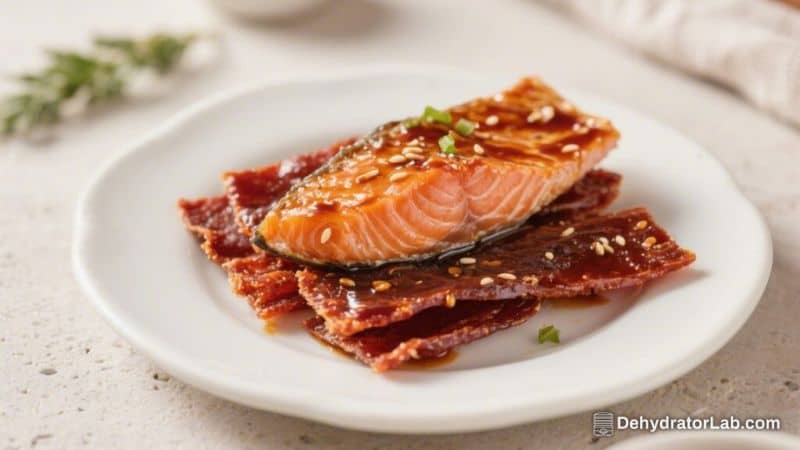
If you love snacks that pack a punch without weighing you down, this Air Fryer Teriyaki Salmon Jerky is for you. It has that classic sweet-salty teriyaki flavor, a gentle chew, and a satisfying bite. You don’t need a dehydrator, just your air fryer and a little patience.
It’s great for road trips, gym bags, or quick protein on the go. Once you try it, you’ll wonder why you ever bought jerky at the store.
In this article:
What Makes This Special
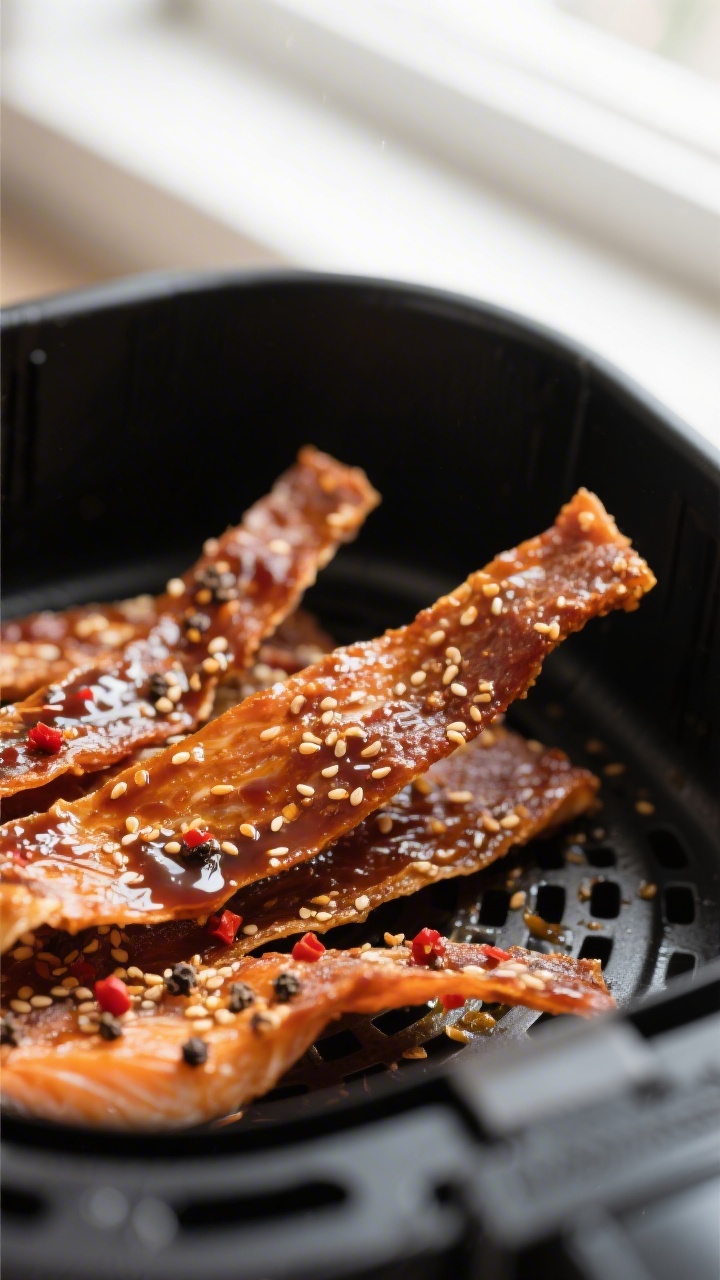
This isn’t your typical beef jerky. Salmon brings a rich, clean flavor and a softer chew, while teriyaki adds a glossy, umami-laced sweetness.
The air fryer speeds things up and keeps the texture pleasantly tender instead of brittle. It’s also budget-friendly and a smart way to use up frozen salmon fillets. Best of all, you can adjust the sweetness, saltiness, and heat exactly how you like it.
What You’ll Need
- 1 to 1.5 pounds skinless salmon fillets (center-cut works best)
- 1/3 cup low-sodium soy sauce or tamari
- 3 tablespoons maple syrup or honey
- 1 tablespoon rice vinegar
- 1 tablespoon mirin (optional for extra gloss and sweetness)
- 1 teaspoon toasted sesame oil
- 1 teaspoon fresh grated ginger (or 1/2 teaspoon ground)
- 2 cloves garlic, minced
- 1/2 teaspoon black pepper
- 1/4 teaspoon red pepper flakes (optional for heat)
- 1 teaspoon cornstarch (optional, for a slightly clingier marinade)
- Nonstick spray or a little neutral oil for the air fryer basket
- Sesame seeds and thinly sliced green onion for garnish (optional)
Instructions
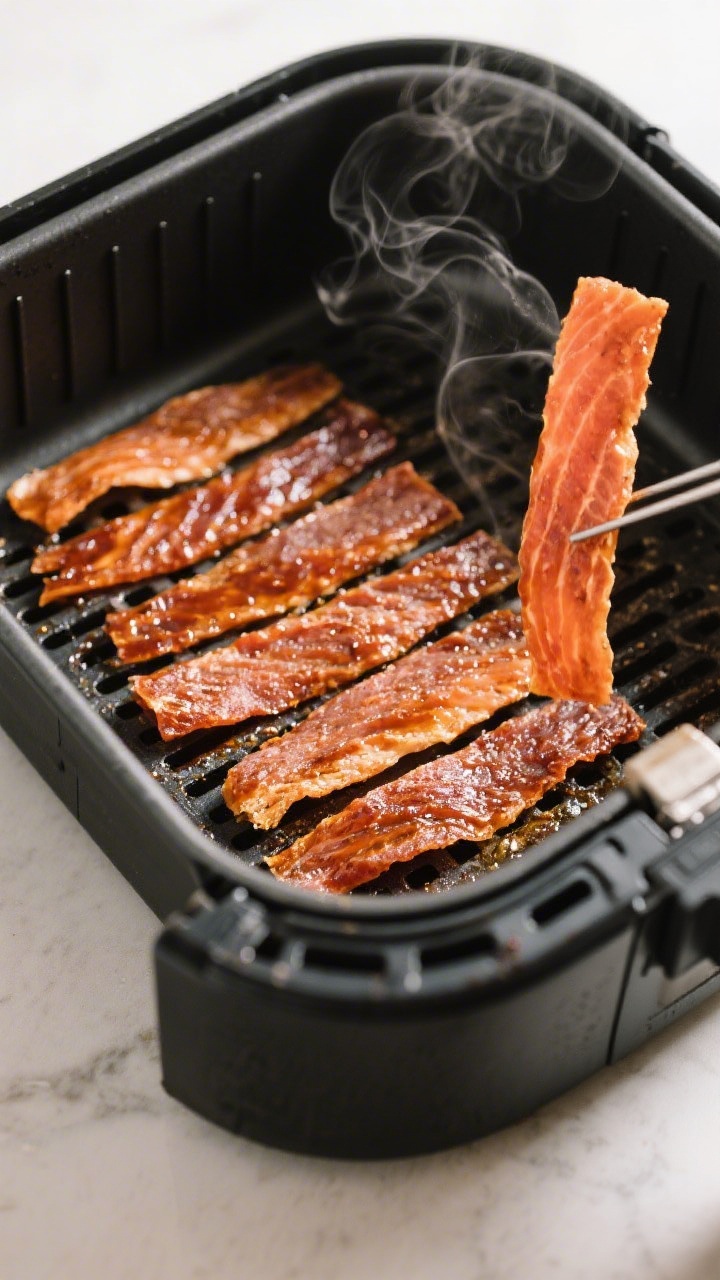
- Prep the salmon. Pat the fillets dry with paper towels.
Using a sharp knife, slice the salmon into long, even strips about 1/4 inch thick. Thinner strips dry faster and chew better. Aim for uniform thickness so everything cooks evenly.
- Make the teriyaki marinade. In a bowl, whisk soy sauce, maple syrup, rice vinegar, mirin (if using), sesame oil, ginger, garlic, black pepper, and red pepper flakes.
If you want a slightly thicker glaze, whisk in the cornstarch until smooth.
- Marinate. Add the salmon strips to the marinade, making sure each piece is fully coated. Cover and refrigerate for at least 2 hours, or up to 8 hours for deeper flavor. Stir once midway so the pieces marinate evenly.
- Optional pre-dry step. For a cleaner finish, lift the salmon from the marinade and lay the strips on a wire rack over a sheet pan for 20–30 minutes in the fridge.
This lets excess liquid drip off and forms a tacky surface that dries better.
- Prep the air fryer. Lightly oil or spray the basket to prevent sticking. Preheat the air fryer to 180–200°F (80–93°C) if your model allows low-temp settings. If not, set it to the lowest setting available and plan for shorter checks.
- Load the basket. Arrange the salmon strips in a single layer with a little space between each piece.
Do not overlap. Work in batches if needed.
- Air fry low and slow. Cook at 180–200°F for 45–60 minutes, flipping every 15 minutes. If your air fryer’s lowest temp is higher (e.g., 250°F), start checking at 25 minutes and flip more frequently to avoid crisping.
- Check for doneness. You’re aiming for dry to the touch, lightly tacky, and flexible—not brittle.
The strips should bend without breaking and feel firm with a gentle chew. Thinner pieces may finish sooner; pull them early as needed.
- Optional final gloss. If you like a shinier finish, brush a teaspoon or two of reserved marinade (that’s been boiled for 2–3 minutes to sanitize) over the strips in the last 5 minutes of drying.
- Cool and condition. Let the jerky cool completely on a rack. For best texture, place the cooled pieces in a loosely covered container for a few hours to “condition.” This equalizes moisture across pieces.
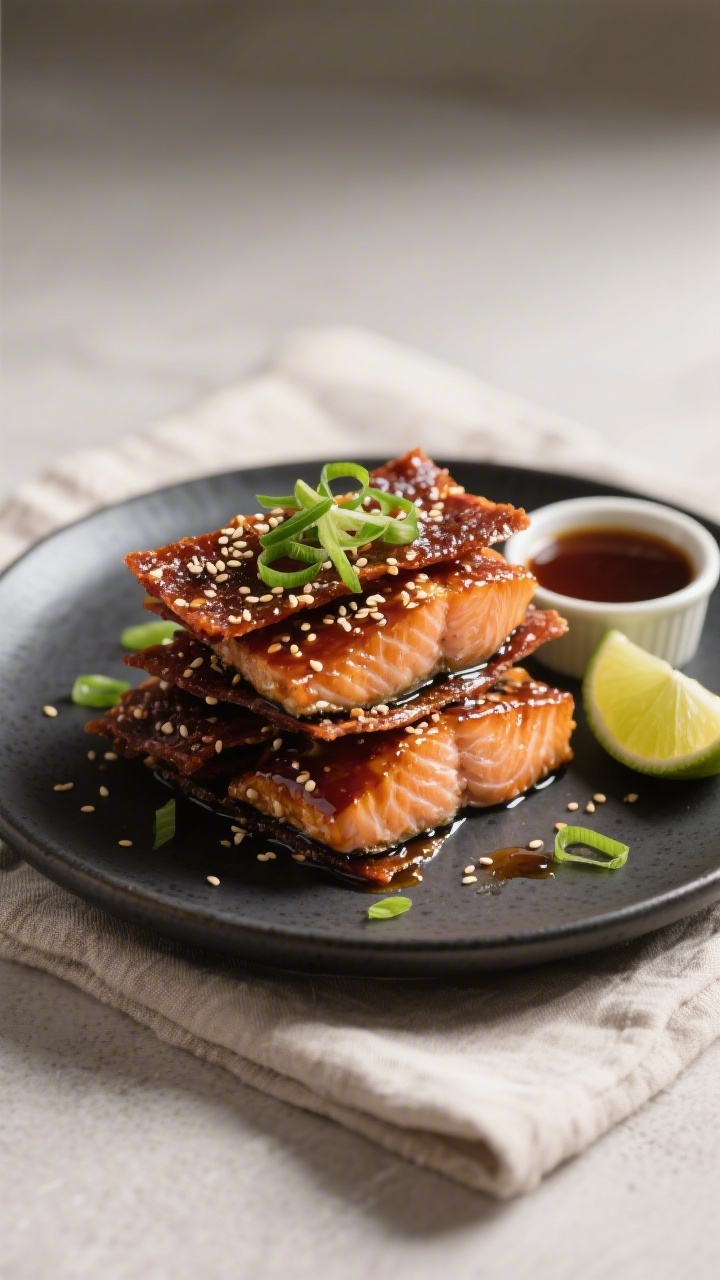
- Garnish and serve. Sprinkle with sesame seeds and green onion right before eating, if you like.
Enjoy as-is or with a squeeze of lime for brightness.
How to Store
- Short term: Store in an airtight container at room temperature for 1–2 days if your jerky is well-dried.
- Refrigerator: Keeps 1–2 weeks in a sealed bag or container. Add a paper towel inside to catch extra moisture.
- Freezer: For longer storage, freeze up to 2–3 months. Thaw in the fridge.
Texture holds up well.
- Check moisture: If condensation forms, return jerky to the air fryer at 180°F for 5–10 minutes to re-dry.
Benefits of This Recipe
- High-protein, omega-3 rich snack: Salmon provides heart-healthy fats and steady energy.
- Faster than oven or dehydrator: The air fryer speeds up drying while keeping texture pleasantly chewy.
- Customizable flavor: Adjust sweetness, salt, and heat to suit your taste.
- Great for meal prep: Make a batch on Sunday and snack all week.
- Lower waste: A practical way to use frozen fillets or trim pieces.
Pitfalls to Watch Out For
- Too much moisture: Overly wet strips won’t dry well. Pat salmon dry and avoid crowding the basket.
- High heat: Temperatures above 225°F can cook the salmon rather than dry it, leading to crisp edges and a tough interior.
- Uneven slicing: Thick pieces stay soft; thin ones turn leathery. Keep slices near 1/4 inch.
- Skipping the flip: Not flipping leads to hot spots and sticky bottoms.
Turn every 10–15 minutes.
- Underdrying before storage: If packed too moist, jerky can spoil faster. Cool fully and condition before sealing.
Recipe Variations
- Spicy Sriracha Teriyaki: Add 1–2 teaspoons sriracha or gochujang to the marinade.
- Citrus-Ginger: Add 1 tablespoon orange zest and a squeeze of fresh orange juice; reduce maple syrup slightly.
- Smoky Sesame: Add 1/2 teaspoon smoked paprika and extra sesame oil for a toasty note.
- Sugar-Free: Use a zero-calorie sweetener designed for cooking and skip the mirin. Taste and adjust.
- Peppery Teriyaki: Finish with coarse cracked black pepper for a steakhouse-style bite.
Can I use frozen salmon?
Yes, but thaw it fully in the fridge, then pat very dry before slicing.
Excess water will slow drying and affect texture.
Do I need to remove the skin?
Skinless fillets are easier for jerky. If your fillets have skin, slice the strips off the skin before marinating, or gently peel after a brief chill when the fish firms up.
What if my air fryer doesn’t go below 250°F?
Use the lowest setting and check every 8–10 minutes. Flip often and pull pieces as soon as they’re firm, dry to the touch, and flexible.
Total time may drop to 25–40 minutes.
How do I know the jerky is safe to eat?
Dry until the exterior is no longer wet and the strips are uniformly firm. For extra assurance, you can briefly heat the salmon strips at 275°F for 3–4 minutes before lowering to dry, then proceed at 180–200°F.
Can I make this with other fish?
Yes. Tuna, steelhead, or trout work well.
Choose thick, meaty fillets and slice evenly for consistent results.
Why is my jerky too tough?
It likely ran at too high a temperature or was sliced too thin. Next time, keep slices around 1/4 inch and use a gentler temp with frequent flipping.
Why is my jerky sticky?
Either the marinade was too sugary or the strips weren’t dried long enough. Reduce sweetener slightly, pre-dry on a rack, and extend the air fryer time a few minutes.
Can I store it at room temperature?
Short term, yes—1 to 2 days if fully dried.
For longer freshness and food safety, refrigerate or freeze.
In Conclusion
Air Fryer Teriyaki Salmon Jerky brings big flavor, clean ingredients, and a satisfying chew with very little fuss. Once you learn your air fryer’s sweet spot, you can knock out a batch anytime. Keep it classic or tweak the marinade to your taste.
It’s a snack that feels special, travels well, and keeps you fueled. Simple, tasty, and surprisingly easy—that’s a win.
Air Fryer Teriyaki Salmon Jerky – Sweet, Savory, and Perfectly Chewy
Ingredients
- 1 to 1.5 pounds skinless salmon fillets (center-cut works best)
- 1/3 cup low-sodium soy sauce or tamari
- 3 tablespoons maple syrup or honey
- 1 tablespoon rice vinegar
- 1 tablespoon mirin (optional for extra gloss and sweetness)
- 1 teaspoon toasted sesame oil
- 1 teaspoon fresh grated ginger (or 1/2 teaspoon ground)
- 2 cloves garlic, minced
- 1/2 teaspoon black pepper
- 1/4 teaspoon red pepper flakes (optional for heat)
- 1 teaspoon cornstarch (optional, for a slightly clingier marinade)
- Nonstick spray or a little neutral oil for the air fryer basket
- Sesame seeds and thinly sliced green onion for garnish (optional)
Instructions
- Prep the salmon. Pat the fillets dry with paper towels.Using a sharp knife, slice the salmon into long, even strips about 1/4 inch thick. Thinner strips dry faster and chew better. Aim for uniform thickness so everything cooks evenly.
- Make the teriyaki marinade. In a bowl, whisk soy sauce, maple syrup, rice vinegar, mirin (if using), sesame oil, ginger, garlic, black pepper, and red pepper flakes.If you want a slightly thicker glaze, whisk in the cornstarch until smooth.
- Marinate. Add the salmon strips to the marinade, making sure each piece is fully coated. Cover and refrigerate for at least 2 hours, or up to 8 hours for deeper flavor. Stir once midway so the pieces marinate evenly.
- Optional pre-dry step. For a cleaner finish, lift the salmon from the marinade and lay the strips on a wire rack over a sheet pan for 20–30 minutes in the fridge.This lets excess liquid drip off and forms a tacky surface that dries better.
- Prep the air fryer. Lightly oil or spray the basket to prevent sticking. Preheat the air fryer to 180–200°F (80–93°C) if your model allows low-temp settings. If not, set it to the lowest setting available and plan for shorter checks.
- Load the basket. Arrange the salmon strips in a single layer with a little space between each piece.Do not overlap. Work in batches if needed.
- Air fry low and slow. Cook at 180–200°F for 45–60 minutes, flipping every 15 minutes. If your air fryer’s lowest temp is higher (e.g., 250°F), start checking at 25 minutes and flip more frequently to avoid crisping.
- Check for doneness. You’re aiming for dry to the touch, lightly tacky, and flexible—not brittle.The strips should bend without breaking and feel firm with a gentle chew. Thinner pieces may finish sooner; pull them early as needed.
- Optional final gloss. If you like a shinier finish, brush a teaspoon or two of reserved marinade (that’s been boiled for 2–3 minutes to sanitize) over the strips in the last 5 minutes of drying.
- Cool and condition. Let the jerky cool completely on a rack. For best texture, place the cooled pieces in a loosely covered container for a few hours to “condition.” This equalizes moisture across pieces.
- Garnish and serve. Sprinkle with sesame seeds and green onion right before eating, if you like.Enjoy as-is or with a squeeze of lime for brightness.
Printable Recipe Card
Want just the essential recipe details without scrolling through the article? Get our printable recipe card with just the ingredients and instructions.