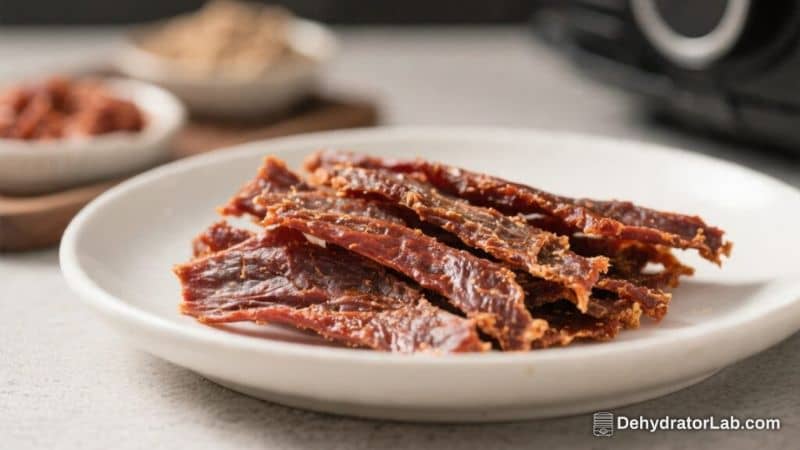
Ostrich jerky might sound unusual, but it’s a fantastic lean protein with a clean, beef-like flavor. Using an air fryer makes the process quicker and more consistent than traditional dehydrating, with less guesswork. You’ll get savory, chewy strips with a satisfying snap—perfect for snacks, hikes, or post-workout fuel.
This method is simple, customizable, and works even if you’ve never made jerky before.
In this article:
TL;DR (Too Long; Didn’t Read): Key Takeaways
- 🦤 Ostrich is naturally lean — trim visible fat and slice against the grain for the best chew.
- 🧊 Partially freeze the meat 45–60 minutes first so it slices thin and even.
- 🥣 Marinate 4–12 hours, then pat strips bone dry before loading the basket.
- 🌡️ Dry low at 180–200°F (82–93°C) for 2–4 hours, flipping every 30–45 minutes.
- ✋ Doneness by feel: bends and cracks with white fiber showing, doesn’t snap clean through.
- 📦 Condition 24 hours before sealing, then refrigerate up to 3 weeks or freeze 3–4 months.
What Makes This Special
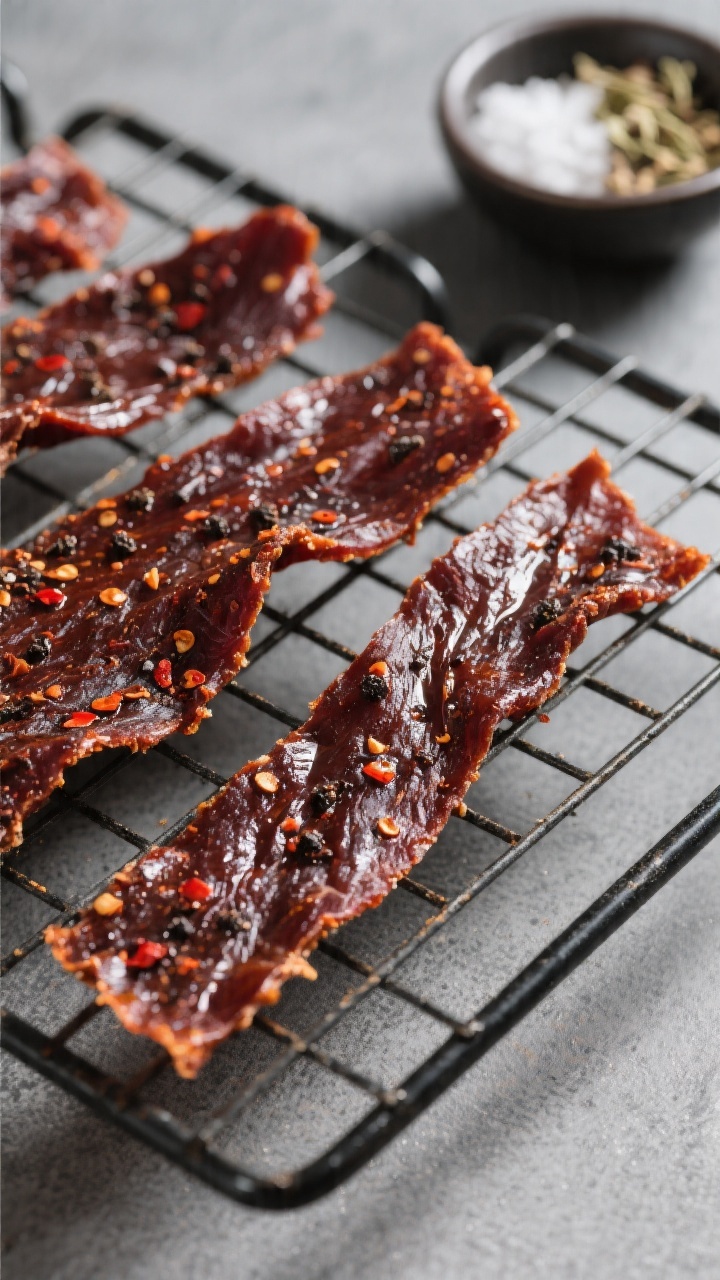
Ostrich meat is very lean, so you get jerky that’s high in protein and low in fat without feeling dry or tough. The air fryer creates steady airflow and gentle heat, turning thinly sliced meat into perfectly dried strips in a fraction of the time. You control the seasoning from mild to bold and can keep sodium and sugar exactly where you want them.
Plus, you don’t need a dehydrator or smoker to make a batch that tastes gourmet.
Ingredients
- 1.5 pounds ostrich steak or fillet, trimmed of visible fat
- 1/3 cup low-sodium soy sauce or coconut aminos
- 2 tablespoons Worcestershire sauce
- 1 tablespoon maple syrup or brown sugar (optional for balance)
- 1 tablespoon apple cider vinegar or rice vinegar
- 2 teaspoons smoked paprika
- 1.5 teaspoons freshly ground black pepper
- 1 teaspoon garlic powder
- 1 teaspoon onion powder
- 1/2 to 1 teaspoon red pepper flakes or cayenne (optional heat)
- 1/2 teaspoon ground coriander (optional, earthy citrus note)
- 1 teaspoon kosher salt (adjust to taste, especially if not using low-sodium soy)
- Nonstick spray or a little neutral oil for the basket/racks
Instructions
- Partially freeze the meat. Place the ostrich in the freezer for 45–60 minutes until firm but not solid. This makes it easier to slice thin and even.
- Slice into thin strips. Cut against the grain into 1/8–1/4-inch slices. Thinner slices dry faster and come out chewier; thicker slices stay meatier.
- Mix the marinade. In a bowl, whisk soy sauce, Worcestershire, maple syrup, vinegar, smoked paprika, pepper, garlic powder, onion powder, red pepper flakes, coriander, and salt.
- Marinate. Add the ostrich strips to a zip-top bag or shallow dish.
Pour in the marinade and toss to coat. Press out air, seal, and chill for at least 4 hours, ideally 8–12. Turn once or twice to distribute flavor.
- Drain and pat dry. Remove strips from the marinade and lay on paper towels.
Blot both sides. Excess moisture will steam instead of dry, so don’t skip this step.
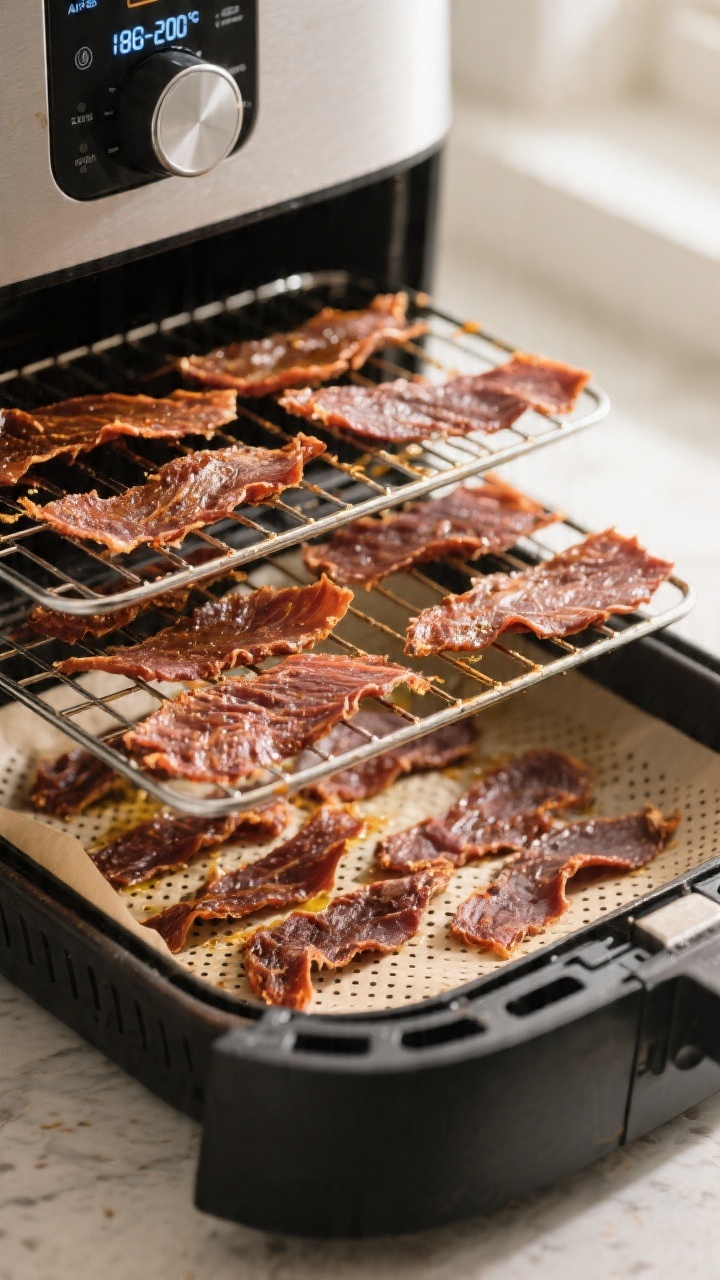
- Prep the air fryer. Lightly oil the basket or racks to prevent sticking. Preheat to 180–200°F (82–93°C) if your model allows. If your air fryer’s lowest setting is higher, choose its lowest temperature and keep the door slightly ajar with a heat-safe utensil to encourage airflow and gentler drying.
- Arrange the strips. Lay pieces in a single layer with a little space between.
Avoid overlap. If you have racks, use them to increase capacity.
- Dry in batches. Air-fry at 180–200°F for 2–4 hours, flipping every 30–45 minutes. Cook time varies by thickness, model, and humidity. Rotate racks if your fryer has multiple levels.
- Check for doneness. Jerky should be dry to the touch but still pliable.
Bend a piece: it should crack and show white fibers inside but not snap completely. If it feels wet or spongy, continue drying in 15–20 minute intervals.
- Cool and condition. Let jerky cool completely on racks. Then place it loosely in a jar or bag for 24 hours at room temp, shaking once or twice. Conditioning equalizes moisture and helps prevent mold.
- Store. Move to airtight containers.
Refrigerate for longest freshness, or freeze for extended storage.
Keeping It Fresh
– For short-term snacking, keep jerky in a sealed bag or jar at room temperature for up to 1 week, somewhere cool and dry. – For best quality, refrigerate up to 3 weeks in an airtight container with a small food-safe desiccant packet if you have one. – For long-term storage, freeze up to 3–4 months. Thaw in the fridge to avoid condensation. – Check weekly for any signs of moisture beads or mold. If moisture appears, return to the air fryer on low heat for 10–15 minutes to re-dry, then cool and repackage.
Benefits of This Recipe
– High protein, low fat: Ostrich is naturally lean, so you get a clean-tasting jerky without greasiness. – Faster than traditional methods: The air fryer speeds up drying while staying consistent. – Customizable flavor: Adjust salt, sweetness, and heat to fit your taste or dietary needs. – No special equipment needed: You don’t need a dehydrator or smoker to get pro-level results. – Great for meal prep: A small batch can cover a week of snacks or gym bag fuel.
Pitfalls to Watch Out For
– Too high heat: Temperatures above 200°F can cook the meat instead of drying it, leading to tough, brittle strips. – Skipping the pat-dry step: Excess surface moisture causes steaming and uneven texture. – Overcrowding: Overlapping strips block airflow and can lead to soft, chewy spots that spoil faster. – Under-seasoning: Flavors mellow as jerky dries.
Season a bit more boldly than you would for a cooked steak. – Uneven slices: Mixed thickness means some pieces will be brittle while others stay under-dried. Aim for uniformity.
Variations You Can Try
– Teriyaki Ostrich: Swap maple syrup for 2 tablespoons of mirin, add 1 teaspoon grated ginger, and a dash of sesame oil. – Black Pepper and Honey: Increase black pepper to 2 teaspoons and use honey instead of maple for a glossy finish. – Chipotle-Lime: Add 1 teaspoon chipotle powder and the zest of one lime. Replace vinegar with lime juice. – Coffee-Cocoa Rub: Mix 1 teaspoon finely ground espresso and 1/2 teaspoon unsweetened cocoa with the dry spices for a deep, smoky profile. – No-Soy Version: Use coconut aminos, add 1/2 teaspoon extra salt, and a splash of fish sauce for umami if you tolerate it.
FAQ
What cut of ostrich works best for jerky?
Look for lean ostrich fillet, fan, or steak cuts without connective tissue.
Trim away visible silver skin and fat. Lean, uniform muscles slice evenly and dry predictably.
Can I use a dehydrator instead of an air fryer?
Yes. Set your dehydrator to 160°F (71°C) for 3–6 hours, checking for that bend-and-crack stage.
Times vary by thickness and machine. The flavor and texture will be similar.
How do I make it safe to eat?
Start with fresh, clean meat and marinate refrigerated. Dry at low heat with good airflow.
To be extra cautious, you can preheat strips in a 275°F (135°C) oven for 10 minutes to bring internal temp to 160°F before drying, then transfer to the air fryer on low to finish.
Why is my jerky brittle?
It likely dried too long or at too high a temperature. Next time, use the lowest setting, flip more often, and start checking early. Slight thickness adjustments also help.
Can I reduce the sodium?
Use low-sodium soy or coconut aminos, and cut added salt in half.
Balance with extra spices and a touch of acid (vinegar or citrus) to keep flavor bright.
Is sugar necessary in the marinade?
No, but a small amount helps with balance and browning. If you skip it, increase spices slightly or add more vinegar for a sharp, savory profile.
How thin should I slice the meat?
Aim for 1/8–1/4 inch. Thinner slices dry faster and turn chewier; thicker slices stay meatier but need more time.
Most people prefer around 3/16 inch for balance.
What if my air fryer’s lowest temp is 300°F?
Use the lowest setting, but keep the basket cracked open slightly to reduce heat buildup and increase airflow. Check every 10–15 minutes and flip often. It will dry faster, so watch closely.
How do I prevent sticking?
Lightly oil the basket or racks and pat the strips very dry before loading.
You can also use perforated parchment designed for air fryers.
How can I tell when it’s done?
The classic test: bend a cooled piece. It should flex, then crack along the surface without snapping clean through. If it’s wet inside or feels rubbery, keep drying in short intervals.
Personal Tips You Can Steal
I always do the oven pre-heat step to 160°F internal before drying — it’s cheap insurance and I don’t skip it with lean game meat. I slice a touch thicker than beef jerky, closer to 1/4 inch, because ostrich dries faster than you’d expect and thin strips can over-dry before you catch them. I crack the air fryer door with a wooden spoon handle when my machine’s lowest setting runs hot — it drops the temp just enough to keep the drying gentle instead of cooking. I always condition the full 24 hours; skipping it once left a batch with damp pockets in the center.
Wrapping Up
Air Fryer Ostrich Jerky is a lean, flavorful snack that’s easy to make and easy to customize.
With a simple marinade, low heat, and good airflow, you’ll get reliable results without special equipment. Tweak the spices to your taste, slice evenly, and keep a close eye on doneness. Once you try this method, you’ll have a go-to protein snack that stores well and tastes like a treat. For more lean, exotic options, try our Lamb Jerky or Elk Jerky.
P.S. Ostrich jerky travels well and doesn’t need refrigeration for a day or two — great one for the glove box on road trips. 🙂
Air Fryer Ostrich Jerky – Lean, Flavorful, and Fast
Ingredients
- 1.5 pounds ostrich steak or fillet, trimmed of visible fat
- 1/3 cup low-sodium soy sauce or coconut aminos
- 2 tablespoons Worcestershire sauce
- 1 tablespoon maple syrup or brown sugar (optional for balance)
- 1 tablespoon apple cider vinegar or rice vinegar
- 2 teaspoons smoked paprika
- 1.5 teaspoons freshly ground black pepper
- 1 teaspoon garlic powder
- 1 teaspoon onion powder
- 1/2 to 1 teaspoon red pepper flakes or cayenne (optional heat)
- 1/2 teaspoon ground coriander (optional, earthy citrus note)
- 1 teaspoon kosher salt (adjust to taste, especially if not using low-sodium soy)
- Nonstick spray or a little neutral oil for the basket/racks
Instructions
- Partially freeze the meat. Place the ostrich in the freezer for 45–60 minutes until firm but not solid. This makes it easier to slice thin and even.
- Slice into thin strips. Cut against the grain into 1/8–1/4-inch slices. Thinner slices dry faster and come out chewier; thicker slices stay meatier.
- Mix the marinade. In a bowl, whisk soy sauce, Worcestershire, maple syrup, vinegar, smoked paprika, pepper, garlic powder, onion powder, red pepper flakes, coriander, and salt.
- Marinate. Add the ostrich strips to a zip-top bag or shallow dish.Pour in the marinade and toss to coat. Press out air, seal, and chill for at least 4 hours, ideally 8–12. Turn once or twice to distribute flavor.
- Drain and pat dry. Remove strips from the marinade and lay on paper towels.Blot both sides. Excess moisture will steam instead of dry, so don’t skip this step.
- Prep the air fryer. Lightly oil the basket or racks to prevent sticking. Preheat to 180–200°F (82–93°C) if your model allows. If your air fryer’s lowest setting is higher, choose its lowest temperature and keep the door slightly ajar with a heat-safe utensil to encourage airflow and gentler drying.
- Arrange the strips. Lay pieces in a single layer with a little space between.Avoid overlap. If you have racks, use them to increase capacity.
- Dry in batches. Air-fry at 180–200°F for 2–4 hours, flipping every 30–45 minutes. Cook time varies by thickness, model, and humidity. Rotate racks if your fryer has multiple levels.
- Check for doneness. Jerky should be dry to the touch but still pliable.Bend a piece: it should crack and show white fibers inside but not snap completely. If it feels wet or spongy, continue drying in 15–20 minute intervals.
- Cool and condition. Let jerky cool completely on racks. Then place it loosely in a jar or bag for 24 hours at room temp, shaking once or twice. Conditioning equalizes moisture and helps prevent mold.
- Store. Move to airtight containers.Refrigerate for longest freshness, or freeze for extended storage.
Printable Recipe Card
Want just the essential recipe details without scrolling through the article? Get our printable recipe card with just the ingredients and instructions.