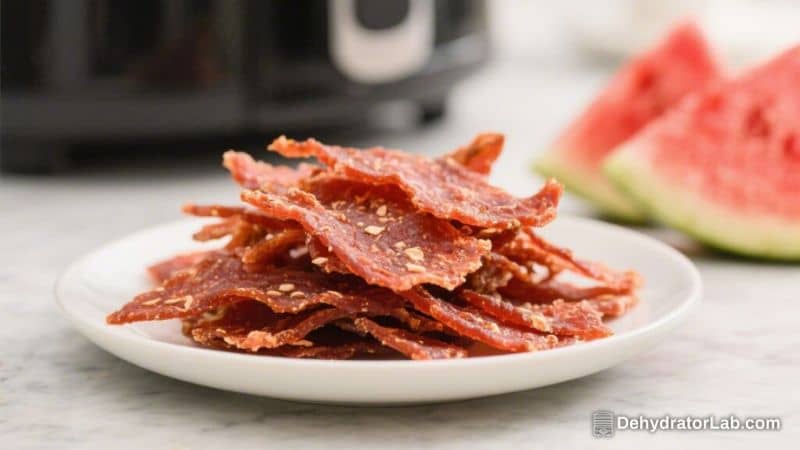
If you’ve never tried turning watermelon into jerky, you’re in for a fun surprise. This snack is chewy, sweet, and a little tangy, with a texture that’s closer to fruit leather than beef jerky. It’s perfect for summer when watermelon is everywhere, but you can make it year-round with a good melon and an air fryer.
The best part? You don’t need fancy equipment or special ingredients. Just a watermelon, a few optional flavor boosters, and some time.
In this article:
What Makes This Recipe So Good
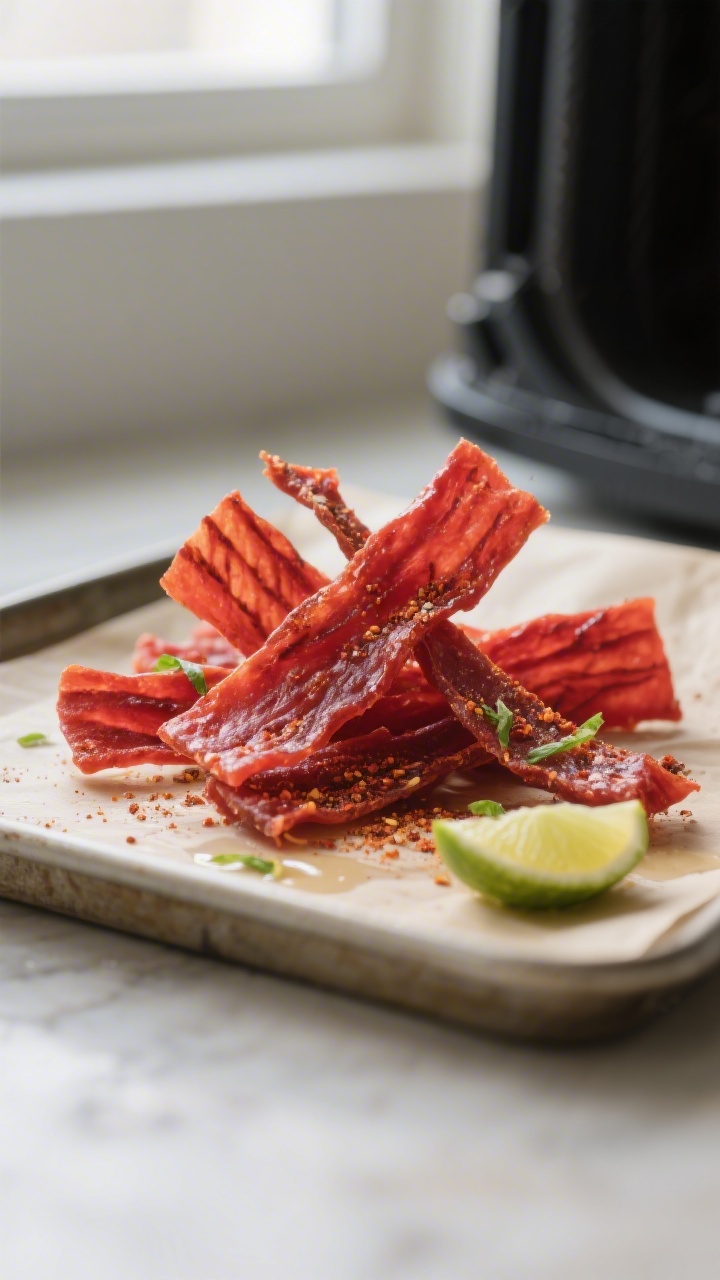
- Minimal ingredients, big payoff: A single watermelon transforms into a batch of addictive, naturally sweet snacks.
- Faster than oven-drying: The air fryer speeds up dehydration while keeping the flavor concentrated.
- Customizable: Go classic and plain, or add lime, chili, or a touch of salt for a flavor kick.
- Great for meal prep: Make a big batch and snack all week.
- No added sugar needed: The slow drying brings out the fruit’s natural sweetness.
Shopping List
- Seedless watermelon (about 1 small or half a large)
- Fresh lime (zest and juice, optional)
- Chili powder or Tajín (optional, for a spicy kick)
- Sea salt (fine or flaky, optional)
- Vanilla extract (optional, for a dessert vibe)
- Cooking spray or a little neutral oil (for the air fryer basket or parchment)
- Parchment paper (optional, for easier cleanup)
Instructions
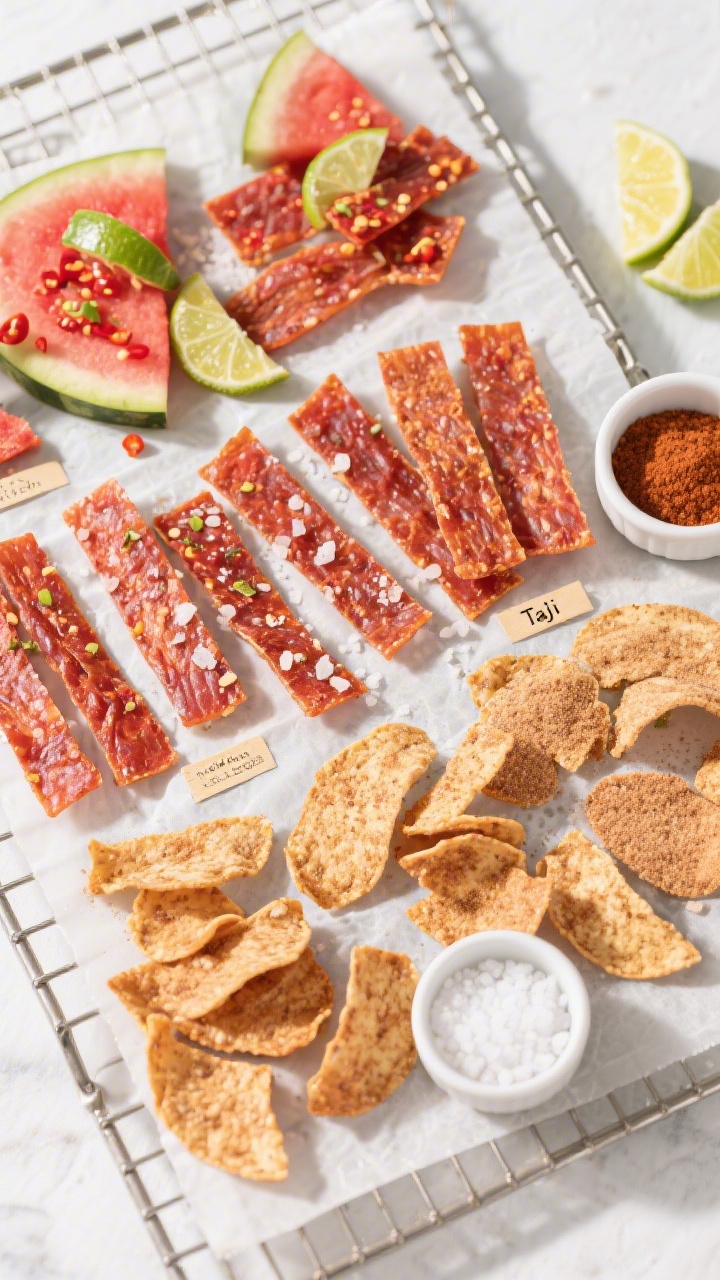
- Prep the air fryer: Line the basket or trays with parchment paper, leaving room for airflow around the edges.
Lightly oil the parchment to prevent sticking.
- Slice the watermelon: Cut off the rind and remove any visible seeds. Slice the flesh into slabs about 1/4 inch thick, then cut into strips or chips. Thinner slices dry faster, but don’t go paper-thin or they’ll shrink to nothing.
- Optional seasoning: For a bright, sweet-tart vibe, toss slices with 1 teaspoon lime zest and 1 tablespoon lime juice.
For heat, dust lightly with chili powder or Tajín. A tiny pinch of salt can help balance sweetness. If using vanilla, brush a very thin layer on each piece.
- Arrange in the basket: Lay slices in a single layer without overlapping.
They will shrink a lot as they dry.
- Set the temperature low: Air fry at 135–150°F (57–66°C) if your model allows. If your air fryer’s minimum is 160–170°F (71–77°C), use that and watch closely to prevent browning.
- Dry slowly: Cook for 3–6 hours, flipping every 45–60 minutes and rotating trays if your fryer has multiple levels. Timing depends on thickness, temperature, and your air fryer’s airflow.
- Check for doneness: The jerky should be dry, leathery, and flexible, not wet or sticky.
If you bend a piece, it should fold without cracking. If it’s still wet or glossy, keep going.
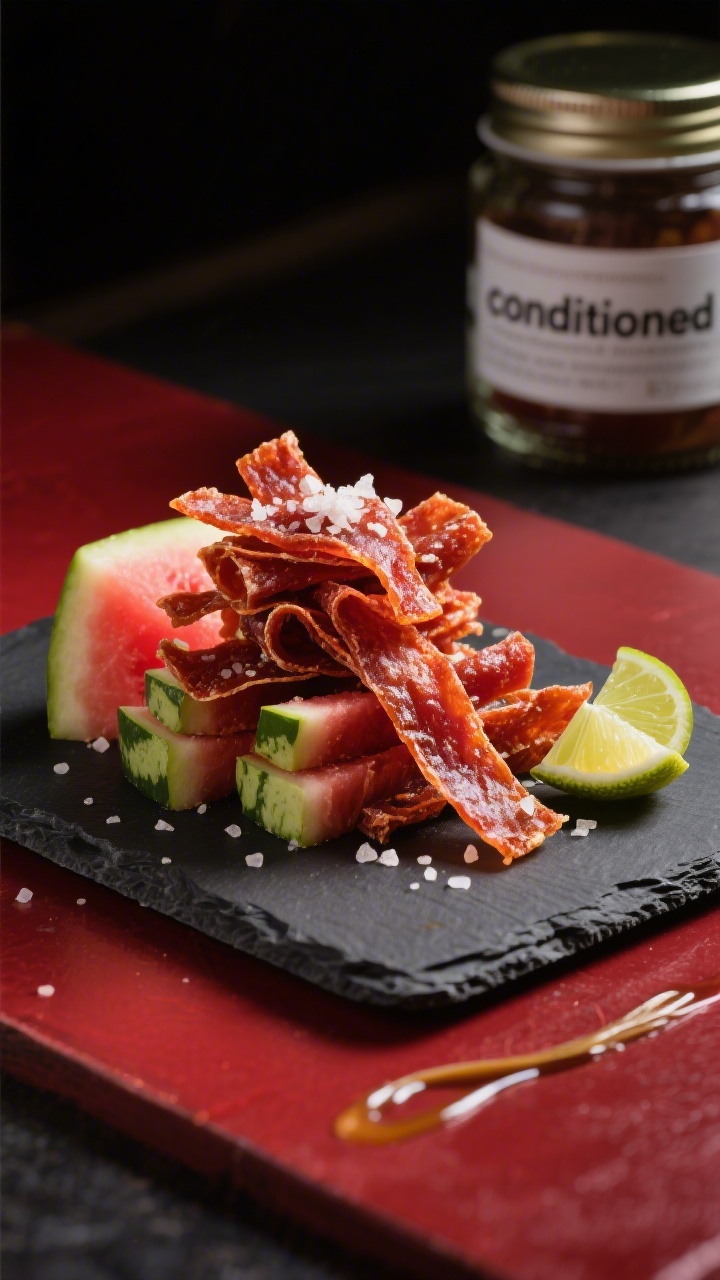
- Condition the jerky: Once done, let the pieces cool completely. Then place them loosely in a clean jar for 24 hours, shaking once or twice.
This equalizes any remaining moisture. If condensation forms, return them to the air fryer for another 30–60 minutes.
- Finish and store: Once fully dry and conditioned, store as directed below. Add a small desiccant pack if you have one for longer shelf life.
How to Store
- Room temperature: In an airtight container in a cool, dark spot for up to 1 week.
- Refrigerator: Up to 2–3 weeks in a sealed bag or jar.
- Freezer: Up to 3 months.
Thaw at room temp; texture stays chewy.
- Avoid moisture: Water is the enemy. Let jerky cool fully before sealing to prevent steam and condensation.
Health Benefits
- Hydration hero, even dried: Fresh watermelon is mostly water, and while jerky is dehydrated, it still delivers that refreshing flavor with fewer drips and more portability.
- Lycopene boost: Watermelon is rich in lycopene, an antioxidant linked to heart health and reduced oxidative stress.
- Vitamins without added sugar: You’ll get vitamin C and A precursors with zero added sweeteners.
- Lighter snack option: Compared to many packaged snacks, this is lower in fat and sodium, especially if you season lightly.
What Not to Do
- Don’t slice too thick: Anything over 1/4 inch can take forever to dry and may stay gummy in the center.
- Don’t crank the heat: High heat cooks and browns the fruit instead of gently drying it. Aim low and slow.
- Don’t crowd the basket: Overlapping traps moisture and leads to uneven texture.
- Don’t store while warm: Warm jerky releases steam in a closed container, causing spoilage.
- Don’t skip flipping: Flipping promotes even drying and prevents sticking.
Recipe Variations
- Spicy-Lime: Toss with lime zest and juice, then sprinkle chili powder or Tajín before drying.
- Salt-and-Vanilla:</-strong> Brush with a micro-thin layer of vanilla extract and finish with a light pinch of flaky sea salt.
- Cinnamon Sugar (light): If you want a dessert twist, dust very lightly with cinnamon and a small pinch of sugar.
Go easy—sugar can make it sticky.
- Ginger Citrus: Mix a few drops of ginger juice with orange zest and brush sparingly on slices.
- Smoky Heat: Add a pinch of smoked paprika and cayenne for a barbecue-style note.
FAQ
Can I use a regular oven instead of an air fryer?
Yes. Set your oven to its lowest temperature, ideally 150–170°F (65–77°C). Place slices on parchment-lined racks and prop the door open slightly with a wooden spoon to improve airflow.
Expect 6–8 hours, flipping a few times.
How do I know when the jerky is done?
It should feel dry, slightly tacky, and flexible. When you bend it, it shouldn’t crack or ooze moisture. If it’s glossy or wet, keep drying.
If it’s brittle, it went too long.
Why is my jerky sticking to the basket?
Watermelon is high in natural sugars, which can stick as they concentrate. Use parchment and a light oil spray. Flip every 45–60 minutes to release the surface before it bonds.
What if my air fryer doesn’t go below 170°F?
Use the lowest setting and check more often.
You can also cycle the heat: run 45 minutes on, then 15 minutes off with the door slightly open to cool, repeating until dry. Keep an eye out for browning.
Can I use seeded watermelon?
You can, but it’s more work. Remove as many seeds as possible before slicing.
Seedless varieties are far easier and dry more evenly.
How thick should the slices be?
Aim for about 1/4 inch. Thinner slices dry faster but shrink more. Thicker slices take much longer and may end up gummy in the middle.
Is it safe to store at room temperature?
Yes, for a short time if it’s fully dried and conditioned.
For best quality and shelf life, refrigerate or freeze, especially in humid climates.
Why “condition” the jerky after drying?
Conditioning lets any remaining moisture distribute evenly across pieces. It helps prevent mold and avoids overly dry edges with wet centers. If you see condensation during conditioning, dry it a bit more.
Can I sweeten it?
You can, but it’s usually not necessary.
If you want extra sweetness, brush with a very thin layer of honey or maple before drying. Note that sugars can make the jerky stickier and extend drying time.
What’s the texture supposed to be like?
Think fruit leather, not crunchy chips. It should be chewy and bendy, with concentrated watermelon flavor and a hint of tang from any added citrus.
In Conclusion
Air fryer watermelon jerky is an easy, playful way to turn a simple fruit into a satisfying snack.
With just a few ingredients and a bit of patience, you get a chewy, flavorful treat that’s perfect for lunch boxes, hikes, or late-night cravings. Keep the heat low, slice evenly, and don’t rush the drying. Once you make a batch, you’ll want to experiment with spices and citrus to find your favorite twist.
It’s low-effort, high-reward, and deliciously unexpected.
Air Fryer Watermelon Jerky – Chewy, Sweet, and Surprisingly Simple
Ingredients
- Seedless watermelon (about 1 small or half a large)
- Fresh lime (zest and juice, optional)
- Chili powder or Tajín (optional, for a spicy kick)
- Sea salt (fine or flaky, optional)
- Vanilla extract (optional, for a dessert vibe)
- Cooking spray or a little neutral oil (for the air fryer basket or parchment)
- Parchment paper (optional, for easier cleanup)
Instructions
- Prep the air fryer: Line the basket or trays with parchment paper, leaving room for airflow around the edges.Lightly oil the parchment to prevent sticking.
- Slice the watermelon: Cut off the rind and remove any visible seeds. Slice the flesh into slabs about 1/4 inch thick, then cut into strips or chips. Thinner slices dry faster, but don’t go paper-thin or they’ll shrink to nothing.
- Optional seasoning: For a bright, sweet-tart vibe, toss slices with 1 teaspoon lime zest and 1 tablespoon lime juice.For heat, dust lightly with chili powder or Tajín. A tiny pinch of salt can help balance sweetness. If using vanilla, brush a very thin layer on each piece.
- Arrange in the basket: Lay slices in a single layer without overlapping.They will shrink a lot as they dry.
- Set the temperature low: Air fry at 135–150°F (57–66°C) if your model allows. If your air fryer’s minimum is 160–170°F (71–77°C), use that and watch closely to prevent browning.
- Dry slowly: Cook for 3–6 hours, flipping every 45–60 minutes and rotating trays if your fryer has multiple levels. Timing depends on thickness, temperature, and your air fryer’s airflow.
- Check for doneness: The jerky should be dry, leathery, and flexible, not wet or sticky.If you bend a piece, it should fold without cracking. If it’s still wet or glossy, keep going.
- Condition the jerky: Once done, let the pieces cool completely. Then place them loosely in a clean jar for 24 hours, shaking once or twice.This equalizes any remaining moisture. If condensation forms, return them to the air fryer for another 30–60 minutes.
- Finish and store: Once fully dry and conditioned, store as directed below. Add a small desiccant pack if you have one for longer shelf life.
Printable Recipe Card
Want just the essential recipe details without scrolling through the article? Get our printable recipe card with just the ingredients and instructions.