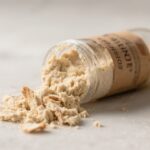
Dehydrated Sourdough Starter – A Simple Way to Save and Share Your Culture
Servings 12 servings
Ingredients
- Active sourdough starter: Recently fed and bubbly works best.
- All-purpose or bread flour: For feeding during revival. Whole wheat or rye can help jump-start activity if needed.
- Water: Room temperature; filtered or dechlorinated is ideal.
- Parchment paper or a silicone mat: For spreading the starter.
- Sheet tray: To hold the parchment while drying.
- Offset spatula or the back of a spoon: For spreading the starter thinly.
- Food dehydrator (optional): Speeds up drying at low temperatures.
- Airtight container or zip-top bag: For storage. Add a label and date.
- Silica gel packet (optional): Helps keep moisture out during storage.
Instructions
- Refresh your starter: Feed your starter 4–8 hours before drying so it’s at peak activity. You want it bubbly, doubled, and smelling pleasantly tangy.
- Prepare your surface: Line a sheet tray with parchment or a silicone mat. This makes removal easy once it’s dry.
- Spread it thin: Scoop 1–2 cups of active starter onto the parchment. Use an offset spatula to spread it into a very thin, even layer—aim for about 1–2 millimeters thick. Thin layers dry faster and more evenly.
- Dry at low temperature: Air-dry at room temperature in a dry, well-ventilated spot, away from direct sun. If using a dehydrator, set it to 95°F–105°F (35°C–40°C). Avoid higher heat to protect the microbes.
- Wait until completely brittle: Drying time varies—anywhere from 12–48 hours depending on humidity and thickness. The starter is ready when it’s fully crisp and snaps cleanly with no soft spots.
- Break into flakes: Peel the sheet off the parchment and crack it into small flakes. You can also pulse gently in a food processor to create coarse crumbs, but avoid turning it into powder.
- Package for storage: Transfer flakes to an airtight container or zip-top bag. Press out extra air. Add a silica gel packet if you have one to keep moisture at bay.
- Label and date: Note the flour type and the date you dehydrated it. Most dehydrated starters keep well for 1–2 years when stored properly.
- Store smart: Keep in a cool, dark, dry place. A pantry works; the freezer is even better for very long storage.